
About This Book
How have military coups reshaped nations, and what discernible patterns emerge across these often violent seizures of power? "Political Coups" delves into the heart of governmental overthrows, dissecting the military strategies employed, the key figures orchestrating them, and the complex, often destabilizing effects they have on national stability. This book is vital for anyone seeking to understand the mechanics and consequences of coups d'état, events that continue to punctuate global politics. This book examines several facets of political coups. First, it scrutinizes the strategic planning and tactical execution involved in successful and unsuccessful coups. Second, it provides profiles of the individuals – both military and civilian – who have masterminded and led these operations. Finally, it analyzes the short-term and long-term ramifications of coups on national governance, economic development, and social cohesion. Understanding these elements is crucial for policymakers, historians, and anyone interested in the dynamics of political power. Historically, coups have been driven by various factors, from deep-seated political corruption and economic inequality to military dissatisfaction and external interference. While each coup is unique, certain conditions – such as weak democratic institutions and divided societies – often create fertile ground for such interventions. Readers ideally possess a basic understanding of political science and military history to fully appreciate the nuances discussed. The central argument of "Political Coups" is that while the immediate triggers and contexts of coups vary widely, identifiable strategic and political patterns consistently shape their execution and subsequent impact. Recognizing these patterns is essential for anticipating, preventing, and mitigating the negative consequences of coups. The book emphasizes that coups are not simply isolated events but are often symptoms of deeper systemic problems within a nation's political structure. The book is structured as follows: a) Initially, it introduces the fundamental concepts of coups d'état, defining different types of coups (e.g., military, self-coup, palace coup) and outlining a framework for analyzing their causes and consequences. b) The core of the book explores several major case studies of coups from around the world, examining the military strategies, key players, and immediate aftermath of each event. This includes analyzing the roles of specific military units, communication technologies, and the exploitation of political vulnerabilities. c) Building on these case studies, the book identifies recurring patterns and common threads in the strategic planning and execution of coups, as well as in their impact on national stability. d) Finally, it concludes by exploring potential strategies for preventing coups and for mitigating their negative consequences through strengthening democratic institutions, promoting inclusive governance, and fostering national unity. The analysis relies on a range of primary and secondary sources, including declassified government documents, military reports, journalistic accounts, and academic studies. It incorporates statistical data on political instability, economic performance, and social indicators to assess the impact of coups on national development. This book connects to the fields of political science, military strategy, and economics. Political science provides the theoretical framework for understanding power dynamics and institutional weaknesses. Military strategy offers insights into the planning and execution of the coups. Economic analysis assesses the impact of coups on economic growth and development. The book also touches upon sociology when analyzing the social unrest that can lead to coups. "Political Coups" adopts a comparative and analytical approach, examining coups from diverse regions and historical periods to identify common themes and contrasting features. It employs a rigorous methodology, drawing on both qualitative and quantitative data to support its arguments. The target audience includes students of political science, military history, and international relations, as well as policymakers, journalists, and anyone interested in understanding the dynamics of political instability and regime change. The book offers valuable insights into the causes, consequences, and prevention of coups d'état. As a work of political and military history, "Political Coups" adheres to the standards of rigorous scholarship, providing well-documented evidence and balanced analysis. It acknowledges the complexities and controversies surrounding the topic, presenting multiple perspectives and interpretations. The scope of the book is limited to analyzing the strategic and political dimensions of coups, focusing on the actions and motivations of the key actors involved. It does not delve deeply into the psychological or cultural factors that may contribute to political instability. The book offers practical insights for policymakers and civil society organizations seeking to strengthen democratic institutions and prevent coups. It suggests strategies for promoting good governance, fostering national unity, and addressing the underlying causes of political instability. The study of coups is inherently associated with debates regarding intervention, sovereignty, and the balance between stability and democracy. This book addresses these debates, acknowledging the complexities of the issues involved and presenting a nuanced perspective.
How have military coups reshaped nations, and what discernible patterns emerge across these often violent seizures of power? "Political Coups" delves into the heart of governmental overthrows, dissecting the military strategies employed, the key figures orchestrating them, and the complex, often destabilizing effects they have on national stability. This book is vital for anyone seeking to understand the mechanics and consequences of coups d'état, events that continue to punctuate global politics. This book examines several facets of political coups. First, it scrutinizes the strategic planning and tactical execution involved in successful and unsuccessful coups. Second, it provides profiles of the individuals – both military and civilian – who have masterminded and led these operations. Finally, it analyzes the short-term and long-term ramifications of coups on national governance, economic development, and social cohesion. Understanding these elements is crucial for policymakers, historians, and anyone interested in the dynamics of political power. Historically, coups have been driven by various factors, from deep-seated political corruption and economic inequality to military dissatisfaction and external interference. While each coup is unique, certain conditions – such as weak democratic institutions and divided societies – often create fertile ground for such interventions. Readers ideally possess a basic understanding of political science and military history to fully appreciate the nuances discussed. The central argument of "Political Coups" is that while the immediate triggers and contexts of coups vary widely, identifiable strategic and political patterns consistently shape their execution and subsequent impact. Recognizing these patterns is essential for anticipating, preventing, and mitigating the negative consequences of coups. The book emphasizes that coups are not simply isolated events but are often symptoms of deeper systemic problems within a nation's political structure. The book is structured as follows: a) Initially, it introduces the fundamental concepts of coups d'état, defining different types of coups (e.g., military, self-coup, palace coup) and outlining a framework for analyzing their causes and consequences. b) The core of the book explores several major case studies of coups from around the world, examining the military strategies, key players, and immediate aftermath of each event. This includes analyzing the roles of specific military units, communication technologies, and the exploitation of political vulnerabilities. c) Building on these case studies, the book identifies recurring patterns and common threads in the strategic planning and execution of coups, as well as in their impact on national stability. d) Finally, it concludes by exploring potential strategies for preventing coups and for mitigating their negative consequences through strengthening democratic institutions, promoting inclusive governance, and fostering national unity. The analysis relies on a range of primary and secondary sources, including declassified government documents, military reports, journalistic accounts, and academic studies. It incorporates statistical data on political instability, economic performance, and social indicators to assess the impact of coups on national development. This book connects to the fields of political science, military strategy, and economics. Political science provides the theoretical framework for understanding power dynamics and institutional weaknesses. Military strategy offers insights into the planning and execution of the coups. Economic analysis assesses the impact of coups on economic growth and development. The book also touches upon sociology when analyzing the social unrest that can lead to coups. "Political Coups" adopts a comparative and analytical approach, examining coups from diverse regions and historical periods to identify common themes and contrasting features. It employs a rigorous methodology, drawing on both qualitative and quantitative data to support its arguments. The target audience includes students of political science, military history, and international relations, as well as policymakers, journalists, and anyone interested in understanding the dynamics of political instability and regime change. The book offers valuable insights into the causes, consequences, and prevention of coups d'état. As a work of political and military history, "Political Coups" adheres to the standards of rigorous scholarship, providing well-documented evidence and balanced analysis. It acknowledges the complexities and controversies surrounding the topic, presenting multiple perspectives and interpretations. The scope of the book is limited to analyzing the strategic and political dimensions of coups, focusing on the actions and motivations of the key actors involved. It does not delve deeply into the psychological or cultural factors that may contribute to political instability. The book offers practical insights for policymakers and civil society organizations seeking to strengthen democratic institutions and prevent coups. It suggests strategies for promoting good governance, fostering national unity, and addressing the underlying causes of political instability. The study of coups is inherently associated with debates regarding intervention, sovereignty, and the balance between stability and democracy. This book addresses these debates, acknowledging the complexities of the issues involved and presenting a nuanced perspective.
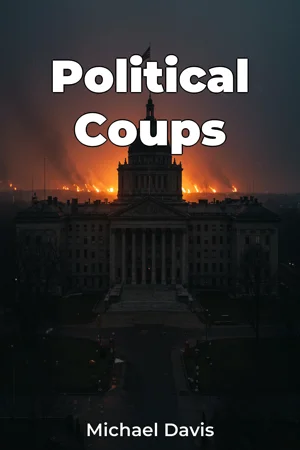
"Political Coups" explores the complex phenomenon of governmental overthrows, examining the military strategies, key figures, and destabilizing effects on national stability. It's vital for those wanting to understand the mechanics and consequences of coups d'état, events that consistently impact global politics. Coups are often driven by political corruption, economic inequality, military dissatisfaction, and external interference. Weak democratic institutions and divided societies can create environments ripe for such interventions, highlighting the importance of understanding the strategic and political patterns that shape their execution and impact. The book adopts a comparative approach, analyzing coups from different regions and historical periods to identify common themes. It begins by defining different types of coups, then explores major case studies, examining military strategies, key players, and immediate aftermaths. Building on these case studies, the patterns in strategic planning, execution, and impact on national stability are identified. Finally, it concludes by exploring strategies for coup prevention and mitigating negative consequences through strengthening democratic institutions and fostering national unity.
Book Details
ISBN
9788235233622
Publisher
Publifye AS
Your Licenses
You don't own any licenses for this book
Purchase a license below to unlock this book and download the EPUB.
Purchase License
Select a tier to unlock this book
Need bulk licensing?
Contact us for enterprise agreements.