
About This Book
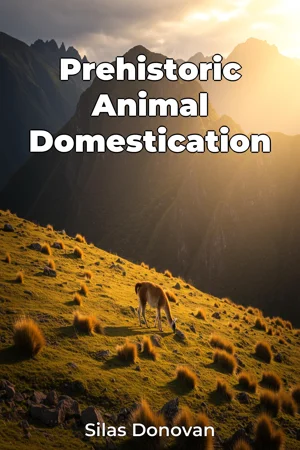
How did early human societies forge partnerships with animals that reshaped civilizations? "Prehistoric Animal Domestication" explores the profound impact of these interactions, focusing on the domestication of llamas, turkeys, and dogs by indigenous peoples. This book examines how these animals were not merely tamed, but integrated into the fabric of human life, providing labor, sustenance, and companionship, altering both human societies and the animals themselves. Understanding these early processes sheds light on present-day relationships with animals, food production, and the complex interplay between culture and biology. This study delves into the archeological and genetic evidence surrounding animal domestication, addressing the central argument that indigenous peoples' innovative approaches to animal management were key to their survival, cultural development, and the establishment of sustainable ecosystems. The book begins by laying the groundwork with an overview of domestication's biological and anthropological underpinnings. It explores various theories regarding the initial motivations and methods used in taming wild species. The subsequent sections focus on specific case studies. First, the domestication of the llama in the Andes region is examined. We analyze how these camelids were selectively bred for pack transport, wool production, and meat, transforming trade routes and social structures. Second, the unique story of turkey domestication in North America is explored. This section details the turkey's role in indigenous diets, rituals, and trading networks, revealing a more complex history than previously understood. Third, the ancient bond between humans and dogs is scrutinized, focusing on the diverse roles dogs played in hunting, guarding, and companionship across different indigenous cultures. The book then synthesizes these case studies, highlighting common threads and divergent paths in domestication strategies. It examines the environmental impact of these practices, considering both the benefits of sustainable management and the potential for ecological disruption. The concluding chapter explores the lasting legacy of indigenous domestication practices, drawing parallels to modern animal husbandry and conservation efforts. "Prehistoric Animal Domestication" relies on a range of evidence, including archeological findings, zooarcheological analysis, genetic studies, and ethnographic accounts. It draws on insights from bone assemblages, ancient DNA analysis, and indigenous oral traditions to reconstruct the timelines and processes of domestication. The book also employs comparative analysis, contrasting different domestication strategies across various geographical regions. This interdisciplinary approach bridges the fields of archeology, genetics, and anthropology, providing a holistic understanding of animal domestication. It also connects to ecology and environmental science, examining the long-term effects of human-animal interactions on ecosystems. Furthermore, the book addresses ethical considerations regarding animal welfare and the responsible use of genetic resources. "Prehistoric Animal Domestication" takes a nuanced approach, acknowledging the agency of both humans and animals in the domestication process. It moves beyond simplistic narratives of human dominance to explore the collaborative and often symbiotic relationships that developed. The tone is academic yet accessible, aiming to engage both scholars and general readers interested in the history of human-animal interactions. The primary audience includes students and researchers in archeology, anthropology, biology, and environmental studies. It also appeals to a broader readership interested in indigenous cultures, animal behavior, and the origins of agriculture. The book avoids overly technical jargon, making it accessible to anyone with an interest in the topic. The book concentrates on the domestication practices of specific indigenous groups in the Americas, recognizing that domestication occurred independently in various parts of the world. While acknowledging the global scope of domestication, the book focuses on providing in-depth case studies to illustrate key principles and processes. Ultimately, "Prehistoric Animal Domestication" offers a compelling narrative of how indigenous people harnessed the potential of animals, demonstrating remarkable ingenuity and ecological awareness. It provides valuable insights into the origins of our relationships with animals and the importance of sustainable practices for a healthy planet.
How did early human societies forge partnerships with animals that reshaped civilizations? "Prehistoric Animal Domestication" explores the profound impact of these interactions, focusing on the domestication of llamas, turkeys, and dogs by indigenous peoples. This book examines how these animals were not merely tamed, but integrated into the fabric of human life, providing labor, sustenance, and companionship, altering both human societies and the animals themselves. Understanding these early processes sheds light on present-day relationships with animals, food production, and the complex interplay between culture and biology. This study delves into the archeological and genetic evidence surrounding animal domestication, addressing the central argument that indigenous peoples' innovative approaches to animal management were key to their survival, cultural development, and the establishment of sustainable ecosystems. The book begins by laying the groundwork with an overview of domestication's biological and anthropological underpinnings. It explores various theories regarding the initial motivations and methods used in taming wild species. The subsequent sections focus on specific case studies. First, the domestication of the llama in the Andes region is examined. We analyze how these camelids were selectively bred for pack transport, wool production, and meat, transforming trade routes and social structures. Second, the unique story of turkey domestication in North America is explored. This section details the turkey's role in indigenous diets, rituals, and trading networks, revealing a more complex history than previously understood. Third, the ancient bond between humans and dogs is scrutinized, focusing on the diverse roles dogs played in hunting, guarding, and companionship across different indigenous cultures. The book then synthesizes these case studies, highlighting common threads and divergent paths in domestication strategies. It examines the environmental impact of these practices, considering both the benefits of sustainable management and the potential for ecological disruption. The concluding chapter explores the lasting legacy of indigenous domestication practices, drawing parallels to modern animal husbandry and conservation efforts. "Prehistoric Animal Domestication" relies on a range of evidence, including archeological findings, zooarcheological analysis, genetic studies, and ethnographic accounts. It draws on insights from bone assemblages, ancient DNA analysis, and indigenous oral traditions to reconstruct the timelines and processes of domestication. The book also employs comparative analysis, contrasting different domestication strategies across various geographical regions. This interdisciplinary approach bridges the fields of archeology, genetics, and anthropology, providing a holistic understanding of animal domestication. It also connects to ecology and environmental science, examining the long-term effects of human-animal interactions on ecosystems. Furthermore, the book addresses ethical considerations regarding animal welfare and the responsible use of genetic resources. "Prehistoric Animal Domestication" takes a nuanced approach, acknowledging the agency of both humans and animals in the domestication process. It moves beyond simplistic narratives of human dominance to explore the collaborative and often symbiotic relationships that developed. The tone is academic yet accessible, aiming to engage both scholars and general readers interested in the history of human-animal interactions. The primary audience includes students and researchers in archeology, anthropology, biology, and environmental studies. It also appeals to a broader readership interested in indigenous cultures, animal behavior, and the origins of agriculture. The book avoids overly technical jargon, making it accessible to anyone with an interest in the topic. The book concentrates on the domestication practices of specific indigenous groups in the Americas, recognizing that domestication occurred independently in various parts of the world. While acknowledging the global scope of domestication, the book focuses on providing in-depth case studies to illustrate key principles and processes. Ultimately, "Prehistoric Animal Domestication" offers a compelling narrative of how indigenous people harnessed the potential of animals, demonstrating remarkable ingenuity and ecological awareness. It provides valuable insights into the origins of our relationships with animals and the importance of sustainable practices for a healthy planet.
"Prehistoric Animal Domestication" explores how early human societies formed vital partnerships with animals, fundamentally changing both civilizations and ecosystems. The book focuses on indigenous domestication practices, particularly with llamas, turkeys, and dogs, highlighting their integration into human life for labor, sustenance, and companionship. It argues that indigenous peoples' innovative approaches were key to their survival and the establishment of sustainable ecosystems. For example, the domestication of llamas in the Andes reshaped trade routes and social structures. The book investigates the archeological and genetic evidence surrounding these relationships, revealing insights into the motivations and methods behind taming wild species. Each chapter delves into specific case studies, such as the unique role of turkeys in North American indigenous diets and rituals, or the diverse functions of dogs in hunting and companionship. By synthesizing these examples, the book emphasizes common threads and divergent paths in domestication strategies, examining their environmental impacts. Employing an interdisciplinary approach, the book bridges archeology, genetics, and anthropology to provide a holistic understanding of prehistoric animal domestication. It progresses from an overview of domestication's biological and anthropological underpinnings to detailed case studies and concludes with the lasting legacy of indigenous practices. This approach offers valuable insights into the origins of human-animal relationships and the importance of sustainable practices.
Book Details
ISBN
9788235232472
Publisher
Publifye AS
Your Licenses
You don't own any licenses for this book
Purchase a license below to unlock this book and download the EPUB.
Purchase License
Select a tier to unlock this book
Need bulk licensing?
Contact us for enterprise agreements.