
About This Book
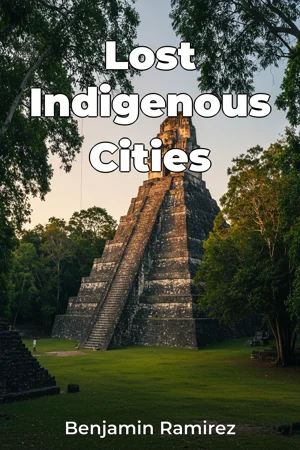
What if the history we thought we knew was only partially told? *Lost Indigenous Cities* challenges the conventional narrative of pre-Columbian America by unveiling the sophisticated urban centers built and sustained by indigenous peoples long before European contact. This book explores the architectural ingenuity, complex social structures, and sustainable practices of these societies, revealing a rich tapestry of urban development that has often been overlooked or marginalized in traditional historical accounts. We delve into three primary areas: firstly, the remarkable architectural achievements of these lost cities, focusing on innovative construction techniques and urban planning principles. Secondly, we examine the social, economic, and political systems that supported these urban centers, highlighting the advanced governance and resource management strategies employed. Finally, we investigate the environmental adaptations and sustainable practices that enabled these cities to thrive for centuries. These topics are vital because they offer a more complete and accurate understanding of human history, challenge Eurocentric perspectives, and provide valuable lessons for contemporary urban planning and sustainability efforts. The backdrop to this exploration is the long-held, but increasingly challenged, belief that complex urban societies in the Americas emerged primarily after European influence. Archaeological discoveries and interdisciplinary research are rewriting this narrative, revealing evidence of widespread urbanization, sophisticated infrastructure, and intricate social organization in pre-Columbian times. Understanding basic archaeological principles and a willingness to reconsider established historical narratives are helpful for the reader. The central argument of *Lost Indigenous Cities* is that pre-Columbian America was home to numerous sophisticated urban centers that rivaled, and in some cases surpassed, those in Europe at the time. These cities demonstrate a high level of social organization, technological innovation, and environmental awareness. This argument is critical because it corrects historical inaccuracies, celebrates the achievements of indigenous cultures, and offers a more nuanced and inclusive understanding of human civilization. The book unfolds in several parts. It starts with an introduction to the concept of indigenous urbanism and its challenges to traditional historical perspectives. Section one details the monumental architecture, advanced infrastructure, and innovative urban planning evident in cities like Cahokia in North America, Caral in South America, and various Mayan centers in Mesoamerica. Emphasis is placed on their unique engineering solutions related to water management, agriculture, and transportation. Section two examines the social and political structures that governed these cities, exploring topics such as trade networks, social stratification, religious practices, and governance systems. Section three investigates the sustainable practices employed by these societies. The book culminates by analyzing the reasons for the decline or abandonment of these cities and discussing the lessons that can be learned from their successes and failures. The evidence presented draws from archaeological excavations, architectural analysis, historical records (including early colonial accounts viewed critically), and environmental studies. We analyze radiocarbon dating, spatial analysis of city layouts, and material culture artifacts. The book also utilizes ethnoarchaeology, drawing parallels between contemporary indigenous practices and those of the past. *Lost Indigenous Cities* connects to several other fields. It intersects with anthropology by examining cultural practices and social structures. It connects with environmental science by studying sustainable practices and ecological adaptations. It also ties into political science by exploring governance systems and power dynamics within these urban centers. These interdisciplinary connections enrich the analysis and provide a more holistic understanding of the subject. This book offers a fresh perspective by centering the narrative on indigenous achievements and challenging Eurocentric biases. It employs a comparative approach, analyzing urban centers across different regions of the Americas to identify common themes and unique adaptations. Written in a fact-based and accessible style, *Lost Indigenous Cities* targets a broad audience, including students, researchers, history enthusiasts, and anyone interested in learning about the rich and complex history of pre-Columbian America. It provides valuable insights into urban planning, sustainable development, and the resilience of indigenous cultures. Adhering to the conventions of the 'Architecture, History, Architecture General' genres, the book includes detailed maps, architectural diagrams, photographs of archaeological sites, and a comprehensive bibliography. The book's scope encompasses urban centers across the Americas from approximately 3000 BCE to 1500 CE with an intentional limitation to focus on pre-Columbian developments, acknowledging post-contact transformations as a separate study. The insights can inform contemporary urban planning by offering examples of sustainable practices, community-based governance, and culturally sensitive design. It also encourages a more inclusive and decolonized approach to historical research and education. The book confronts debates surrounding the interpretation of archaeological evidence, the role of indigenous knowledge in historical reconstruction, and the ethical considerations of archaeological research. It also addresses controversies regarding the dating and significance of certain sites.
What if the history we thought we knew was only partially told? *Lost Indigenous Cities* challenges the conventional narrative of pre-Columbian America by unveiling the sophisticated urban centers built and sustained by indigenous peoples long before European contact. This book explores the architectural ingenuity, complex social structures, and sustainable practices of these societies, revealing a rich tapestry of urban development that has often been overlooked or marginalized in traditional historical accounts. We delve into three primary areas: firstly, the remarkable architectural achievements of these lost cities, focusing on innovative construction techniques and urban planning principles. Secondly, we examine the social, economic, and political systems that supported these urban centers, highlighting the advanced governance and resource management strategies employed. Finally, we investigate the environmental adaptations and sustainable practices that enabled these cities to thrive for centuries. These topics are vital because they offer a more complete and accurate understanding of human history, challenge Eurocentric perspectives, and provide valuable lessons for contemporary urban planning and sustainability efforts. The backdrop to this exploration is the long-held, but increasingly challenged, belief that complex urban societies in the Americas emerged primarily after European influence. Archaeological discoveries and interdisciplinary research are rewriting this narrative, revealing evidence of widespread urbanization, sophisticated infrastructure, and intricate social organization in pre-Columbian times. Understanding basic archaeological principles and a willingness to reconsider established historical narratives are helpful for the reader. The central argument of *Lost Indigenous Cities* is that pre-Columbian America was home to numerous sophisticated urban centers that rivaled, and in some cases surpassed, those in Europe at the time. These cities demonstrate a high level of social organization, technological innovation, and environmental awareness. This argument is critical because it corrects historical inaccuracies, celebrates the achievements of indigenous cultures, and offers a more nuanced and inclusive understanding of human civilization. The book unfolds in several parts. It starts with an introduction to the concept of indigenous urbanism and its challenges to traditional historical perspectives. Section one details the monumental architecture, advanced infrastructure, and innovative urban planning evident in cities like Cahokia in North America, Caral in South America, and various Mayan centers in Mesoamerica. Emphasis is placed on their unique engineering solutions related to water management, agriculture, and transportation. Section two examines the social and political structures that governed these cities, exploring topics such as trade networks, social stratification, religious practices, and governance systems. Section three investigates the sustainable practices employed by these societies. The book culminates by analyzing the reasons for the decline or abandonment of these cities and discussing the lessons that can be learned from their successes and failures. The evidence presented draws from archaeological excavations, architectural analysis, historical records (including early colonial accounts viewed critically), and environmental studies. We analyze radiocarbon dating, spatial analysis of city layouts, and material culture artifacts. The book also utilizes ethnoarchaeology, drawing parallels between contemporary indigenous practices and those of the past. *Lost Indigenous Cities* connects to several other fields. It intersects with anthropology by examining cultural practices and social structures. It connects with environmental science by studying sustainable practices and ecological adaptations. It also ties into political science by exploring governance systems and power dynamics within these urban centers. These interdisciplinary connections enrich the analysis and provide a more holistic understanding of the subject. This book offers a fresh perspective by centering the narrative on indigenous achievements and challenging Eurocentric biases. It employs a comparative approach, analyzing urban centers across different regions of the Americas to identify common themes and unique adaptations. Written in a fact-based and accessible style, *Lost Indigenous Cities* targets a broad audience, including students, researchers, history enthusiasts, and anyone interested in learning about the rich and complex history of pre-Columbian America. It provides valuable insights into urban planning, sustainable development, and the resilience of indigenous cultures. Adhering to the conventions of the 'Architecture, History, Architecture General' genres, the book includes detailed maps, architectural diagrams, photographs of archaeological sites, and a comprehensive bibliography. The book's scope encompasses urban centers across the Americas from approximately 3000 BCE to 1500 CE with an intentional limitation to focus on pre-Columbian developments, acknowledging post-contact transformations as a separate study. The insights can inform contemporary urban planning by offering examples of sustainable practices, community-based governance, and culturally sensitive design. It also encourages a more inclusive and decolonized approach to historical research and education. The book confronts debates surrounding the interpretation of archaeological evidence, the role of indigenous knowledge in historical reconstruction, and the ethical considerations of archaeological research. It also addresses controversies regarding the dating and significance of certain sites.
*Lost Indigenous Cities* unveils the remarkable, often overlooked, urban achievements of pre-Columbian America. Challenging traditional historical narratives, the book explores the sophisticated architectural ingenuity, intricate social structures, and sustainable practices of indigenous societies long before European contact. These cities demonstrate a high level of social organization, technological innovation, and environmental awareness. Discoveries reveal widespread urbanization, sophisticated infrastructure, and intricate social organization, exemplified by monumental architecture and innovative urban planning in places like Cahokia, Caral, and various Mayan centers. The book progresses by first introducing indigenous urbanism and its challenge to traditional perspectives. It then details monumental architecture and urban planning, followed by examinations of social and political structures. Finally, the approach investigates sustainable practices. By centering the narrative on indigenous achievements, *Lost Indigenous Cities* challenges Eurocentric biases, offering a comparative analysis of urban centers across different regions of the Americas to identify common themes and unique adaptations.
Book Details
ISBN
9788235232380
Publisher
Publifye AS
Your Licenses
You don't own any licenses for this book
Purchase a license below to unlock this book and download the EPUB.
Purchase License
Select a tier to unlock this book
Need bulk licensing?
Contact us for enterprise agreements.