
About This Book
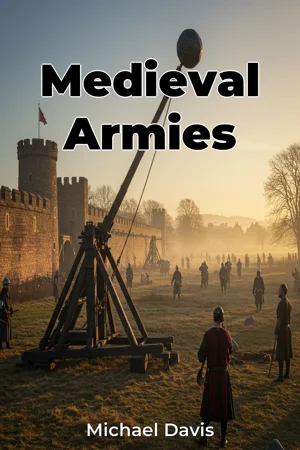
What made a medieval army effective? Was it the heavily armored knight atop his warhorse, or the disciplined ranks of peasant soldiers? This book, *Medieval Armies*, delves into the intricate world of warfare from the early to the late medieval period, exploring the composition, weaponry, and battle strategies that defined these forces. It is vital to understand these elements, as they shaped not only the course of battles but also the political and social landscapes of the era. This book examines the evolution of medieval armies, starting with the fragmented warbands of the early Middle Ages and progressing to the more organized and professional forces of the later period. A strong emphasis is placed on understanding the societal contexts that shaped military organization. It explores the feudal system’s impact on military service, the role of mercenaries, and the gradual rise of standing armies. The central thesis argues that the success of any medieval army depended not solely on individual bravery or advanced weaponry, but on the effective integration of diverse troop types, strategic adaptability, and logistical capabilities. *Medieval Armies* is structured to provide a comprehensive overview of the topic, beginning with an introduction to the key types of soldiers found in medieval armies. These include the elite knightly cavalry, the various forms of infantry (from spearmen and archers to crossbowmen and billmen), and specialized troops such as siege engineers and sappers. The book then devotes extensive sections to the evolution of battlefield tactics and formations, examining how these changed in response to new weapons and technologies. The development of castle warfare and siege tactics is also covered, as is the crucial role of supply and logistics in sustaining military campaigns. The final section of the book analyzes several key battles and campaigns, using them as case studies to illustrate the principles discussed throughout. The arguments presented are meticulously supported by historical sources, including chronicles, military treatises, archaeological findings, and surviving equipment. The book draws from a wide range of primary and secondary sources, offering a balanced and nuanced view of medieval warfare. It also incorporates insights from related fields, such as social history, economic history, and the history of technology, to provide a holistic understanding of the subject. This study connects to other fields by considering the economic impact of warfare on medieval societies: the cost of equipping and maintaining armies, the effects of raiding and plunder, and the role of military spending in shaping economic development. There are also connections to political science, as military organization was inextricably linked to political structures and power dynamics. Furthermore, the book touches on the sociology of warfare, examining the motivations and experiences of soldiers from all social classes. The book takes a unique approach by emphasizing the interconnectedness of military, social, and technological factors. Rather than focusing solely on battles and leaders, it seeks to understand how medieval armies functioned as complex systems within their respective societies. The tone is academic yet accessible, aiming to engage readers with clear explanations and compelling examples. The target audience includes students of medieval history, military history enthusiasts, and anyone interested in learning more about the realities of warfare in the Middle Ages. It will be of value because it provides a comprehensive and up-to-date overview of the topic, drawing on the latest research and offering fresh perspectives. It aligns with the conventions of military history by providing detailed accounts of battles and campaigns, while also adhering to the standards of academic history by rigorously analyzing sources and presenting balanced arguments. The book's scope is broad, covering the major military developments of the European Middle Ages, with some attention paid to developments in the Middle East during the Crusades. It avoids overly detailed accounts of individual battles, focusing instead on broader trends and patterns. The information here can be applied to understanding how warfare shaped medieval societies and how military institutions evolved over time. The book also considers ongoing debates among historians regarding the effectiveness of different types of troops, the impact of new technologies, and the nature of medieval military organization.
What made a medieval army effective? Was it the heavily armored knight atop his warhorse, or the disciplined ranks of peasant soldiers? This book, *Medieval Armies*, delves into the intricate world of warfare from the early to the late medieval period, exploring the composition, weaponry, and battle strategies that defined these forces. It is vital to understand these elements, as they shaped not only the course of battles but also the political and social landscapes of the era. This book examines the evolution of medieval armies, starting with the fragmented warbands of the early Middle Ages and progressing to the more organized and professional forces of the later period. A strong emphasis is placed on understanding the societal contexts that shaped military organization. It explores the feudal system’s impact on military service, the role of mercenaries, and the gradual rise of standing armies. The central thesis argues that the success of any medieval army depended not solely on individual bravery or advanced weaponry, but on the effective integration of diverse troop types, strategic adaptability, and logistical capabilities. *Medieval Armies* is structured to provide a comprehensive overview of the topic, beginning with an introduction to the key types of soldiers found in medieval armies. These include the elite knightly cavalry, the various forms of infantry (from spearmen and archers to crossbowmen and billmen), and specialized troops such as siege engineers and sappers. The book then devotes extensive sections to the evolution of battlefield tactics and formations, examining how these changed in response to new weapons and technologies. The development of castle warfare and siege tactics is also covered, as is the crucial role of supply and logistics in sustaining military campaigns. The final section of the book analyzes several key battles and campaigns, using them as case studies to illustrate the principles discussed throughout. The arguments presented are meticulously supported by historical sources, including chronicles, military treatises, archaeological findings, and surviving equipment. The book draws from a wide range of primary and secondary sources, offering a balanced and nuanced view of medieval warfare. It also incorporates insights from related fields, such as social history, economic history, and the history of technology, to provide a holistic understanding of the subject. This study connects to other fields by considering the economic impact of warfare on medieval societies: the cost of equipping and maintaining armies, the effects of raiding and plunder, and the role of military spending in shaping economic development. There are also connections to political science, as military organization was inextricably linked to political structures and power dynamics. Furthermore, the book touches on the sociology of warfare, examining the motivations and experiences of soldiers from all social classes. The book takes a unique approach by emphasizing the interconnectedness of military, social, and technological factors. Rather than focusing solely on battles and leaders, it seeks to understand how medieval armies functioned as complex systems within their respective societies. The tone is academic yet accessible, aiming to engage readers with clear explanations and compelling examples. The target audience includes students of medieval history, military history enthusiasts, and anyone interested in learning more about the realities of warfare in the Middle Ages. It will be of value because it provides a comprehensive and up-to-date overview of the topic, drawing on the latest research and offering fresh perspectives. It aligns with the conventions of military history by providing detailed accounts of battles and campaigns, while also adhering to the standards of academic history by rigorously analyzing sources and presenting balanced arguments. The book's scope is broad, covering the major military developments of the European Middle Ages, with some attention paid to developments in the Middle East during the Crusades. It avoids overly detailed accounts of individual battles, focusing instead on broader trends and patterns. The information here can be applied to understanding how warfare shaped medieval societies and how military institutions evolved over time. The book also considers ongoing debates among historians regarding the effectiveness of different types of troops, the impact of new technologies, and the nature of medieval military organization.
*Medieval Armies* explores the multifaceted nature of warfare throughout the Middle Ages, challenging common perceptions of battlefield dynamics. Rather than solely focusing on knights, the book investigates the roles of infantry, siege engineers, and the crucial logistics that sustained military campaigns. The book reveals how the composition, weaponry, and battle strategies of medieval armies were deeply entwined with the political and social structures of the time, from the feudal system's impact to the rise of mercenaries. Beginning with the fragmented warbands of the early Middle Ages, the book traces the evolution of military organization to the more professional forces of the later period. It emphasizes the integration of diverse troop types and strategic adaptability as key factors in an army's success. Case studies of key battles and campaigns, supported by historical sources and archaeological findings, illustrate the principles discussed, providing a balanced view of medieval warfare. The book uniquely connects military history with social, economic, and technological factors, offering a comprehensive view of medieval armies as complex systems. By considering the economic impact of warfare, such as the cost of equipping armies and the effects of raiding, it provides fresh perspectives relevant to students, military history enthusiasts, and anyone interested in the realities of medieval war history.
Book Details
ISBN
9788235232229
Publisher
Publifye AS
Your Licenses
You don't own any licenses for this book
Purchase a license below to unlock this book and download the EPUB.
Purchase License
Select a tier to unlock this book
Need bulk licensing?
Contact us for enterprise agreements.