
About This Book
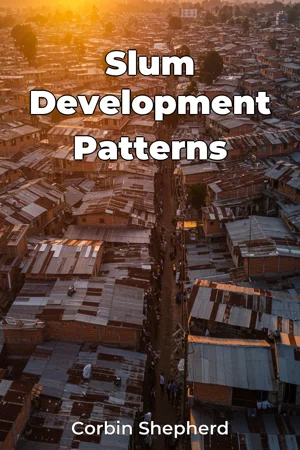
Why do informal settlements, often referred to as slums, continue to proliferate despite decades of urban planning and development initiatives? *Slum Development Patterns* delves into this critical question, offering a comprehensive analysis of the complex factors that drive the emergence and evolution of these settlements in rapidly urbanizing regions. This book is essential reading for anyone seeking to understand the dynamics of urban poverty, migration, and housing policy in the developing world. This book examines the intricate interplay of economic forces, migration patterns, and governmental housing policies that collectively contribute to the formation and persistence of slums. The central argument is that slum development is not a random occurrence but rather a predictable outcome of specific socio-economic and political conditions, often exacerbated by inadequate or misguided urban planning strategies. Understanding these patterns is crucial for developing effective interventions aimed at improving the living conditions of slum dwellers and preventing the further expansion of informal settlements. The book begins by establishing a robust theoretical framework for understanding slum development, drawing on concepts from urban economics, migration studies, and political science. It provides a historical overview of informal settlements globally, highlighting the diverse forms they take and the common challenges they face. Key concepts, such as land tenure security, access to basic services, and social capital, are defined and explored in detail. Following the introductory section, the book systematically examines the key drivers of slum development. One major section is dedicated to analyzing the economic factors, including poverty, unemployment, and the informal economy, which push individuals and families into informal settlements. Another section explores the role of migration, both rural-to-urban and international, in shaping the demographic composition and spatial distribution of slums. A third major area of focus is on housing policies, evaluating the effectiveness of different approaches to providing affordable housing and upgrading existing slums. To support its arguments, *Slum Development Patterns* draws on a wide range of empirical evidence, including case studies of slums in different regions of the world, statistical data on urbanization and poverty, and policy analyses of housing programs. The book utilizes both quantitative and qualitative research methods to provide a nuanced understanding of the challenges and opportunities associated with slum development. Unique data sources, such as satellite imagery analysis and household surveys conducted directly in informal settlements, offer fresh insights into the lived experiences of slum dwellers. The book also makes important interdisciplinary connections, linking slum development to issues of public health, environmental sustainability, and social justice. It demonstrates how poor living conditions in slums can lead to increased rates of disease, environmental degradation, and social exclusion. These connections highlight the need for integrated, multi-sectoral approaches to addressing the root causes of slum development. *Slum Development Patterns* adopts a rigorous academic approach, providing a clear and concise analysis of complex issues. The writing style is accessible to a broad audience, including students, researchers, policymakers, and practitioners working in the fields of urban planning, development studies, and social work. The book's scope is intentionally broad, covering a range of geographic contexts and policy approaches, but it also acknowledges the limitations of generalizing across vastly different situations. The findings presented in this book have numerous real-world applications. By understanding the underlying patterns of slum development, policymakers can design more effective interventions to prevent the formation of new slums, upgrade existing settlements, and improve the lives of slum dwellers. Urban planners can use this knowledge to create more inclusive and sustainable cities that provide opportunities for all residents. The book also addresses ongoing debates about the best approaches to slum upgrading, considering the trade-offs between in-situ improvements and resettlement programs. It offers a balanced perspective, recognizing the complexities and challenges involved in addressing this pressing global issue.
Why do informal settlements, often referred to as slums, continue to proliferate despite decades of urban planning and development initiatives? *Slum Development Patterns* delves into this critical question, offering a comprehensive analysis of the complex factors that drive the emergence and evolution of these settlements in rapidly urbanizing regions. This book is essential reading for anyone seeking to understand the dynamics of urban poverty, migration, and housing policy in the developing world. This book examines the intricate interplay of economic forces, migration patterns, and governmental housing policies that collectively contribute to the formation and persistence of slums. The central argument is that slum development is not a random occurrence but rather a predictable outcome of specific socio-economic and political conditions, often exacerbated by inadequate or misguided urban planning strategies. Understanding these patterns is crucial for developing effective interventions aimed at improving the living conditions of slum dwellers and preventing the further expansion of informal settlements. The book begins by establishing a robust theoretical framework for understanding slum development, drawing on concepts from urban economics, migration studies, and political science. It provides a historical overview of informal settlements globally, highlighting the diverse forms they take and the common challenges they face. Key concepts, such as land tenure security, access to basic services, and social capital, are defined and explored in detail. Following the introductory section, the book systematically examines the key drivers of slum development. One major section is dedicated to analyzing the economic factors, including poverty, unemployment, and the informal economy, which push individuals and families into informal settlements. Another section explores the role of migration, both rural-to-urban and international, in shaping the demographic composition and spatial distribution of slums. A third major area of focus is on housing policies, evaluating the effectiveness of different approaches to providing affordable housing and upgrading existing slums. To support its arguments, *Slum Development Patterns* draws on a wide range of empirical evidence, including case studies of slums in different regions of the world, statistical data on urbanization and poverty, and policy analyses of housing programs. The book utilizes both quantitative and qualitative research methods to provide a nuanced understanding of the challenges and opportunities associated with slum development. Unique data sources, such as satellite imagery analysis and household surveys conducted directly in informal settlements, offer fresh insights into the lived experiences of slum dwellers. The book also makes important interdisciplinary connections, linking slum development to issues of public health, environmental sustainability, and social justice. It demonstrates how poor living conditions in slums can lead to increased rates of disease, environmental degradation, and social exclusion. These connections highlight the need for integrated, multi-sectoral approaches to addressing the root causes of slum development. *Slum Development Patterns* adopts a rigorous academic approach, providing a clear and concise analysis of complex issues. The writing style is accessible to a broad audience, including students, researchers, policymakers, and practitioners working in the fields of urban planning, development studies, and social work. The book's scope is intentionally broad, covering a range of geographic contexts and policy approaches, but it also acknowledges the limitations of generalizing across vastly different situations. The findings presented in this book have numerous real-world applications. By understanding the underlying patterns of slum development, policymakers can design more effective interventions to prevent the formation of new slums, upgrade existing settlements, and improve the lives of slum dwellers. Urban planners can use this knowledge to create more inclusive and sustainable cities that provide opportunities for all residents. The book also addresses ongoing debates about the best approaches to slum upgrading, considering the trade-offs between in-situ improvements and resettlement programs. It offers a balanced perspective, recognizing the complexities and challenges involved in addressing this pressing global issue.
"Slum Development Patterns" explores why informal settlements persist despite urban planning efforts. The book examines the socio-economic and political factors driving slum development, arguing it's a predictable outcome of specific conditions, not a random occurrence. It's crucial for understanding urban poverty, migration patterns, and housing policy, especially in the developing world where rapid urbanization fuels the growth of these settlements. One intriguing insight is how inadequate land tenure security often exacerbates the problem. The book progresses from establishing a theoretical framework rooted in urban economics and political science to systematically analyzing key drivers like poverty, unemployment, and rural-to-urban migration. It delves into housing policies, evaluating their effectiveness in providing affordable housing and upgrading existing slums, and uses case studies to support its arguments. The book highlights the need for integrated approaches to address the root causes of slum development, emphasizing connections to public health, environmental sustainability, and social justice.
Book Details
ISBN
9788235230805
Publisher
Publifye AS
Your Licenses
You don't own any licenses for this book
Purchase a license below to unlock this book and download the EPUB.
Purchase License
Select a tier to unlock this book
Need bulk licensing?
Contact us for enterprise agreements.