
About This Book
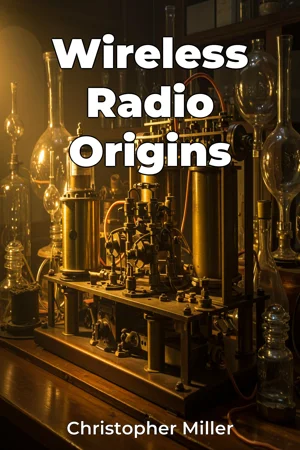
How did a scientific curiosity evolve into the ubiquitous wireless communication systems that underpin modern society? "Wireless Radio Origins" delves into the captivating genesis of radio technology, charting its course from esoteric experiments to global broadcasting and beyond. This book explores how the confluence of scientific discovery, technological innovation, and entrepreneurial spirit birthed an era of unprecedented connectivity. We will primarily examine two pivotal themes: the foundational scientific principles that made wireless communication possible and the ingenious individuals who transformed these principles into tangible working systems. Understanding the physics of electromagnetic waves and their propagation is crucial, as is recognizing the contributions of early pioneers like Heinrich Hertz, Guglielmo Marconi, and Reginald Fessenden. Their relentless pursuit of wireless transmission laid the groundwork for subsequent advancements. To fully appreciate these developments, we will first establish the historical landscape of the late 19th and early 20th centuries. The book assumes a basic understanding of physics and electricity, but will provide accessible explanations of more complex concepts as they arise. The central argument of "Wireless Radio Origins" is that the development of radio was not a singular invention but rather an iterative process of refinement and innovation built upon the shoulders of numerous contributors. It highlights the collaborative nature of scientific progress and the often-overlooked contributions of lesser-known figures. The book unfolds in three distinct phases. Initially, we will explore the theoretical underpinnings of radio, starting with James Clerk Maxwell's electromagnetic theory and Hertz's experimental validation. Following this, we will trace the practical application of these theories, focusing on Marconi's transatlantic transmissions and Fessenden's groundbreaking work in continuous wave radio. Finally, we will examine the early commercialization of radio, including the rise of broadcasting and its societal impact. The book draws upon a wide range of sources, including original scientific papers, patent filings, biographical accounts, and archival materials from early radio companies. We will meticulously analyze these sources to reconstruct the technical and social context of early radio development. "Wireless Radio Origins" connects to several other fields of study, including the history of science, electrical engineering, and communications studies. It also intersects with business history through the early growth and competition of radio companies. These interdisciplinary connections enrich our understanding of radio's multifaceted impact on society. What distinguishes this book is its emphasis on the incremental nature of innovation and the diverse range of individuals who contributed to the development of radio. It moves beyond a purely technological narrative to examine the social, economic, and cultural forces that shaped its trajectory. The writing style is factual and analytical, aiming to provide a clear and comprehensive account of early radio development. While grounded in scientific and historical rigor, the book is written to be accessible to a broad audience. The target audience includes students, researchers, historians of technology, and anyone interested in the history of wireless communication. It will be valuable to readers seeking a deeper understanding of the technology that underpins our modern interconnected world. As a work of historical technology, "Wireless Radio Origins" adheres to the conventions of meticulous research, accurate representation of sources, and objective analysis. While the book aims to provide a comprehensive overview, it is necessarily limited to the early decades of radio development, setting the stage for subsequent innovations in broadcasting and telecommunications covered elsewhere. The lessons learned from the early development of radio have practical applications today. Understanding the iterative process of innovation and the importance of collaboration can inform contemporary efforts in technology development. The book will also briefly touch upon some of the early controversies surrounding radio, including patent disputes and concerns about its potential impact on society. By addressing these debates, we gain a more nuanced understanding of the challenges and opportunities presented by this transformative technology.
How did a scientific curiosity evolve into the ubiquitous wireless communication systems that underpin modern society? "Wireless Radio Origins" delves into the captivating genesis of radio technology, charting its course from esoteric experiments to global broadcasting and beyond. This book explores how the confluence of scientific discovery, technological innovation, and entrepreneurial spirit birthed an era of unprecedented connectivity. We will primarily examine two pivotal themes: the foundational scientific principles that made wireless communication possible and the ingenious individuals who transformed these principles into tangible working systems. Understanding the physics of electromagnetic waves and their propagation is crucial, as is recognizing the contributions of early pioneers like Heinrich Hertz, Guglielmo Marconi, and Reginald Fessenden. Their relentless pursuit of wireless transmission laid the groundwork for subsequent advancements. To fully appreciate these developments, we will first establish the historical landscape of the late 19th and early 20th centuries. The book assumes a basic understanding of physics and electricity, but will provide accessible explanations of more complex concepts as they arise. The central argument of "Wireless Radio Origins" is that the development of radio was not a singular invention but rather an iterative process of refinement and innovation built upon the shoulders of numerous contributors. It highlights the collaborative nature of scientific progress and the often-overlooked contributions of lesser-known figures. The book unfolds in three distinct phases. Initially, we will explore the theoretical underpinnings of radio, starting with James Clerk Maxwell's electromagnetic theory and Hertz's experimental validation. Following this, we will trace the practical application of these theories, focusing on Marconi's transatlantic transmissions and Fessenden's groundbreaking work in continuous wave radio. Finally, we will examine the early commercialization of radio, including the rise of broadcasting and its societal impact. The book draws upon a wide range of sources, including original scientific papers, patent filings, biographical accounts, and archival materials from early radio companies. We will meticulously analyze these sources to reconstruct the technical and social context of early radio development. "Wireless Radio Origins" connects to several other fields of study, including the history of science, electrical engineering, and communications studies. It also intersects with business history through the early growth and competition of radio companies. These interdisciplinary connections enrich our understanding of radio's multifaceted impact on society. What distinguishes this book is its emphasis on the incremental nature of innovation and the diverse range of individuals who contributed to the development of radio. It moves beyond a purely technological narrative to examine the social, economic, and cultural forces that shaped its trajectory. The writing style is factual and analytical, aiming to provide a clear and comprehensive account of early radio development. While grounded in scientific and historical rigor, the book is written to be accessible to a broad audience. The target audience includes students, researchers, historians of technology, and anyone interested in the history of wireless communication. It will be valuable to readers seeking a deeper understanding of the technology that underpins our modern interconnected world. As a work of historical technology, "Wireless Radio Origins" adheres to the conventions of meticulous research, accurate representation of sources, and objective analysis. While the book aims to provide a comprehensive overview, it is necessarily limited to the early decades of radio development, setting the stage for subsequent innovations in broadcasting and telecommunications covered elsewhere. The lessons learned from the early development of radio have practical applications today. Understanding the iterative process of innovation and the importance of collaboration can inform contemporary efforts in technology development. The book will also briefly touch upon some of the early controversies surrounding radio, including patent disputes and concerns about its potential impact on society. By addressing these debates, we gain a more nuanced understanding of the challenges and opportunities presented by this transformative technology.
"Wireless Radio Origins" explores the fascinating beginnings of wireless radio, detailing its evolution from scientific curiosity to a cornerstone of modern communication. The book emphasizes that radio's development wasn't a singular invention but a series of incremental innovations. Early pioneers grappled with the physics of electromagnetic waves, a concept first theorized by James Clerk Maxwell, and later validated by Heinrich Hertz's experiments. Understanding these principles was crucial for inventors like Guglielmo Marconi, who achieved transatlantic transmissions, and Reginald Fessenden, who advanced continuous wave radio. The book progresses chronologically, starting with the theoretical foundations laid by Maxwell and Hertz. It then transitions to the practical applications and breakthroughs achieved by Marconi and Fessenden. Finally, it examines the early commercialization of radio and its initial societal impact. By examining original scientific papers, patent filings, and biographical accounts, "Wireless Radio Origins" provides a comprehensive look at the technological and social landscape that shaped early radio development. This historical analysis offers valuable insights into how technological innovation unfolds, emphasizing collaboration and iterative refinement.
Book Details
ISBN
9788235230096
Publisher
Publifye AS
Your Licenses
You don't own any licenses for this book
Purchase a license below to unlock this book and download the EPUB.
Purchase License
Select a tier to unlock this book
Need bulk licensing?
Contact us for enterprise agreements.