
About This Book
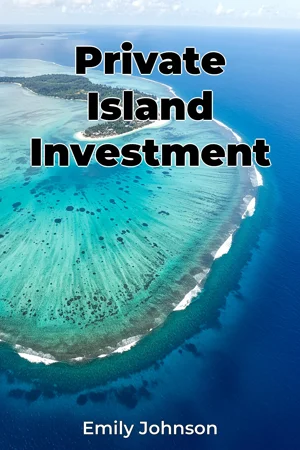
Have you ever dreamt of escaping to your own private island, a sanctuary away from the pressures of modern life? "Private Island Investment" delves into the complex reality of acquiring and managing your own island, exploring both the seductive allure and the significant financial and logistical challenges involved. This book provides a comprehensive analysis for prospective buyers and curious investors, offering a realistic perspective on this unique asset class. We explore two key areas: the financial aspects of island ownership, including valuation, acquisition costs, and ongoing expenses; and the practical considerations of development, sustainability, and legal compliance. These topics are vital because uninformed decisions in either area can lead to substantial financial losses and environmental damage. Understanding the intricacies of island ownership is not merely about realizing a dream; it's about making informed, responsible investment choices. Historically, private islands were the domain of royalty and the ultra-wealthy. Today, while still exclusive, advancements in transportation and communication have made island ownership a more attainable, though still complex, possibility for a broader range of high-net-worth individuals. A basic understanding of real estate investment principles is helpful, but not strictly required, as we cover foundational concepts. The central argument of "Private Island Investment" is that acquiring a private island should be approached as a serious, strategic investment, not simply an emotional purchase. We advocate for a data-driven, risk-aware approach to island acquisition and management. This argument is crucial because the inherent risks associated with island ownership – remoteness, environmental vulnerability, and logistical complexities – are often underestimated, leading to potentially devastating financial consequences for the unprepared. The book begins by introducing the fundamental concepts of island valuation and due diligence. We then develop these ideas through detailed explorations of key areas: (1) financial modeling for island investments, including revenue generation opportunities (e.g., tourism, sustainable agriculture) and expense management; (2) legal and regulatory frameworks governing island development, focusing on environmental protection laws, property rights, and international regulations; (3) and sustainable development practices for islands, emphasizing renewable energy sources, waste management, and biodiversity conservation. The book culminates in a practical guide to island management, covering topics such as infrastructure maintenance, security, and community relations. Our analysis is supported by a combination of financial data, legal case studies, and environmental impact assessments. We draw on data from real estate transactions, government reports, and academic research to provide a comprehensive and objective assessment of the private island market. We also present case studies of successful and unsuccessful island developments, highlighting the key factors that contribute to positive outcomes. “Private Island Investment” intersects with several fields, including environmental science (assessing ecological impacts), international law (navigating maritime boundaries and regulations), and tourism management (developing sustainable tourism models). These interdisciplinary connections enrich our analysis, providing a holistic view of the challenges and opportunities associated with island ownership. What sets this book apart is its balanced perspective. We neither romanticize nor dismiss the idea of private island ownership. Instead, we offer a realistic, data-driven assessment of the risks and rewards, empowering readers to make informed decisions based on thorough research and sound financial analysis. Written in a professional yet accessible style, "Private Island Investment" is targeted towards high-net-worth individuals, real estate investors, and anyone considering purchasing or investing in a private island. It is also relevant to professionals in the fields of real estate, finance, and environmental management who seek a deeper understanding of this unique asset class. The book adheres to the conventions of the finance and business genres, focusing on factual accuracy, data analysis, and practical applications. The scope of the book is limited to the financial, legal, and environmental aspects of private island ownership. While we touch on the cultural and social implications, our primary focus is on providing a practical guide for investors and owners. The information presented can be applied directly to the process of evaluating, acquiring, and managing a private island. Readers will gain the knowledge and tools necessary to conduct thorough due diligence, develop sustainable business plans, and navigate the complex regulatory landscape. The book also addresses ongoing debates surrounding the environmental impact of island development and the ethical considerations of private ownership in ecologically sensitive areas. We present different perspectives on these issues, encouraging readers to form their own informed opinions.
Have you ever dreamt of escaping to your own private island, a sanctuary away from the pressures of modern life? "Private Island Investment" delves into the complex reality of acquiring and managing your own island, exploring both the seductive allure and the significant financial and logistical challenges involved. This book provides a comprehensive analysis for prospective buyers and curious investors, offering a realistic perspective on this unique asset class. We explore two key areas: the financial aspects of island ownership, including valuation, acquisition costs, and ongoing expenses; and the practical considerations of development, sustainability, and legal compliance. These topics are vital because uninformed decisions in either area can lead to substantial financial losses and environmental damage. Understanding the intricacies of island ownership is not merely about realizing a dream; it's about making informed, responsible investment choices. Historically, private islands were the domain of royalty and the ultra-wealthy. Today, while still exclusive, advancements in transportation and communication have made island ownership a more attainable, though still complex, possibility for a broader range of high-net-worth individuals. A basic understanding of real estate investment principles is helpful, but not strictly required, as we cover foundational concepts. The central argument of "Private Island Investment" is that acquiring a private island should be approached as a serious, strategic investment, not simply an emotional purchase. We advocate for a data-driven, risk-aware approach to island acquisition and management. This argument is crucial because the inherent risks associated with island ownership – remoteness, environmental vulnerability, and logistical complexities – are often underestimated, leading to potentially devastating financial consequences for the unprepared. The book begins by introducing the fundamental concepts of island valuation and due diligence. We then develop these ideas through detailed explorations of key areas: (1) financial modeling for island investments, including revenue generation opportunities (e.g., tourism, sustainable agriculture) and expense management; (2) legal and regulatory frameworks governing island development, focusing on environmental protection laws, property rights, and international regulations; (3) and sustainable development practices for islands, emphasizing renewable energy sources, waste management, and biodiversity conservation. The book culminates in a practical guide to island management, covering topics such as infrastructure maintenance, security, and community relations. Our analysis is supported by a combination of financial data, legal case studies, and environmental impact assessments. We draw on data from real estate transactions, government reports, and academic research to provide a comprehensive and objective assessment of the private island market. We also present case studies of successful and unsuccessful island developments, highlighting the key factors that contribute to positive outcomes. “Private Island Investment” intersects with several fields, including environmental science (assessing ecological impacts), international law (navigating maritime boundaries and regulations), and tourism management (developing sustainable tourism models). These interdisciplinary connections enrich our analysis, providing a holistic view of the challenges and opportunities associated with island ownership. What sets this book apart is its balanced perspective. We neither romanticize nor dismiss the idea of private island ownership. Instead, we offer a realistic, data-driven assessment of the risks and rewards, empowering readers to make informed decisions based on thorough research and sound financial analysis. Written in a professional yet accessible style, "Private Island Investment" is targeted towards high-net-worth individuals, real estate investors, and anyone considering purchasing or investing in a private island. It is also relevant to professionals in the fields of real estate, finance, and environmental management who seek a deeper understanding of this unique asset class. The book adheres to the conventions of the finance and business genres, focusing on factual accuracy, data analysis, and practical applications. The scope of the book is limited to the financial, legal, and environmental aspects of private island ownership. While we touch on the cultural and social implications, our primary focus is on providing a practical guide for investors and owners. The information presented can be applied directly to the process of evaluating, acquiring, and managing a private island. Readers will gain the knowledge and tools necessary to conduct thorough due diligence, develop sustainable business plans, and navigate the complex regulatory landscape. The book also addresses ongoing debates surrounding the environmental impact of island development and the ethical considerations of private ownership in ecologically sensitive areas. We present different perspectives on these issues, encouraging readers to form their own informed opinions.
"Private Island Investment" explores the alluring yet complex world of island ownership, transforming the dream of a private sanctuary into a strategic financial venture. This book provides prospective buyers and curious investors with a realistic perspective on this unique real estate investment. Historically reserved for royalty, private islands are now more accessible, although still complex undertakings for high-net-worth individuals, requiring a firm grasp of financial modeling, legal compliance, and sustainable development. The book reveals that while the idea of owning a private island is enticing, it's crucial to approach it as a serious investment, given the inherent risks such as remoteness and environmental vulnerability. The book progresses from fundamental concepts of island valuation and due diligence to detailed explorations of financial modeling, legal frameworks, and sustainable practices. It emphasizes data-driven decision-making and risk awareness, supported by financial data, legal case studies, and environmental impact assessments. For example, tourism management and sustainable agriculture are presented as potential revenue streams. What distinguishes this book is its balanced view, providing a realistic assessment of risks and rewards, empowering readers to make informed choices about island investment.
Book Details
ISBN
9788235229861
Publisher
Publifye AS
Your Licenses
You don't own any licenses for this book
Purchase a license below to unlock this book and download the EPUB.
Purchase License
Select a tier to unlock this book
Need bulk licensing?
Contact us for enterprise agreements.