
About This Book
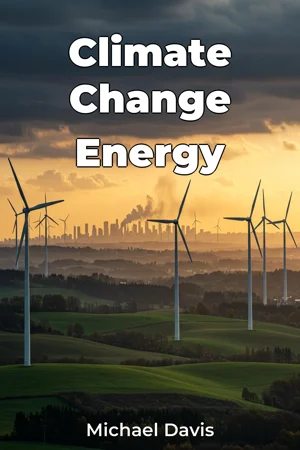
Can energy policy truly steer us toward effective climate mitigation, or are we merely rearranging deck chairs on a rapidly warming planet? "Climate Change Energy" delves into this critical question, exploring the intricate relationship between energy policy and its consequential role in addressing the climate crisis. This book examines the political, environmental, and economic dimensions of transitioning to a sustainable energy future. The book centers on three core themes: the efficacy of current energy policies in meeting climate goals, the socio-economic impacts of transitioning to renewable energy sources, and the geopolitical implications of a global shift away from fossil fuels. Understanding these interconnected issues is crucial because energy policy serves as both a primary driver of greenhouse gas emissions and a pivotal tool for decarbonization. Without informed, strategic energy policies, achieving meaningful climate mitigation is impossible. To provide context, the book traces the historical evolution of energy policy from the industrial revolution to the present day, highlighting key milestones such as the Kyoto Protocol and the Paris Agreement. It also examines the scientific consensus on climate change, presenting a concise overview of the causes, consequences, and potential pathways to a sustainable future. Readers with a basic understanding of environmental science and political systems will find the material readily accessible. The central argument of "Climate Change Energy" is that effective climate mitigation hinges on the implementation of comprehensive, integrated energy policies that address not only technological advancements but also social equity and global cooperation. This argument is vital because piecemeal solutions and isolated national efforts are insufficient to tackle the global challenge of climate change. The book’s structure follows a logical progression. It begins by introducing the fundamental concepts of climate science and energy systems. It then develops the argument through three major sections: (1) an analysis of existing energy policies, evaluating their successes and failures in reducing carbon emissions; (2) an exploration of renewable energy technologies, examining their potential, limitations, and the challenges of large-scale deployment; and (3) a discussion of the political and economic barriers to a clean energy transition, with a focus on international cooperation and policy design. The book culminates by synthesizing the evidence and proposing a framework for a more effective and equitable energy policy agenda and examines several real-world case studies of regions that have made progress in transitioning towards sustainable energy systems, drawing lessons applicable to other contexts. The arguments presented are supported by a wide range of data and research, including peer-reviewed scientific studies, government reports, and economic analyses. The book also draws on original case studies and interviews with policymakers, industry leaders, and community stakeholders. Methodologically, the book employs a multidisciplinary approach, combining quantitative analysis with qualitative insights to provide a holistic understanding of the complex issues at stake. "Climate Change Energy" forges connections across several disciplines, linking environmental science with political science, economics, and sociology. The book examines how environmental regulations impact economic growth. It also considers the social justice implications of energy policy, such as the disproportionate burden of pollution on marginalized communities. It discusses how international relations influence the development and implementation of global climate agreements. A unique aspect of this book is its focus on policy integration, emphasizing the need to align energy policies with other sectors, such as transportation, agriculture, and urban planning. This integrated approach offers a more comprehensive and effective way to address climate change than sector-specific policies alone. The tone is academic, yet accessible, aiming to inform and engage a broad audience. The writing style is clear and concise, avoiding jargon and technical terms where possible. The target audience includes students, researchers, policymakers, and anyone interested in understanding the complex relationship between energy policy and climate change. This book would be valuable to them because it provides a comprehensive and balanced overview of the key issues, challenges, and opportunities in the field. As a work of non-fiction in the environmental and political genres, the book adheres to standards of accuracy, objectivity, and evidence-based analysis. It presents multiple perspectives on complex issues, avoiding advocacy and bias. The book's scope is global, covering energy policies and climate mitigation strategies in different regions of the world. However, it acknowledges limitations in its ability to provide detailed, country-specific analyses for every nation. The information contained within has real-world application, offering insights and recommendations that can be used to inform policy debates, guide investment decisions, and promote citizen engagement in the transition to a sustainable energy future. Finally, ongoing debates within the field are acknowledged, such as the role of carbon capture technology, the feasibility of 100% renewable energy systems, and the appropriate level of government intervention in energy markets. By addressing these controversies head-on, the book aims to promote critical thinking and informed discussion.
Can energy policy truly steer us toward effective climate mitigation, or are we merely rearranging deck chairs on a rapidly warming planet? "Climate Change Energy" delves into this critical question, exploring the intricate relationship between energy policy and its consequential role in addressing the climate crisis. This book examines the political, environmental, and economic dimensions of transitioning to a sustainable energy future. The book centers on three core themes: the efficacy of current energy policies in meeting climate goals, the socio-economic impacts of transitioning to renewable energy sources, and the geopolitical implications of a global shift away from fossil fuels. Understanding these interconnected issues is crucial because energy policy serves as both a primary driver of greenhouse gas emissions and a pivotal tool for decarbonization. Without informed, strategic energy policies, achieving meaningful climate mitigation is impossible. To provide context, the book traces the historical evolution of energy policy from the industrial revolution to the present day, highlighting key milestones such as the Kyoto Protocol and the Paris Agreement. It also examines the scientific consensus on climate change, presenting a concise overview of the causes, consequences, and potential pathways to a sustainable future. Readers with a basic understanding of environmental science and political systems will find the material readily accessible. The central argument of "Climate Change Energy" is that effective climate mitigation hinges on the implementation of comprehensive, integrated energy policies that address not only technological advancements but also social equity and global cooperation. This argument is vital because piecemeal solutions and isolated national efforts are insufficient to tackle the global challenge of climate change. The book’s structure follows a logical progression. It begins by introducing the fundamental concepts of climate science and energy systems. It then develops the argument through three major sections: (1) an analysis of existing energy policies, evaluating their successes and failures in reducing carbon emissions; (2) an exploration of renewable energy technologies, examining their potential, limitations, and the challenges of large-scale deployment; and (3) a discussion of the political and economic barriers to a clean energy transition, with a focus on international cooperation and policy design. The book culminates by synthesizing the evidence and proposing a framework for a more effective and equitable energy policy agenda and examines several real-world case studies of regions that have made progress in transitioning towards sustainable energy systems, drawing lessons applicable to other contexts. The arguments presented are supported by a wide range of data and research, including peer-reviewed scientific studies, government reports, and economic analyses. The book also draws on original case studies and interviews with policymakers, industry leaders, and community stakeholders. Methodologically, the book employs a multidisciplinary approach, combining quantitative analysis with qualitative insights to provide a holistic understanding of the complex issues at stake. "Climate Change Energy" forges connections across several disciplines, linking environmental science with political science, economics, and sociology. The book examines how environmental regulations impact economic growth. It also considers the social justice implications of energy policy, such as the disproportionate burden of pollution on marginalized communities. It discusses how international relations influence the development and implementation of global climate agreements. A unique aspect of this book is its focus on policy integration, emphasizing the need to align energy policies with other sectors, such as transportation, agriculture, and urban planning. This integrated approach offers a more comprehensive and effective way to address climate change than sector-specific policies alone. The tone is academic, yet accessible, aiming to inform and engage a broad audience. The writing style is clear and concise, avoiding jargon and technical terms where possible. The target audience includes students, researchers, policymakers, and anyone interested in understanding the complex relationship between energy policy and climate change. This book would be valuable to them because it provides a comprehensive and balanced overview of the key issues, challenges, and opportunities in the field. As a work of non-fiction in the environmental and political genres, the book adheres to standards of accuracy, objectivity, and evidence-based analysis. It presents multiple perspectives on complex issues, avoiding advocacy and bias. The book's scope is global, covering energy policies and climate mitigation strategies in different regions of the world. However, it acknowledges limitations in its ability to provide detailed, country-specific analyses for every nation. The information contained within has real-world application, offering insights and recommendations that can be used to inform policy debates, guide investment decisions, and promote citizen engagement in the transition to a sustainable energy future. Finally, ongoing debates within the field are acknowledged, such as the role of carbon capture technology, the feasibility of 100% renewable energy systems, and the appropriate level of government intervention in energy markets. By addressing these controversies head-on, the book aims to promote critical thinking and informed discussion.
"Climate Change Energy" explores the crucial link between energy policy and climate mitigation, questioning whether current efforts are truly effective. It delves into the political, environmental, and economic aspects of transitioning to sustainable energy. The book highlights the importance of integrated energy policies, noting that without them, meaningful decarbonization is impossible. It acknowledges the historical context, from the Industrial Revolution to the Paris Agreement, and the scientific consensus on climate change. The book argues that effective climate mitigation requires comprehensive energy policies addressing technological advancements, social equity, and global cooperation. It examines existing energy policies, evaluates renewable energy technologies, and discusses political and economic barriers to a clean energy transition. A key insight is how energy policies must align with other sectors like transportation and agriculture for a more effective approach. The book progresses logically, starting with fundamental concepts, then analyzing policies, exploring technologies, and finally discussing political and economic barriers. Ultimately, "Climate Change Energy" provides a multidisciplinary understanding of the complex issues at stake, combining quantitative analysis with qualitative insights. It emphasizes the need for global cooperation in addressing carbon emissions and promotes critical thinking about ongoing debates in the field.
Book Details
ISBN
9788235228130
Publisher
Publifye AS
Your Licenses
You don't own any licenses for this book
Purchase a license below to unlock this book and download the EPUB.
Purchase License
Select a tier to unlock this book
Need bulk licensing?
Contact us for enterprise agreements.