
About This Book
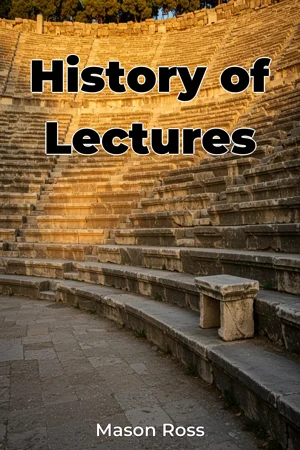
What if the seeds of modern education were sown not in classrooms, but in the public squares of ancient Greece? 'History of Lectures' traces the evolution of the lecture, from its origins in classical oratory to its current form in universities worldwide, revealing its enduring influence on academic learning and the transmission of knowledge. This book delves into the historical context, pedagogical significance, and evolving methodologies of lecturing, examining its role in shaping intellectual discourse across centuries. Central to our exploration are three key themes: the transformation of the lecture format over time, the socio-political influences that have molded its content and delivery, and the continued relevance of lecturing in the digital age. Each of these themes is crucial for understanding how lectures have not only disseminated information but also fostered critical thinking and shaped academic communities. The history of lectures is inextricably linked to the development of civilization itself. From the rhetorical schools of ancient Greece to the medieval universities and the enlightenment salons, the spoken word has been a primary means of instruction and intellectual exchange. Understanding this historical backdrop is essential for appreciating the lecture's enduring appeal and its adaptability to different eras and contexts. The central argument of 'History of Lectures' is that the lecture, despite criticisms of passivity and one-way communication, remains a vital tool for fostering intellectual engagement and shaping academic discourse. The book demonstrates this by tracing the lecture's evolution and highlighting its capacity to adapt to changing pedagogical needs and technological advancements. The book unfolds in three major sections. The first section examines the pre-university lecture – its roots in classical rhetoric, the role of public orators, and the emergence of formal lecturing in early centers of learning. The second section focuses on the development of the university lecture from the medieval period to the 20th century, highlighting the influence of key figures, pedagogical innovations, and the rise of different lecturing styles. The third part considers the modern lecture in the context of digital technologies, exploring online lectures, hybrid learning models, and the ongoing debate about the lecture's role in contemporary education. The conclusion synthesizes these historical threads and considers the future of lecturing in an increasingly networked and digitized world. 'History of Lectures' draws upon a wide range of primary and secondary sources, including archival documents, university records, personal letters, and published lectures. It also incorporates insights from educational theory, communication studies, and social history to provide a comprehensive and nuanced analysis of the lecture's evolution. This book connects to fields such as communication studies, education, and sociology. Communication studies provides insight into the art of rhetoric, education explores the lecture's effectiveness, and sociology reveals the power dynamics within academic settings. 'History of Lectures' offers a unique perspective by combining historical analysis with contemporary pedagogical concerns, providing a balanced and insightful assessment of the lecture's past, present, and future. It avoids romanticizing the past. The book adopts a formal academic writing style, striving for clarity, precision, and intellectual rigor. It is intended for educators, students, historians of education, and anyone interested in the history and theory of knowledge transmission. The book is specifically relevant to those seeking to improve their teaching practices, or those looking to understand the historical context of modern educational institutions. As a work of historical scholarship, 'History of Lectures' aims to provide a comprehensive overview of the lecture's evolution, focusing primarily on Western academic traditions. While acknowledging the diversity of lecturing practices across different cultures and contexts, This book mostly covers lectures in Europe and North America. The insights offered in 'History of Lectures' have practical applications for educators seeking to enhance their lecturing skills and adapt their teaching methods to meet the needs of today’s students. By understanding the lecture's historical roots and its ongoing evolution, instructors can make more informed decisions about how to use this powerful tool to foster intellectual engagement and promote student learning. The book also addresses ongoing debates about the effectiveness of lecturing as a pedagogical method, considering arguments for and against its continued use in higher education. By examining the historical context of these debates, the book offers a nuanced perspective on the challenges and opportunities facing lecturers in the 21st century.
What if the seeds of modern education were sown not in classrooms, but in the public squares of ancient Greece? 'History of Lectures' traces the evolution of the lecture, from its origins in classical oratory to its current form in universities worldwide, revealing its enduring influence on academic learning and the transmission of knowledge. This book delves into the historical context, pedagogical significance, and evolving methodologies of lecturing, examining its role in shaping intellectual discourse across centuries. Central to our exploration are three key themes: the transformation of the lecture format over time, the socio-political influences that have molded its content and delivery, and the continued relevance of lecturing in the digital age. Each of these themes is crucial for understanding how lectures have not only disseminated information but also fostered critical thinking and shaped academic communities. The history of lectures is inextricably linked to the development of civilization itself. From the rhetorical schools of ancient Greece to the medieval universities and the enlightenment salons, the spoken word has been a primary means of instruction and intellectual exchange. Understanding this historical backdrop is essential for appreciating the lecture's enduring appeal and its adaptability to different eras and contexts. The central argument of 'History of Lectures' is that the lecture, despite criticisms of passivity and one-way communication, remains a vital tool for fostering intellectual engagement and shaping academic discourse. The book demonstrates this by tracing the lecture's evolution and highlighting its capacity to adapt to changing pedagogical needs and technological advancements. The book unfolds in three major sections. The first section examines the pre-university lecture – its roots in classical rhetoric, the role of public orators, and the emergence of formal lecturing in early centers of learning. The second section focuses on the development of the university lecture from the medieval period to the 20th century, highlighting the influence of key figures, pedagogical innovations, and the rise of different lecturing styles. The third part considers the modern lecture in the context of digital technologies, exploring online lectures, hybrid learning models, and the ongoing debate about the lecture's role in contemporary education. The conclusion synthesizes these historical threads and considers the future of lecturing in an increasingly networked and digitized world. 'History of Lectures' draws upon a wide range of primary and secondary sources, including archival documents, university records, personal letters, and published lectures. It also incorporates insights from educational theory, communication studies, and social history to provide a comprehensive and nuanced analysis of the lecture's evolution. This book connects to fields such as communication studies, education, and sociology. Communication studies provides insight into the art of rhetoric, education explores the lecture's effectiveness, and sociology reveals the power dynamics within academic settings. 'History of Lectures' offers a unique perspective by combining historical analysis with contemporary pedagogical concerns, providing a balanced and insightful assessment of the lecture's past, present, and future. It avoids romanticizing the past. The book adopts a formal academic writing style, striving for clarity, precision, and intellectual rigor. It is intended for educators, students, historians of education, and anyone interested in the history and theory of knowledge transmission. The book is specifically relevant to those seeking to improve their teaching practices, or those looking to understand the historical context of modern educational institutions. As a work of historical scholarship, 'History of Lectures' aims to provide a comprehensive overview of the lecture's evolution, focusing primarily on Western academic traditions. While acknowledging the diversity of lecturing practices across different cultures and contexts, This book mostly covers lectures in Europe and North America. The insights offered in 'History of Lectures' have practical applications for educators seeking to enhance their lecturing skills and adapt their teaching methods to meet the needs of today’s students. By understanding the lecture's historical roots and its ongoing evolution, instructors can make more informed decisions about how to use this powerful tool to foster intellectual engagement and promote student learning. The book also addresses ongoing debates about the effectiveness of lecturing as a pedagogical method, considering arguments for and against its continued use in higher education. By examining the historical context of these debates, the book offers a nuanced perspective on the challenges and opportunities facing lecturers in the 21st century.
"History of Lectures" explores the long and fascinating journey of the lecture, from its ancient origins to its modern-day iterations in universities worldwide. The book reveals how this method of knowledge transmission has evolved over centuries, influenced by socio-political factors and pedagogical innovations. Intriguingly, the lecture's roots can be traced back to the public squares of ancient Greece, highlighting its enduring role in intellectual discourse and educational theory. It also examines how the format has adapted through time, especially with the rise of digital technologies and hybrid learning models. The book argues that lectures, despite criticisms, remain a valuable tool for intellectual engagement. It examines the lecture's evolution and highlights its capacity to adapt to changing pedagogical needs. "History of Lectures" is structured in three key sections, starting with the pre-university lecture, then the development of university lectures from the medieval period to the 20th century, and finally, the modern lecture in the context of digital technologies. This historical analysis offers practical applications for educators seeking to enhance their teaching skills and understand the historical context of modern educational institutions.
Book Details
ISBN
9788235226303
Publisher
Publifye AS
Your Licenses
You don't own any licenses for this book
Purchase a license below to unlock this book and download the EPUB.
Purchase License
Select a tier to unlock this book
Need bulk licensing?
Contact us for enterprise agreements.