
About This Book
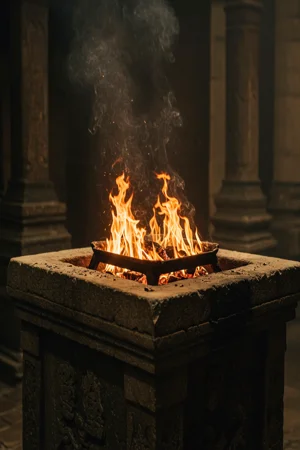
What secrets are revealed when we examine the enduring presence of fire in the sacred spaces of human civilization? "Temple Fires" delves into the profound and multifaceted role of fire within religious sanctuaries, sacrificial rituals, and divine offerings across diverse cultures and throughout history. This book explores how fire, beyond its practical applications, has served as a potent symbol of purification, transformation, communication with the divine, and the very essence of spiritual power. We begin by examining the fundamental significance of fire in ancient cosmologies and religious practices. This exploration necessitates understanding the historical and social contexts in which these beliefs arose. Understanding the origins of fire worship and its integration into early religious systems provides the necessary foundation for comprehending its persistent relevance across millennia. The book argues that fire, as a universal element, provided a tangible connection between the human and divine realms, shaping religious practices in ways that continue to resonate today. The book's structure unfolds in three major sections. The first section introduces the primal role of fire in early religious systems. It examines the archaeological evidence of hearths in ritual spaces and the ethnographic accounts of fire ceremonies in indigenous cultures. The second section focuses on specific cultural expressions of fire rituals, analyzing examples from ancient Greece, Rome, the Near East, and pre-Columbian Americas. The function of fire in these traditions, from cleansing rituals to the burning of offerings is thoroughly examined. This second section develops the central idea of fire as a medium of exchange between humanity and the divine. The third section explores the symbolic evolution of fire in major world religions, including Hinduism, Christianity, and Buddhism, tracing how early fire-based practices were adapted and reinterpreted within these evolving belief systems. The arguments presented are supported by a synthesis of archaeological findings, textual analysis of religious scriptures, and comparative studies of ritual practices. The book draws upon a wide range of sources, including ancient religious texts, anthropological studies, and historical accounts, to provide a comprehensive and evidence-based analysis. Our methodology involves critically examining the available data, identifying patterns, and drawing informed conclusions about the significance of fire in religious contexts. "Temple Fires" connects to several other fields of study. It intersects with anthropology through the study of ritual practices, archaeology through the analysis of material remains, and art history through the examination of depictions of fire in religious art. These interdisciplinary connections enrich the analysis and provide a more nuanced understanding of the subject matter. Our approach offers a fresh perspective on the study of religion by focusing specifically on the element of fire. This concentration allows for a deeper examination of its symbolic meanings and its role in shaping religious beliefs and practices. The book is written in a style that is both scholarly and accessible, aiming to engage a broad audience interested in religion, history, and cultural studies. The target audience includes students and scholars of religion, history, and anthropology, as well as general readers interested in exploring the cultural and symbolic significance of fire. This book would be valuable to those seeking a deeper understanding of the roots of religious practices and the enduring power of symbolism. The scope of "Temple Fires" is intentionally broad, encompassing a variety of cultures and historical periods. However, it acknowledges the limitations of covering every instance of fire worship and ritual in human history. Instead, it focuses on providing representative examples that illustrate the key themes and arguments. The information presented has practical applications for understanding contemporary religious practices and cultural traditions. By exploring the historical roots of fire rituals, readers can gain insights into the underlying symbolism and meanings that continue to inform these practices today. The book also addresses ongoing debates about the interpretation of religious symbols and rituals, offering a balanced and informed perspective. "Temple Fires" seeks to illuminate the enduring significance of fire as a sacred element in human civilization.
What secrets are revealed when we examine the enduring presence of fire in the sacred spaces of human civilization? "Temple Fires" delves into the profound and multifaceted role of fire within religious sanctuaries, sacrificial rituals, and divine offerings across diverse cultures and throughout history. This book explores how fire, beyond its practical applications, has served as a potent symbol of purification, transformation, communication with the divine, and the very essence of spiritual power. We begin by examining the fundamental significance of fire in ancient cosmologies and religious practices. This exploration necessitates understanding the historical and social contexts in which these beliefs arose. Understanding the origins of fire worship and its integration into early religious systems provides the necessary foundation for comprehending its persistent relevance across millennia. The book argues that fire, as a universal element, provided a tangible connection between the human and divine realms, shaping religious practices in ways that continue to resonate today. The book's structure unfolds in three major sections. The first section introduces the primal role of fire in early religious systems. It examines the archaeological evidence of hearths in ritual spaces and the ethnographic accounts of fire ceremonies in indigenous cultures. The second section focuses on specific cultural expressions of fire rituals, analyzing examples from ancient Greece, Rome, the Near East, and pre-Columbian Americas. The function of fire in these traditions, from cleansing rituals to the burning of offerings is thoroughly examined. This second section develops the central idea of fire as a medium of exchange between humanity and the divine. The third section explores the symbolic evolution of fire in major world religions, including Hinduism, Christianity, and Buddhism, tracing how early fire-based practices were adapted and reinterpreted within these evolving belief systems. The arguments presented are supported by a synthesis of archaeological findings, textual analysis of religious scriptures, and comparative studies of ritual practices. The book draws upon a wide range of sources, including ancient religious texts, anthropological studies, and historical accounts, to provide a comprehensive and evidence-based analysis. Our methodology involves critically examining the available data, identifying patterns, and drawing informed conclusions about the significance of fire in religious contexts. "Temple Fires" connects to several other fields of study. It intersects with anthropology through the study of ritual practices, archaeology through the analysis of material remains, and art history through the examination of depictions of fire in religious art. These interdisciplinary connections enrich the analysis and provide a more nuanced understanding of the subject matter. Our approach offers a fresh perspective on the study of religion by focusing specifically on the element of fire. This concentration allows for a deeper examination of its symbolic meanings and its role in shaping religious beliefs and practices. The book is written in a style that is both scholarly and accessible, aiming to engage a broad audience interested in religion, history, and cultural studies. The target audience includes students and scholars of religion, history, and anthropology, as well as general readers interested in exploring the cultural and symbolic significance of fire. This book would be valuable to those seeking a deeper understanding of the roots of religious practices and the enduring power of symbolism. The scope of "Temple Fires" is intentionally broad, encompassing a variety of cultures and historical periods. However, it acknowledges the limitations of covering every instance of fire worship and ritual in human history. Instead, it focuses on providing representative examples that illustrate the key themes and arguments. The information presented has practical applications for understanding contemporary religious practices and cultural traditions. By exploring the historical roots of fire rituals, readers can gain insights into the underlying symbolism and meanings that continue to inform these practices today. The book also addresses ongoing debates about the interpretation of religious symbols and rituals, offering a balanced and informed perspective. "Temple Fires" seeks to illuminate the enduring significance of fire as a sacred element in human civilization.
"Temple Fires" explores the central role of fire in religious practices across history and cultures. The book examines fire not just as a practical element, but as a potent symbol of purification, transformation, and communication with the divine. From ancient cosmologies to modern faiths, fire serves as a tangible connection between the human and spiritual realms, shaping rituals and beliefs in profound ways. Did you know that archaeological evidence reveals hearths in ritual spaces, indicating the primal role of fire in early religious systems? Or that many cultures, from ancient Greece to the pre-Columbian Americas, used fire in cleansing rituals and as a medium for offerings? The book unfolds in three key sections, beginning with the primal role of fire in early religious systems, then moving into specific cultural expressions of fire rituals in ancient civilizations. Finally, it explores the symbolic evolution of fire in major world religions such as Hinduism, Christianity, and Buddhism, tracing how early fire-based practices were adapted and reinterpreted. By synthesizing archaeological findings, religious texts, and anthropological studies, "Temple Fires" provides a fresh perspective on the study of religion and offers valuable insights into the enduring power of religious symbolism and ritual practices.
Book Details
ISBN
9788235223500
Publisher
Publifye AS
Your Licenses
You don't own any licenses for this book
Purchase a license below to unlock this book and download the EPUB.
Purchase License
Select a tier to unlock this book
Need bulk licensing?
Contact us for enterprise agreements.