
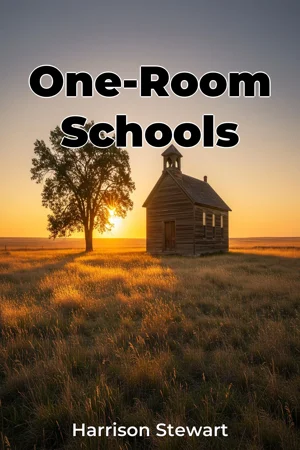
About This Book
Have you ever wondered how education was delivered in a time before sprawling school complexes and specialized classrooms? "One-Room Schools" delves into the captivating history of these unique institutions, exploring their vital role in shaping communities across America and beyond. This book examines not only the physical characteristics of these schools, but also the pedagogical approaches, the social dynamics, and the lasting impact they had on generations of students. This historical exploration is significant because it sheds light on a period when education was deeply intertwined with community life; the one-room schoolhouse served as a center for social gatherings, political discussions, and civic engagement. Understanding this history allows us to appreciate the evolution of educational practices and to consider the potential benefits of smaller, more community-focused learning environments. Furthermore, the resourcefulness and dedication of the teachers who managed these diverse classrooms provide valuable insights into effective teaching strategies. "One-Room Schools" offers a comprehensive overview, beginning with the origins and proliferation of these schools, driven by westward expansion and a growing commitment to universal education. It examines the architecture and resources of a typical one-room school, detailing the challenges and innovations inherent in teaching students of varying ages and abilities simultaneously. The book then explores the daily routines, curriculum, and teaching methods employed by educators, highlighting the emphasis on fundamental skills and character development. Subsequent sections delve into the social and cultural aspects of one-room school life, examining its role in fostering community bonds and shaping local identities. Finally, the book analyzes the decline of the one-room school in the face of urbanization and educational reforms, assessing its legacy and its potential relevance to contemporary educational debates. The central argument of "One-Room Schools" is that these institutions, despite their simplicity and limitations, played a crucial role in democratizing education and fostering a strong sense of community. By providing access to learning in even the most remote areas, one-room schools empowered individuals and contributed to the social and economic development of the nation; their legacy continues to inform discussions about educational equity, personalized learning, and the importance of community involvement in schools. The book draws upon a variety of primary and secondary sources, including historical documents, photographs, personal accounts, and educational research. It incorporates data from school district archives, census records, and oral histories to provide a comprehensive and nuanced understanding of the one-room school experience. The methodology involves a combination of historical analysis, comparative studies, and qualitative research to examine the various facets of these schools. "One-Room Schools" connects to other fields such as sociology (exploring community dynamics), architecture (analyzing schoolhouse design), and educational psychology (understanding teaching methods). These interdisciplinary connections enhance the book's argument by providing a broader context for understanding the significance of one-room schools. This book distinguishes itself by offering a holistic perspective on the one-room school phenomenon, examining not only the educational aspects but also the social, cultural, and economic dimensions. The book is written in an accessible and engaging style, making it suitable for a wide audience including educators, historians, students, and anyone interested in the history of education and community development; this approach aligns with the conventions of the "History, Textbook" genres. The scope focuses primarily on the United States but also includes examples from other countries to offer a broader perspective. The information in "One-Room Schools" has practical applications for contemporary educators and policymakers who are seeking to create more personalized, community-based learning environments. It offers insights into effective teaching strategies, curriculum design, and community engagement that can be applied in modern schools. While the book acknowledges the limitations of the one-room school model in today's complex world, it also highlights the enduring value of its core principles.
Have you ever wondered how education was delivered in a time before sprawling school complexes and specialized classrooms? "One-Room Schools" delves into the captivating history of these unique institutions, exploring their vital role in shaping communities across America and beyond. This book examines not only the physical characteristics of these schools, but also the pedagogical approaches, the social dynamics, and the lasting impact they had on generations of students. This historical exploration is significant because it sheds light on a period when education was deeply intertwined with community life; the one-room schoolhouse served as a center for social gatherings, political discussions, and civic engagement. Understanding this history allows us to appreciate the evolution of educational practices and to consider the potential benefits of smaller, more community-focused learning environments. Furthermore, the resourcefulness and dedication of the teachers who managed these diverse classrooms provide valuable insights into effective teaching strategies. "One-Room Schools" offers a comprehensive overview, beginning with the origins and proliferation of these schools, driven by westward expansion and a growing commitment to universal education. It examines the architecture and resources of a typical one-room school, detailing the challenges and innovations inherent in teaching students of varying ages and abilities simultaneously. The book then explores the daily routines, curriculum, and teaching methods employed by educators, highlighting the emphasis on fundamental skills and character development. Subsequent sections delve into the social and cultural aspects of one-room school life, examining its role in fostering community bonds and shaping local identities. Finally, the book analyzes the decline of the one-room school in the face of urbanization and educational reforms, assessing its legacy and its potential relevance to contemporary educational debates. The central argument of "One-Room Schools" is that these institutions, despite their simplicity and limitations, played a crucial role in democratizing education and fostering a strong sense of community. By providing access to learning in even the most remote areas, one-room schools empowered individuals and contributed to the social and economic development of the nation; their legacy continues to inform discussions about educational equity, personalized learning, and the importance of community involvement in schools. The book draws upon a variety of primary and secondary sources, including historical documents, photographs, personal accounts, and educational research. It incorporates data from school district archives, census records, and oral histories to provide a comprehensive and nuanced understanding of the one-room school experience. The methodology involves a combination of historical analysis, comparative studies, and qualitative research to examine the various facets of these schools. "One-Room Schools" connects to other fields such as sociology (exploring community dynamics), architecture (analyzing schoolhouse design), and educational psychology (understanding teaching methods). These interdisciplinary connections enhance the book's argument by providing a broader context for understanding the significance of one-room schools. This book distinguishes itself by offering a holistic perspective on the one-room school phenomenon, examining not only the educational aspects but also the social, cultural, and economic dimensions. The book is written in an accessible and engaging style, making it suitable for a wide audience including educators, historians, students, and anyone interested in the history of education and community development; this approach aligns with the conventions of the "History, Textbook" genres. The scope focuses primarily on the United States but also includes examples from other countries to offer a broader perspective. The information in "One-Room Schools" has practical applications for contemporary educators and policymakers who are seeking to create more personalized, community-based learning environments. It offers insights into effective teaching strategies, curriculum design, and community engagement that can be applied in modern schools. While the book acknowledges the limitations of the one-room school model in today's complex world, it also highlights the enduring value of its core principles.
"One-Room Schools" explores the fascinating history of education in these compact, community-centered institutions. Delving into American education's past, the book reveals how these schoolhouses served not only as places of learning but also as vital hubs for social gatherings and civic engagement. The resourcefulness of teachers managing diverse age groups and the emphasis on fundamental skills highlight the unique characteristics of rural education during this era. The book traces the evolution of these schools from their origins amidst westward expansion to their decline with urbanization. Examining the curriculum, teaching methods, and daily routines, it uncovers the profound impact these schools had on fostering community bonds and shaping local identities. "One-Room Schools" uses historical documents and personal accounts to offer a comprehensive view, making it a valuable resource for anyone interested in the history of education, educational reform, or the enduring power of community schools.
Book Details
ISBN
9788235219985
Publisher
Publifye AS
Your Licenses
You don't own any licenses for this book
Purchase a license below to unlock this book and download the EPUB.
Purchase License
Select a tier to unlock this book
Need bulk licensing?
Contact us for enterprise agreements.