
About This Book
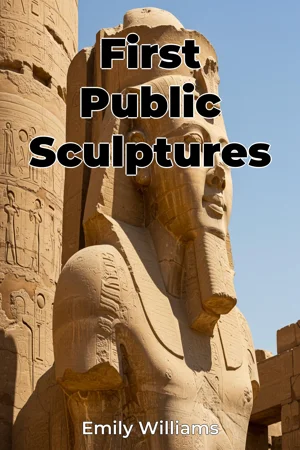
How did societies first use monumental art to shape public consciousness and civic identity? "First Public Sculptures" explores the genesis of public sculpture, examining its pivotal role in inspiring populations, educating citizens, and commemorating significant events across diverse cultures and historical periods. This investigation is vital because understanding the origins and evolution of public art provides critical insights into the values, ideologies, and power structures that have shaped human societies. This book contends that the earliest forms of public sculpture were not merely decorative embellishments but powerful tools used by rulers, religious institutions, and emerging civic bodies to communicate specific messages and reinforce social cohesion. We will delve into the socio-political landscapes that fostered the creation and proliferation of these sculptures, analyzing their impact on public perception and collective memory. Our journey begins with an examination of pre-classical civilizations, focusing on monumental works in ancient Egypt and Mesopotamia. We’ll analyze how colossal statues of pharaohs and depictions of deities served as potent symbols of divine authority and imperial power. Next, we turn to early Greek and Roman societies, where the development of civic spaces led to the creation of sculptures celebrating military victories, honoring prominent citizens, and embodying abstract concepts of justice and civic virtue. The book traces the evolution of sculptural techniques and artistic styles, illustrating how these developments influenced the expressive potential of public art. The core chapters will focus on three key areas: the use of sculpture to propagate political ideologies, its function as a medium for public education, and its role in shaping collective memory through commemoration. Each section will analyze specific case studies, drawing on archaeological evidence, historical texts, and art-historical analysis to support its claims. The arguments presented in "First Public Sculptures" are grounded in a multidisciplinary approach, integrating art history, archaeology, political science, and sociology. We will analyze primary source materials, including inscriptions, architectural plans, and contemporary accounts, alongside existing scholarship in these fields. The book will explore the interdisciplinary connections between art, history, and political science, illustrating how public sculptures reflect and influence social dynamics. "First Public Sculptures" provides a novel examination of the topic by focusing on the *earliest* examples of public sculpture and their immediate societal impact. This approach distinguishes the book from broader surveys of public art, offering a focused analysis of the foundational principles that have governed its use throughout history. Written in a clear and accessible style, "First Public Sculptures" is targeted toward students and scholars of art history, archaeology, and history, as well as general readers interested in the intersection of art and society. This book offers a comprehensive overview of the topic, suitable for academic study while remaining engaging for a broader audience. The book avoids delving deeply into the theoretical nuances of art criticism allowing it to remain accessible and fact-based. While the book offers a global perspective, it concentrates primarily on Western and Near Eastern examples due to the availability of research and historical documentation. Future research could expand this scope to include earlier examples from other regions not covered in this work. The insights from this book have practical applications for contemporary discussions surrounding public art, monument preservation, and the politics of memory. Understanding how past societies utilized sculpture can inform contemporary debates about the role of public art in shaping public discourse and promoting civic engagement. The book also addresses ongoing controversies surrounding the removal or recontextualization of historical monuments, providing a historical framework for these debates.
How did societies first use monumental art to shape public consciousness and civic identity? "First Public Sculptures" explores the genesis of public sculpture, examining its pivotal role in inspiring populations, educating citizens, and commemorating significant events across diverse cultures and historical periods. This investigation is vital because understanding the origins and evolution of public art provides critical insights into the values, ideologies, and power structures that have shaped human societies. This book contends that the earliest forms of public sculpture were not merely decorative embellishments but powerful tools used by rulers, religious institutions, and emerging civic bodies to communicate specific messages and reinforce social cohesion. We will delve into the socio-political landscapes that fostered the creation and proliferation of these sculptures, analyzing their impact on public perception and collective memory. Our journey begins with an examination of pre-classical civilizations, focusing on monumental works in ancient Egypt and Mesopotamia. We’ll analyze how colossal statues of pharaohs and depictions of deities served as potent symbols of divine authority and imperial power. Next, we turn to early Greek and Roman societies, where the development of civic spaces led to the creation of sculptures celebrating military victories, honoring prominent citizens, and embodying abstract concepts of justice and civic virtue. The book traces the evolution of sculptural techniques and artistic styles, illustrating how these developments influenced the expressive potential of public art. The core chapters will focus on three key areas: the use of sculpture to propagate political ideologies, its function as a medium for public education, and its role in shaping collective memory through commemoration. Each section will analyze specific case studies, drawing on archaeological evidence, historical texts, and art-historical analysis to support its claims. The arguments presented in "First Public Sculptures" are grounded in a multidisciplinary approach, integrating art history, archaeology, political science, and sociology. We will analyze primary source materials, including inscriptions, architectural plans, and contemporary accounts, alongside existing scholarship in these fields. The book will explore the interdisciplinary connections between art, history, and political science, illustrating how public sculptures reflect and influence social dynamics. "First Public Sculptures" provides a novel examination of the topic by focusing on the *earliest* examples of public sculpture and their immediate societal impact. This approach distinguishes the book from broader surveys of public art, offering a focused analysis of the foundational principles that have governed its use throughout history. Written in a clear and accessible style, "First Public Sculptures" is targeted toward students and scholars of art history, archaeology, and history, as well as general readers interested in the intersection of art and society. This book offers a comprehensive overview of the topic, suitable for academic study while remaining engaging for a broader audience. The book avoids delving deeply into the theoretical nuances of art criticism allowing it to remain accessible and fact-based. While the book offers a global perspective, it concentrates primarily on Western and Near Eastern examples due to the availability of research and historical documentation. Future research could expand this scope to include earlier examples from other regions not covered in this work. The insights from this book have practical applications for contemporary discussions surrounding public art, monument preservation, and the politics of memory. Understanding how past societies utilized sculpture can inform contemporary debates about the role of public art in shaping public discourse and promoting civic engagement. The book also addresses ongoing controversies surrounding the removal or recontextualization of historical monuments, providing a historical framework for these debates.
"First Public Sculptures" delves into the origins of monumental art, revealing how ancient societies leveraged these creations to mold public consciousness and establish civic identity. Exploring cultures from ancient Egypt and Mesopotamia to Greece and Rome, the book highlights how these sculptures served as potent symbols of power and cohesion. For instance, colossal statues of pharaohs weren't mere decorations, but declarations of divine authority. Similarly, the Greeks and Romans used sculpture in civic spaces to celebrate victories and honor citizens, thereby embodying ideals of justice. The book traces the evolution of public sculpture, focusing on its use to propagate political ideologies, educate the public, and shape collective memory. It examines specific cases with archaeological evidence, historical texts, and art-historical analysis. This approach distinguishes the book from broader surveys by focusing on the earliest examples and their immediate impact. The arguments in "First Public Sculptures" emerge from a multidisciplinary approach, integrating art history, archaeology, political science, and sociology. By analyzing primary source materials and existing scholarship, the book illustrates how these sculptures reflect and influence social dynamics. The book progresses by first examining pre-classical civilizations, then moving onto the early Greek and Roman societies, and finally focusing on political ideologies, public education, and collective memory.
Book Details
ISBN
9788235219435
Publisher
Publifye AS
Your Licenses
You don't own any licenses for this book
Purchase a license below to unlock this book and download the EPUB.
Purchase License
Select a tier to unlock this book
Need bulk licensing?
Contact us for enterprise agreements.