
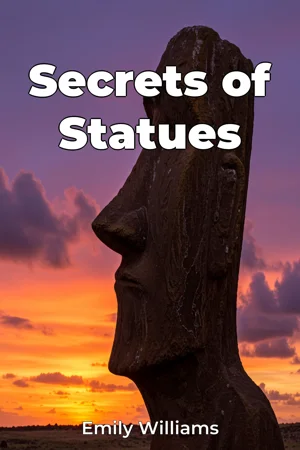
About This Book
Do you ever look at a statue and wonder what story it truly tells? "Secrets of Statues" unveils the intricate layers of meaning embedded within some of the world's most renowned sculptures, exploring not only their aesthetic beauty but also the historical, cultural, and symbolic narratives they embody. This book delves into the hidden language of statues, examining how these silent figures communicate powerful messages about the societies that created them. Statues stand as testaments to history, art, and cultural identity. Understanding their symbolism allows us to interpret the values, beliefs, and power dynamics of past civilizations. Furthermore, exploring the history of statues provides insight into the evolution of artistic techniques and the changing social landscapes that influenced their creation. We begin by establishing a framework for understanding statue symbolism, providing the necessary historical and artistic context to appreciate the nuances of each piece. No prior specialized knowledge is needed, as we provide clear and accessible explanations of art historical terms. The central argument of "Secrets of Statues" is that statues are not merely decorative objects; they serve as deliberate and complex forms of communication, reflecting and reinforcing societal values, political ideologies, and spiritual beliefs. By meticulously examining the symbolism, context, and historical significance of these works, we can unlock a deeper understanding of human history and culture. The book is structured to guide the reader through a comprehensive exploration of statue symbolism. First, foundational material covers the basic elements of statuary, including materials, techniques, and artistic styles, clarifying how these elements contribute to a statue’s overall meaning. Second, we devote individual chapters to detailed analyses of selected iconic statues from various cultures and historical periods. These case studies will explore the symbolism, historical context, and cultural impact of works such as the Statue of Liberty, Michelangelo’s David, the Terracotta Army, and the Moai of Easter Island, among others. Third, we examine the ways in which statues have been used to communicate political power, religious authority, and cultural identity. We use examples of statues erected by specific leaders, the role statues play in shaping national narratives, and the impact of iconoclasm (the destruction of statues) on collective memory. Finally, we explore the ongoing debates surrounding the preservation, interpretation, and removal of statues in the modern era. This section will address issues of cultural appropriation, historical revisionism, and the role of statues in shaping public spaces. The interpretations presented are supported by a range of evidence, including art historical scholarship, primary source documents, archaeological findings, and cultural studies analyses. Further support comes from comparative analyses of statues from different cultures and time periods, highlighting both common themes and unique cultural expressions. "Secrets of Statues" draws connections between art history, anthropology, political science, and religious studies. By examining statues through an interdisciplinary lens, the book offers a more holistic understanding of their significance as cultural artifacts. The book stands out by providing a deep dive into the specific symbolism and historical context of individual statues, rather than offering a superficial overview. It synthesizes diverse research to offer a fresh perspective on their role in shaping human history and culture. The writing style is accessible and engaging, designed to appeal to a broad audience. The tone is informative and analytical, avoiding jargon and complex theoretical frameworks. The book is aimed at anyone with an interest in art, history, and cultural studies. It will appeal to students, educators, travelers, and anyone curious about the hidden meanings behind the objects we see around us. As a work of non-fiction, "Secrets of Statues" adheres to rigorous standards of accuracy and objectivity. All claims are supported by credible evidence and sources, and different perspectives are acknowledged. While the book covers a wide range of statues from different cultures and historical periods, it does not aim to be an exhaustive encyclopedia. Instead, it focuses on a selection of iconic works that exemplify the key themes and concepts discussed. The knowledge gained from "Secrets of Statues" can be applied in a variety of real-world contexts. It can enhance the experience of visiting museums and historical sites, deepen appreciation for art and culture, and provide a critical framework for understanding the ways in which symbols and images shape our perceptions of the world. The book addresses controversies regarding the removal of Confederate monuments in the United States and the repatriation of cultural artifacts to their countries of origin. It explores the ethical and political dimensions of these debates, offering different perspectives on the role of statues in public spaces.
Do you ever look at a statue and wonder what story it truly tells? "Secrets of Statues" unveils the intricate layers of meaning embedded within some of the world's most renowned sculptures, exploring not only their aesthetic beauty but also the historical, cultural, and symbolic narratives they embody. This book delves into the hidden language of statues, examining how these silent figures communicate powerful messages about the societies that created them. Statues stand as testaments to history, art, and cultural identity. Understanding their symbolism allows us to interpret the values, beliefs, and power dynamics of past civilizations. Furthermore, exploring the history of statues provides insight into the evolution of artistic techniques and the changing social landscapes that influenced their creation. We begin by establishing a framework for understanding statue symbolism, providing the necessary historical and artistic context to appreciate the nuances of each piece. No prior specialized knowledge is needed, as we provide clear and accessible explanations of art historical terms. The central argument of "Secrets of Statues" is that statues are not merely decorative objects; they serve as deliberate and complex forms of communication, reflecting and reinforcing societal values, political ideologies, and spiritual beliefs. By meticulously examining the symbolism, context, and historical significance of these works, we can unlock a deeper understanding of human history and culture. The book is structured to guide the reader through a comprehensive exploration of statue symbolism. First, foundational material covers the basic elements of statuary, including materials, techniques, and artistic styles, clarifying how these elements contribute to a statue’s overall meaning. Second, we devote individual chapters to detailed analyses of selected iconic statues from various cultures and historical periods. These case studies will explore the symbolism, historical context, and cultural impact of works such as the Statue of Liberty, Michelangelo’s David, the Terracotta Army, and the Moai of Easter Island, among others. Third, we examine the ways in which statues have been used to communicate political power, religious authority, and cultural identity. We use examples of statues erected by specific leaders, the role statues play in shaping national narratives, and the impact of iconoclasm (the destruction of statues) on collective memory. Finally, we explore the ongoing debates surrounding the preservation, interpretation, and removal of statues in the modern era. This section will address issues of cultural appropriation, historical revisionism, and the role of statues in shaping public spaces. The interpretations presented are supported by a range of evidence, including art historical scholarship, primary source documents, archaeological findings, and cultural studies analyses. Further support comes from comparative analyses of statues from different cultures and time periods, highlighting both common themes and unique cultural expressions. "Secrets of Statues" draws connections between art history, anthropology, political science, and religious studies. By examining statues through an interdisciplinary lens, the book offers a more holistic understanding of their significance as cultural artifacts. The book stands out by providing a deep dive into the specific symbolism and historical context of individual statues, rather than offering a superficial overview. It synthesizes diverse research to offer a fresh perspective on their role in shaping human history and culture. The writing style is accessible and engaging, designed to appeal to a broad audience. The tone is informative and analytical, avoiding jargon and complex theoretical frameworks. The book is aimed at anyone with an interest in art, history, and cultural studies. It will appeal to students, educators, travelers, and anyone curious about the hidden meanings behind the objects we see around us. As a work of non-fiction, "Secrets of Statues" adheres to rigorous standards of accuracy and objectivity. All claims are supported by credible evidence and sources, and different perspectives are acknowledged. While the book covers a wide range of statues from different cultures and historical periods, it does not aim to be an exhaustive encyclopedia. Instead, it focuses on a selection of iconic works that exemplify the key themes and concepts discussed. The knowledge gained from "Secrets of Statues" can be applied in a variety of real-world contexts. It can enhance the experience of visiting museums and historical sites, deepen appreciation for art and culture, and provide a critical framework for understanding the ways in which symbols and images shape our perceptions of the world. The book addresses controversies regarding the removal of Confederate monuments in the United States and the repatriation of cultural artifacts to their countries of origin. It explores the ethical and political dimensions of these debates, offering different perspectives on the role of statues in public spaces.
"Secrets of Statues" explores the hidden stories behind the world's most famous sculptures, revealing their significance as more than just decorative art. This exploration into art history and cultural history examines how statues serve as powerful communication tools, reflecting and reinforcing societal values, political ideologies, and spiritual beliefs. For example, statues have been used to communicate political power, religious authority, and cultural identity for centuries. Understanding statue symbolism provides insight into the values, beliefs, and power dynamics of past civilizations. The book progresses from foundational material covering artistic styles and techniques, to detailed analyses of iconic statues like the Statue of Liberty and the Terracotta Army. It then examines how statues have been used to communicate political power and religious authority, before exploring modern debates surrounding their preservation and interpretation. By drawing connections between art history, anthropology, and political science, "Secrets of Statues" offers a holistic understanding of these cultural artifacts.
Book Details
ISBN
9788235219282
Publisher
Publifye AS
Your Licenses
You don't own any licenses for this book
Purchase a license below to unlock this book and download the EPUB.
Purchase License
Select a tier to unlock this book
Need bulk licensing?
Contact us for enterprise agreements.