
About This Book
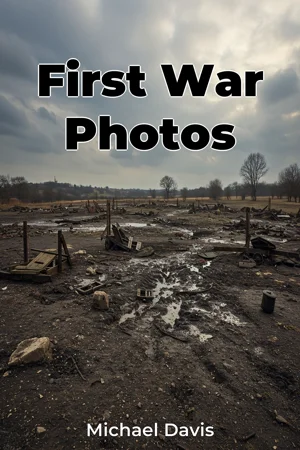
How did humanity first attempt to visually document the brutal realities of warfare, and what impact did these nascent images have on public perception and the course of history? "First War Photos" delves into the earliest endeavors to capture battle scenes through the lens of photography, exploring their profound historical impact and lasting legacy. This book examines the technical challenges, artistic considerations, and ethical dilemmas faced by pioneering photographers who dared to bring the battlefield to the home front. The book will primarily focus on two key areas: the evolution of photographic technology in the context of warfare and the socio-political consequences of disseminating these images to a wider audience. These elements are important because they reveal the complex interplay between technological advancement, artistic intent, and public opinion. To understand the significance of these first war photos, some background in the development of early photographic processes and the nature of 19th-century warfare is necessary. The book will provide this context, explaining the limitations of daguerreotypes and wet plate collodion processes and contrasting them with the rapid technological advancements that would follow. "First War Photos" argues that these initial attempts at war photography, despite their technical limitations and staged nature, fundamentally altered the relationship between the public and armed conflict. They served as a crucial step in shaping modern war reporting and influencing public discourse on military matters. The book’s structure is designed to create a coherent narrative exploring the subject with an approach that is historical and factual. The "Introduction" lays the groundwork by discussing the state of photography before its application to war, highlighting the key technological innovations and artistic trends that made war photography possible. The main body of the book is divided into chapters focusing on specific conflicts and photographic pioneers. One point will be on the Crimean War (1853-1856) and the work of Roger Fenton, examining the challenges he faced in documenting the conflict and the impact his images had on British public opinion. Another focuses on the American Civil War (1861-1865), analyzing the work of Mathew Brady and his team and their efforts to capture the scale and devastation of the war. These sections will explore the transition from staged scenes to more candid depictions of battlefield life and death. The "Conclusion" synthesizes the findings, assessing the long-term impact of these early war photos on journalism, art, and military history, and then considering the ethical implications of war photography, then and now. Real-world implications include a better understanding of propaganda, censorship and media bias. The arguments presented are supported by a meticulous examination of primary source materials, including original photographs, letters, diaries, and contemporary newspaper articles, and the book uses photographic analysis and historical contextualization. Specific attention is given to restoring and analyzing degraded or damaged prints utilizing modern digital techniques. This book establishes interdisciplinary connections by drawing on insights from media studies, art history, and military sociology. These connections enhance the book's argument by illuminating the broader cultural and social contexts within which these photographs were created and consumed. What distinguishes this book is its comprehensive approach to analyzing the earliest war photos, combining technical analysis of photographic processes with insightful commentary on the socio-political impact of these images. "First War Photos" adopts a tone that is academically rigorous yet accessible to a broad readership. The writing style is clear, concise, and engaging. The target audience includes photography enthusiasts, military history buffs, students of journalism and media studies, and anyone interested in the intersection of technology, art, and history. The book offers value to this readership by providing a fresh perspective on a pivotal moment in the history of visual communication and its effects on the perception of armed conflict. The scope of this book is limited to the earliest phases of war photography, primarily focusing on the mid-19th century. It does not delve into the technological advancements and ethical debates of modern war photography. This book avoids sensationalism and focuses on providing a balanced and nuanced account of these early attempts to capture the reality of war through photography.
How did humanity first attempt to visually document the brutal realities of warfare, and what impact did these nascent images have on public perception and the course of history? "First War Photos" delves into the earliest endeavors to capture battle scenes through the lens of photography, exploring their profound historical impact and lasting legacy. This book examines the technical challenges, artistic considerations, and ethical dilemmas faced by pioneering photographers who dared to bring the battlefield to the home front. The book will primarily focus on two key areas: the evolution of photographic technology in the context of warfare and the socio-political consequences of disseminating these images to a wider audience. These elements are important because they reveal the complex interplay between technological advancement, artistic intent, and public opinion. To understand the significance of these first war photos, some background in the development of early photographic processes and the nature of 19th-century warfare is necessary. The book will provide this context, explaining the limitations of daguerreotypes and wet plate collodion processes and contrasting them with the rapid technological advancements that would follow. "First War Photos" argues that these initial attempts at war photography, despite their technical limitations and staged nature, fundamentally altered the relationship between the public and armed conflict. They served as a crucial step in shaping modern war reporting and influencing public discourse on military matters. The book’s structure is designed to create a coherent narrative exploring the subject with an approach that is historical and factual. The "Introduction" lays the groundwork by discussing the state of photography before its application to war, highlighting the key technological innovations and artistic trends that made war photography possible. The main body of the book is divided into chapters focusing on specific conflicts and photographic pioneers. One point will be on the Crimean War (1853-1856) and the work of Roger Fenton, examining the challenges he faced in documenting the conflict and the impact his images had on British public opinion. Another focuses on the American Civil War (1861-1865), analyzing the work of Mathew Brady and his team and their efforts to capture the scale and devastation of the war. These sections will explore the transition from staged scenes to more candid depictions of battlefield life and death. The "Conclusion" synthesizes the findings, assessing the long-term impact of these early war photos on journalism, art, and military history, and then considering the ethical implications of war photography, then and now. Real-world implications include a better understanding of propaganda, censorship and media bias. The arguments presented are supported by a meticulous examination of primary source materials, including original photographs, letters, diaries, and contemporary newspaper articles, and the book uses photographic analysis and historical contextualization. Specific attention is given to restoring and analyzing degraded or damaged prints utilizing modern digital techniques. This book establishes interdisciplinary connections by drawing on insights from media studies, art history, and military sociology. These connections enhance the book's argument by illuminating the broader cultural and social contexts within which these photographs were created and consumed. What distinguishes this book is its comprehensive approach to analyzing the earliest war photos, combining technical analysis of photographic processes with insightful commentary on the socio-political impact of these images. "First War Photos" adopts a tone that is academically rigorous yet accessible to a broad readership. The writing style is clear, concise, and engaging. The target audience includes photography enthusiasts, military history buffs, students of journalism and media studies, and anyone interested in the intersection of technology, art, and history. The book offers value to this readership by providing a fresh perspective on a pivotal moment in the history of visual communication and its effects on the perception of armed conflict. The scope of this book is limited to the earliest phases of war photography, primarily focusing on the mid-19th century. It does not delve into the technological advancements and ethical debates of modern war photography. This book avoids sensationalism and focuses on providing a balanced and nuanced account of these early attempts to capture the reality of war through photography.
"First War Photos" explores the dawn of war photography, examining how early photographic technology captured 19th-century warfare and shaped public perception. It delves into the challenges faced by pioneers like Roger Fenton during the Crimean War and Mathew Brady during the American Civil War, revealing how their images, despite technical limitations, brought the battlefield to the home front. These first war photos, though sometimes staged, marked a significant shift in war reporting. The book investigates the evolution of photographic processes, from daguerreotypes to wet plate collodion, and their impact on documenting military history. It highlights how these images altered the relationship between the public and armed conflict. Through meticulous examination of primary sources and photographic analysis, the book progresses from an introduction covering photography's pre-war state to chapters focusing on specific conflicts and photographers, culminating in a conclusion assessing the long-term impact and ethical implications of early war photography.
Book Details
ISBN
9788235218735
Publisher
Publifye AS
Your Licenses
You don't own any licenses for this book
Purchase a license below to unlock this book and download the EPUB.
Purchase License
Select a tier to unlock this book
Need bulk licensing?
Contact us for enterprise agreements.