
About This Book
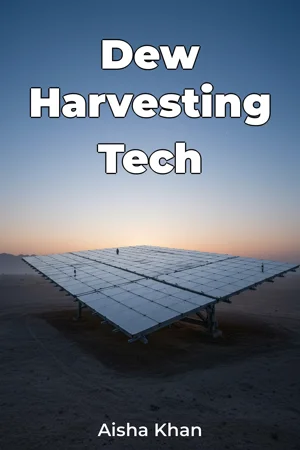
In arid regions where water scarcity poses a significant threat, could the answer to hydration lie in the air itself? "Dew Harvesting Tech" explores innovative methods of extracting atmospheric moisture, specifically dew, to provide a sustainable water source for communities facing drought and water shortages. This book examines the intersection of environmental science and technological innovation to offer practical solutions for addressing water scarcity. This book focuses on three key topics: the science of dew formation, the engineering of dew-collecting devices, and the socio-environmental impact of dew harvesting. The science of dew formation is crucial to understanding the atmospheric conditions required for optimal dew yields. Engineering efficient and cost-effective dew-collecting devices is the next critical step, balancing materials science, thermodynamics, and design principles. Finally, examining the socio-environmental impact assesses the sustainability and scalability of these technologies in diverse arid environments and their potential effect on local ecosystems and communities. The importance of these topics stems from the growing urgency to find sustainable, localized water sources in the face of climate change and increasing global water demand. Dew harvesting is not a new concept. Throughout history, various cultures have employed rudimentary methods to collect dew for drinking and irrigation. Modern approaches leverage advances in materials science, such as specialized hydrophobic and radiative cooling surfaces, and sophisticated meteorological understanding to maximize yields and minimize environmental impact. A basic understanding of atmospheric thermodynamics and heat transfer principles will be helpful for the reader, but complex equations are minimized in favor of conceptual understanding. The central argument of "Dew Harvesting Tech" is that with appropriate technological development and implementation, dew harvesting can contribute substantially to water security in arid regions, providing a decentralized, environmentally sound alternative to traditional water sources that are often energy-intensive or ecologically damaging. The book emphasizes that dew harvesting should be seen as part of an integrated water management strategy rather than a standalone solution. The book's structure begins with an introduction to the science of dew formation, explaining the meteorological processes that lead to dew deposition. It then explores various dew-collecting technologies, ranging from passive condensers to active systems using thermoelectric cooling. Through case studies, the book investigates the implementation of dew harvesting systems in different arid environments, assessing their effectiveness, cost-effectiveness, and social acceptance. The book culminates with a discussion of the future of dew harvesting, identifying research priorities and policy recommendations for maximizing its potential as a sustainable water source. The evidence presented in this book includes data from field studies, laboratory experiments, and computer simulations. It analyzes the performance of different dew-collecting surfaces under varying climatic conditions. Unique data sources include long-term monitoring of dew yields at several pilot sites and life cycle assessments of dew harvesting systems to quantify their environmental footprint. "Dew Harvesting Tech" engages with several interdisciplinary fields. Environmental science provides the context for understanding water scarcity and the environmental impacts of traditional water sources. Materials science informs the development of efficient dew-collecting surfaces. Engineering principles guide the design and optimization of dew-harvesting systems. These interdisciplinary connections strengthen the book's argument by providing a holistic perspective on the challenges and opportunities of dew harvesting. This book takes a practical engineering perspective, focusing on the design, optimization, and implementation of dew-harvesting systems. It moves beyond theoretical discussions and provides actionable insights for researchers, policymakers, and practitioners. The target audience for "Dew Harvesting Tech" includes environmental scientists, engineers, policymakers, water resource managers, entrepreneurs, and anyone interested in sustainable water solutions. It is valuable to those seeking innovative approaches to address water scarcity in arid environments. The book is written in a professional yet accessible style, making it suitable for both academic and non-academic readers. In line with the conventions of environmental technology literature, the book presents factual information, empirical data, and practical recommendations, as well as considering environmental ethics. The scope of the book is limited to dew harvesting technologies for arid and semi-arid environments. While it acknowledges other atmospheric water harvesting methods, such as fog collection, its primary focus remains on dew. The information in this book can be applied practically by engineers designing dew-harvesting systems, policymakers developing water management strategies, and communities seeking sustainable water sources. It offers guidance on selecting appropriate technologies, optimizing system performance, and evaluating the environmental impact of dew harvesting. While the potential of dew harvesting is generally recognized, there are ongoing debates about its cost-effectiveness and scalability compared to other water sources. "Dew Harvesting Tech" addresses these controversies by presenting a balanced assessment of the advantages and limitations of dew harvesting, informed by empirical data and case studies.
In arid regions where water scarcity poses a significant threat, could the answer to hydration lie in the air itself? "Dew Harvesting Tech" explores innovative methods of extracting atmospheric moisture, specifically dew, to provide a sustainable water source for communities facing drought and water shortages. This book examines the intersection of environmental science and technological innovation to offer practical solutions for addressing water scarcity. This book focuses on three key topics: the science of dew formation, the engineering of dew-collecting devices, and the socio-environmental impact of dew harvesting. The science of dew formation is crucial to understanding the atmospheric conditions required for optimal dew yields. Engineering efficient and cost-effective dew-collecting devices is the next critical step, balancing materials science, thermodynamics, and design principles. Finally, examining the socio-environmental impact assesses the sustainability and scalability of these technologies in diverse arid environments and their potential effect on local ecosystems and communities. The importance of these topics stems from the growing urgency to find sustainable, localized water sources in the face of climate change and increasing global water demand. Dew harvesting is not a new concept. Throughout history, various cultures have employed rudimentary methods to collect dew for drinking and irrigation. Modern approaches leverage advances in materials science, such as specialized hydrophobic and radiative cooling surfaces, and sophisticated meteorological understanding to maximize yields and minimize environmental impact. A basic understanding of atmospheric thermodynamics and heat transfer principles will be helpful for the reader, but complex equations are minimized in favor of conceptual understanding. The central argument of "Dew Harvesting Tech" is that with appropriate technological development and implementation, dew harvesting can contribute substantially to water security in arid regions, providing a decentralized, environmentally sound alternative to traditional water sources that are often energy-intensive or ecologically damaging. The book emphasizes that dew harvesting should be seen as part of an integrated water management strategy rather than a standalone solution. The book's structure begins with an introduction to the science of dew formation, explaining the meteorological processes that lead to dew deposition. It then explores various dew-collecting technologies, ranging from passive condensers to active systems using thermoelectric cooling. Through case studies, the book investigates the implementation of dew harvesting systems in different arid environments, assessing their effectiveness, cost-effectiveness, and social acceptance. The book culminates with a discussion of the future of dew harvesting, identifying research priorities and policy recommendations for maximizing its potential as a sustainable water source. The evidence presented in this book includes data from field studies, laboratory experiments, and computer simulations. It analyzes the performance of different dew-collecting surfaces under varying climatic conditions. Unique data sources include long-term monitoring of dew yields at several pilot sites and life cycle assessments of dew harvesting systems to quantify their environmental footprint. "Dew Harvesting Tech" engages with several interdisciplinary fields. Environmental science provides the context for understanding water scarcity and the environmental impacts of traditional water sources. Materials science informs the development of efficient dew-collecting surfaces. Engineering principles guide the design and optimization of dew-harvesting systems. These interdisciplinary connections strengthen the book's argument by providing a holistic perspective on the challenges and opportunities of dew harvesting. This book takes a practical engineering perspective, focusing on the design, optimization, and implementation of dew-harvesting systems. It moves beyond theoretical discussions and provides actionable insights for researchers, policymakers, and practitioners. The target audience for "Dew Harvesting Tech" includes environmental scientists, engineers, policymakers, water resource managers, entrepreneurs, and anyone interested in sustainable water solutions. It is valuable to those seeking innovative approaches to address water scarcity in arid environments. The book is written in a professional yet accessible style, making it suitable for both academic and non-academic readers. In line with the conventions of environmental technology literature, the book presents factual information, empirical data, and practical recommendations, as well as considering environmental ethics. The scope of the book is limited to dew harvesting technologies for arid and semi-arid environments. While it acknowledges other atmospheric water harvesting methods, such as fog collection, its primary focus remains on dew. The information in this book can be applied practically by engineers designing dew-harvesting systems, policymakers developing water management strategies, and communities seeking sustainable water sources. It offers guidance on selecting appropriate technologies, optimizing system performance, and evaluating the environmental impact of dew harvesting. While the potential of dew harvesting is generally recognized, there are ongoing debates about its cost-effectiveness and scalability compared to other water sources. "Dew Harvesting Tech" addresses these controversies by presenting a balanced assessment of the advantages and limitations of dew harvesting, informed by empirical data and case studies.
"Dew Harvesting Tech" explores innovative technologies for extracting atmospheric moisture, specifically dew, offering a sustainable solution to water scarcity in arid regions. The book bridges environmental science and technological innovation, highlighting how specialized hydrophobic surfaces and radiative cooling can maximize dew yields. It argues that dew harvesting, when appropriately developed and implemented, can significantly contribute to water security, offering a decentralized, environmentally sound alternative to traditional water sources. The book progresses from the science of dew formation and the engineering of collection devices to the socio-environmental impact of these technologies. Case studies demonstrate the implementation of dew harvesting systems across diverse arid environments, assessing their effectiveness and social acceptance. By considering the environmental footprint of these systems, the book emphasizes dew harvesting as part of an integrated water management strategy for a sustainable water source. The book's structure begins with an introduction to the science of dew formation, explaining the meteorological processes that lead to dew deposition. It then explores various dew-collecting technologies, ranging from passive condensers to active systems using thermoelectric cooling. The book culminates with a discussion of the future of dew harvesting, identifying research priorities and policy recommendations for maximizing its potential as a sustainable water source.
Book Details
ISBN
9788235213105
Publisher
Publifye AS
Your Licenses
You don't own any licenses for this book
Purchase a license below to unlock this book and download the EPUB.
Purchase License
Select a tier to unlock this book
Need bulk licensing?
Contact us for enterprise agreements.