
About This Book
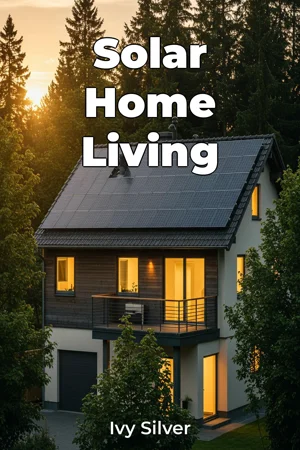
Can solar energy truly empower families to achieve greater sustainability and resilience in the face of increasing environmental concerns and energy costs? _Solar Home Living_ delves into this question, offering a comprehensive exploration of how solar technology can be practically integrated into the modern family home to foster environmental responsibility, financial savings, and a more secure future. This book addresses three key topics: the fundamental principles of solar energy and its technological applications in residential settings; the economic implications of transitioning to solar power, including cost-benefit analyses and available incentives; and the broader environmental and social impacts of widespread solar adoption within communities. These topics are vital because they offer families the knowledge they need to make informed decisions about their energy consumption and contribute to a more sustainable future. Understanding contemporary solar technology requires some context. _Solar Home Living_ provides a concise history of photovoltaic (PV) technology, tracing its evolution from early scientific discoveries to today's efficient and affordable solar panels. We also examine current energy policies and the growing awareness of climate change, which are driving the increased demand for renewable energy solutions. Readers will benefit from a basic understanding of household electricity and energy consumption metrics. The central argument of _Solar Home Living_ is that solar energy is not merely an alternative energy source but a practical and accessible tool for families to take control of their energy needs, reduce their carbon footprint, and build long-term financial stability. We present evidence to show that transitioning to solar is a viable option for a growing number of homeowners. The book begins by introducing the fundamental principles of solar energy, explaining how sunlight is converted into electricity and how solar panels are designed and installed. Section two examines the financial aspects of solar energy, providing detailed analyses of upfront costs, long-term savings, and available tax credits and rebates. It also discusses various financing options, such as loans and leasing agreements. Section three broadens the scope to explore the environmental benefits of solar energy, including reduced greenhouse gas emissions and decreased reliance on fossil fuels. Finally, we will present a culmination of case studies of families who have successfully integrated solar energy into their homes and offer practical advice for readers looking to do the same, including tips on selecting the right solar panels, finding qualified installers, and maximizing energy efficiency. To support our arguments, _Solar Home Living_ presents data from reputable sources, including the U.S. Energy Information Administration, the National Renewable Energy Laboratory, and peer-reviewed scientific studies. We also include interviews with homeowners who have adopted solar energy, providing real-world examples of the benefits and challenges involved. Unique data drawn from local municipality records of solar panel adoption rates will be included where available to support regional nuances. _Solar Home Living_ connects to various disciplines, including environmental science, economics, and engineering. By integrating these perspectives, we provide a holistic understanding of solar energy and its potential impact. The book stands out by offering a practical, family-focused approach to solar energy education. Rather than focusing solely on technical details or abstract environmental concerns, we emphasize the tangible benefits of solar energy for everyday families. The tone of _Solar Home Living_ is informative and accessible, avoiding technical jargon and presenting information in a clear, conversational style. The target audience is homeowners, families interested in reducing their carbon footprint, and anyone curious about the potential of solar energy. The book's value lies in its ability to empower readers with the knowledge and confidence to make informed decisions about their energy future. As a work of non-fiction, _Solar Home Living_ adheres to rigorous standards of accuracy and objectivity providing citations and references to support our claims. The book's scope is limited to residential solar energy applications, focusing primarily on photovoltaic systems. We acknowledge that other forms of renewable energy, such as wind and geothermal, also have potential. The information in _Solar Home Living_ can be applied in numerous ways. Readers can use the book to assess the feasibility of installing solar panels on their homes, compare different solar energy products and services, and navigate the process of financing and installing a solar energy system. While solar energy enjoys broad support, debates exist regarding the optimal level of government subsidies and the impact of large-scale solar farms on land use. _Solar Home Living_ acknowledges these debates, presenting different perspectives and encouraging readers to form their own informed opinions.
Can solar energy truly empower families to achieve greater sustainability and resilience in the face of increasing environmental concerns and energy costs? _Solar Home Living_ delves into this question, offering a comprehensive exploration of how solar technology can be practically integrated into the modern family home to foster environmental responsibility, financial savings, and a more secure future. This book addresses three key topics: the fundamental principles of solar energy and its technological applications in residential settings; the economic implications of transitioning to solar power, including cost-benefit analyses and available incentives; and the broader environmental and social impacts of widespread solar adoption within communities. These topics are vital because they offer families the knowledge they need to make informed decisions about their energy consumption and contribute to a more sustainable future. Understanding contemporary solar technology requires some context. _Solar Home Living_ provides a concise history of photovoltaic (PV) technology, tracing its evolution from early scientific discoveries to today's efficient and affordable solar panels. We also examine current energy policies and the growing awareness of climate change, which are driving the increased demand for renewable energy solutions. Readers will benefit from a basic understanding of household electricity and energy consumption metrics. The central argument of _Solar Home Living_ is that solar energy is not merely an alternative energy source but a practical and accessible tool for families to take control of their energy needs, reduce their carbon footprint, and build long-term financial stability. We present evidence to show that transitioning to solar is a viable option for a growing number of homeowners. The book begins by introducing the fundamental principles of solar energy, explaining how sunlight is converted into electricity and how solar panels are designed and installed. Section two examines the financial aspects of solar energy, providing detailed analyses of upfront costs, long-term savings, and available tax credits and rebates. It also discusses various financing options, such as loans and leasing agreements. Section three broadens the scope to explore the environmental benefits of solar energy, including reduced greenhouse gas emissions and decreased reliance on fossil fuels. Finally, we will present a culmination of case studies of families who have successfully integrated solar energy into their homes and offer practical advice for readers looking to do the same, including tips on selecting the right solar panels, finding qualified installers, and maximizing energy efficiency. To support our arguments, _Solar Home Living_ presents data from reputable sources, including the U.S. Energy Information Administration, the National Renewable Energy Laboratory, and peer-reviewed scientific studies. We also include interviews with homeowners who have adopted solar energy, providing real-world examples of the benefits and challenges involved. Unique data drawn from local municipality records of solar panel adoption rates will be included where available to support regional nuances. _Solar Home Living_ connects to various disciplines, including environmental science, economics, and engineering. By integrating these perspectives, we provide a holistic understanding of solar energy and its potential impact. The book stands out by offering a practical, family-focused approach to solar energy education. Rather than focusing solely on technical details or abstract environmental concerns, we emphasize the tangible benefits of solar energy for everyday families. The tone of _Solar Home Living_ is informative and accessible, avoiding technical jargon and presenting information in a clear, conversational style. The target audience is homeowners, families interested in reducing their carbon footprint, and anyone curious about the potential of solar energy. The book's value lies in its ability to empower readers with the knowledge and confidence to make informed decisions about their energy future. As a work of non-fiction, _Solar Home Living_ adheres to rigorous standards of accuracy and objectivity providing citations and references to support our claims. The book's scope is limited to residential solar energy applications, focusing primarily on photovoltaic systems. We acknowledge that other forms of renewable energy, such as wind and geothermal, also have potential. The information in _Solar Home Living_ can be applied in numerous ways. Readers can use the book to assess the feasibility of installing solar panels on their homes, compare different solar energy products and services, and navigate the process of financing and installing a solar energy system. While solar energy enjoys broad support, debates exist regarding the optimal level of government subsidies and the impact of large-scale solar farms on land use. _Solar Home Living_ acknowledges these debates, presenting different perspectives and encouraging readers to form their own informed opinions.
"Solar Home Living" explores how families can embrace solar energy for a sustainable and financially secure future. It highlights how residential solar adoption contributes to environmental responsibility, offering practical insights for homeowners aiming to reduce their carbon footprint. The book explains the evolution of photovoltaic technology, from early discoveries to today's affordable solar panels, and emphasizes the growing demand for renewable energy driven by climate change awareness. Did you know that transitioning to solar power can offer long-term financial stability, along with reducing reliance on traditional energy sources? The book starts by explaining the core principles of solar energy, including how sunlight is converted into electricity and how solar panels are designed. It then delves into financial considerations, such as upfront costs, long-term savings, tax incentives, rebates, and financing options. Progressing further, the book explores the environmental benefits and features case studies of families who've successfully integrated solar energy to guide readers in selecting the right solar panels and installers. It uniquely combines environmental science, economics, and engineering to offer a holistic understanding, emphasizing practical, family-focused benefits and presenting data from reputable sources like the U.S. Energy Information Administration.
Book Details
ISBN
9788235212641
Publisher
Publifye AS
Your Licenses
You don't own any licenses for this book
Purchase a license below to unlock this book and download the EPUB.
Purchase License
Select a tier to unlock this book
Need bulk licensing?
Contact us for enterprise agreements.