
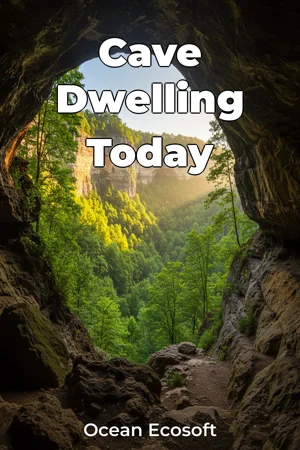
About This Book
Why, in our age of skyscrapers and sprawling urban centers, do some people still choose to live in caves? This book, "Cave Dwelling Today," explores the contemporary phenomenon of natural cave habitation, moving beyond primitive stereotypes to reveal the complex social, cultural, and economic factors that drive this often-overlooked aspect of human life. Our investigation is centered on three key topics: the persistence of cave dwelling as a chosen lifestyle, the diverse motivations behind this choice, and the adaptation strategies employed by cave dwellers to thrive in their unique environment. These topics are significant because they challenge conventional notions of progress and development, prompting us to reconsider the relationship between humans and the natural world. To understand modern cave dwelling, we draw upon anthropology, earth sciences, and geography. Historically, caves have served as shelters, refuges, and sacred spaces across cultures and time periods. Today, the reasons for inhabiting caves are multifaceted, ranging from seeking affordable housing to pursuing spiritual retreats or maintaining ancestral traditions. What emerges is that cave dwelling is far from a relic of the past. The central argument of "Cave Dwelling Today" is that cave dwelling represents a resilient and adaptable form of human habitation, reflecting a conscious decision to prioritize specific values and needs over mainstream societal norms. This argument is important because it sheds light on the diversity of human experience and challenges assumptions about what constitutes a "successful" or "modern" lifestyle. The book begins by introducing the concept of contemporary cave habitation, defining its scope and distinguishing it from historical or archaeological contexts. We explore the different types of natural caves used for dwellings, considering their geological formations, microclimates, and resource availability. Following this introduction, the book develops its argument through three major sections. First, we examine the social and cultural dimensions of cave dwelling, drawing on anthropological data to analyze the community structures, social hierarchies, and cultural practices of cave-dwelling populations. Second, we investigate the economic factors that contribute to the appeal of cave dwelling, considering issues such as land ownership, resource management, and sustainable livelihoods. Third, we analyze the environmental adaptations of cave dwellers, exploring their strategies for managing water resources, waste disposal, and energy consumption in a sustainable manner. The book culminates by considering the implications of cave dwelling for sustainable development and cultural preservation, offering practical insights for policymakers, researchers, and community leaders. The evidence presented in "Cave Dwelling Today" is derived from diverse sources, including ethnographic fieldwork, geological surveys, and socio-economic data analysis. We incorporate case studies from various regions around the world, highlighting the unique challenges and opportunities faced by cave-dwelling communities in different environmental and cultural contexts. "Cave Dwelling Today" connects to several other fields of study, including environmental studies, sociology, and urban planning. By examining the environmental impact of cave dwelling, we contribute to debates about sustainable resource management and alternative housing models. By analyzing the social dynamics of cave-dwelling communities, we offer insights into the challenges of social inclusion and cultural diversity. By exploring the spatial organization of cave dwellings, we inform discussions about urban planning and community development in marginalized areas. This book offers a unique perspective by focusing specifically on contemporary natural-cave dwelling as a conscious and adaptive choice, rather than solely as a historical artifact. It also adopts an interdisciplinary approach, integrating insights from anthropology, earth sciences, and geography to provide a holistic understanding of this complex phenomenon. The tone of the book is academic but accessible, aiming to engage both specialists and general readers interested in alternative lifestyles and sustainable living. It is targeted at academics and students in anthropology, geography, and environmental studies, policymakers working on sustainable development, and individuals interested in alternative lifestyles and cultural preservation. As a work of non-fiction in the earth sciences, social sciences, and geography genres, "Cave Dwelling Today" adheres to standards of objectivity, accuracy, and evidence-based analysis. The scope of the book is limited to natural cave dwellings, excluding artificial cave dwellings or underground structures. The information presented in "Cave Dwelling Today" has practical applications for sustainable development initiatives, cultural heritage preservation, and community empowerment. The book addresses the ongoing debates within anthropology and geography concerning the definition of 'modernity' and challenges the Eurocentric view of progress.
Why, in our age of skyscrapers and sprawling urban centers, do some people still choose to live in caves? This book, "Cave Dwelling Today," explores the contemporary phenomenon of natural cave habitation, moving beyond primitive stereotypes to reveal the complex social, cultural, and economic factors that drive this often-overlooked aspect of human life. Our investigation is centered on three key topics: the persistence of cave dwelling as a chosen lifestyle, the diverse motivations behind this choice, and the adaptation strategies employed by cave dwellers to thrive in their unique environment. These topics are significant because they challenge conventional notions of progress and development, prompting us to reconsider the relationship between humans and the natural world. To understand modern cave dwelling, we draw upon anthropology, earth sciences, and geography. Historically, caves have served as shelters, refuges, and sacred spaces across cultures and time periods. Today, the reasons for inhabiting caves are multifaceted, ranging from seeking affordable housing to pursuing spiritual retreats or maintaining ancestral traditions. What emerges is that cave dwelling is far from a relic of the past. The central argument of "Cave Dwelling Today" is that cave dwelling represents a resilient and adaptable form of human habitation, reflecting a conscious decision to prioritize specific values and needs over mainstream societal norms. This argument is important because it sheds light on the diversity of human experience and challenges assumptions about what constitutes a "successful" or "modern" lifestyle. The book begins by introducing the concept of contemporary cave habitation, defining its scope and distinguishing it from historical or archaeological contexts. We explore the different types of natural caves used for dwellings, considering their geological formations, microclimates, and resource availability. Following this introduction, the book develops its argument through three major sections. First, we examine the social and cultural dimensions of cave dwelling, drawing on anthropological data to analyze the community structures, social hierarchies, and cultural practices of cave-dwelling populations. Second, we investigate the economic factors that contribute to the appeal of cave dwelling, considering issues such as land ownership, resource management, and sustainable livelihoods. Third, we analyze the environmental adaptations of cave dwellers, exploring their strategies for managing water resources, waste disposal, and energy consumption in a sustainable manner. The book culminates by considering the implications of cave dwelling for sustainable development and cultural preservation, offering practical insights for policymakers, researchers, and community leaders. The evidence presented in "Cave Dwelling Today" is derived from diverse sources, including ethnographic fieldwork, geological surveys, and socio-economic data analysis. We incorporate case studies from various regions around the world, highlighting the unique challenges and opportunities faced by cave-dwelling communities in different environmental and cultural contexts. "Cave Dwelling Today" connects to several other fields of study, including environmental studies, sociology, and urban planning. By examining the environmental impact of cave dwelling, we contribute to debates about sustainable resource management and alternative housing models. By analyzing the social dynamics of cave-dwelling communities, we offer insights into the challenges of social inclusion and cultural diversity. By exploring the spatial organization of cave dwellings, we inform discussions about urban planning and community development in marginalized areas. This book offers a unique perspective by focusing specifically on contemporary natural-cave dwelling as a conscious and adaptive choice, rather than solely as a historical artifact. It also adopts an interdisciplinary approach, integrating insights from anthropology, earth sciences, and geography to provide a holistic understanding of this complex phenomenon. The tone of the book is academic but accessible, aiming to engage both specialists and general readers interested in alternative lifestyles and sustainable living. It is targeted at academics and students in anthropology, geography, and environmental studies, policymakers working on sustainable development, and individuals interested in alternative lifestyles and cultural preservation. As a work of non-fiction in the earth sciences, social sciences, and geography genres, "Cave Dwelling Today" adheres to standards of objectivity, accuracy, and evidence-based analysis. The scope of the book is limited to natural cave dwellings, excluding artificial cave dwellings or underground structures. The information presented in "Cave Dwelling Today" has practical applications for sustainable development initiatives, cultural heritage preservation, and community empowerment. The book addresses the ongoing debates within anthropology and geography concerning the definition of 'modernity' and challenges the Eurocentric view of progress.
"Cave Dwelling Today" explores the surprising persistence of living in natural caves in the modern world, moving beyond stereotypical views to examine the motivations and adaptations of contemporary cave dwellers. This book sheds light on cave dwelling not as a primitive relic, but as a conscious choice driven by diverse factors like seeking affordable housing, pursuing spiritual retreats, or preserving cultural heritage. The book unveils how these communities manage resources and maintain social structures, challenging conventional ideas of progress and successful lifestyles. The book uniquely combines anthropology, earth sciences, and geography to understand this phenomenon. It investigates the cultural and economic dimensions, showing how cave dwellers adapt to their environment through sustainable practices. For instance, the book analyzes how geological formations influence microclimates within caves, impacting resource availability. By presenting case studies from around the world, "Cave Dwelling Today" demonstrates the resilience and adaptability of cave communities. The book progresses from defining contemporary cave habitation to examining its social, cultural, and economic aspects, culminating in a discussion of its implications for sustainable development and cultural preservation. This interdisciplinary approach makes the book valuable for policymakers, researchers, and anyone interested in alternative lifestyles, offering insights into sustainable living and community development.
Book Details
ISBN
9788235212368
Publisher
Publifye AS
Your Licenses
You don't own any licenses for this book
Purchase a license below to unlock this book and download the EPUB.
Purchase License
Select a tier to unlock this book
Need bulk licensing?
Contact us for enterprise agreements.