
About This Book
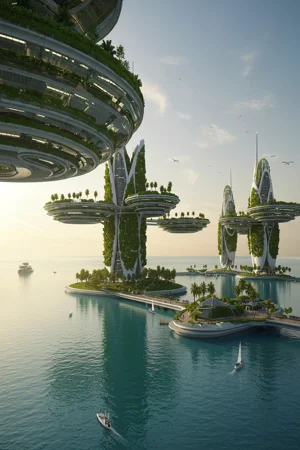
As coastal populations swell and the threat of rising sea levels looms ever larger, how can we reimagine our cities to not only survive but thrive in an era of increasing aquatic challenges? "Floating City Concepts" delves into the innovative and increasingly vital field of water-based urban living. It presents a comprehensive examination of the feasibility and potential of floating cities as a tangible solution to the pressures of overpopulation, climate change, and land scarcity. This book is crucial for understanding how we might reshape our urban landscapes in harmony with the water that surrounds us. The book addresses several main topics: the technological and engineering aspects of constructing stable and sustainable floating structures, the socio-economic factors influencing the adoption and governance of floating communities, and the environmental impact of such developments. These discussions provide an understanding of the complex interplay between human settlement and aquatic environments. The historical context of human settlements on water, from ancient stilt villages to modern houseboats, forms a foundation for understanding current floating city proposals. Furthermore, an overview of current projections regarding climate change and its effects on coastal regions provides a sense of urgency and relevance to the solutions presented. While readers do not need specialized knowledge to understand the core concepts, a basic awareness of urban planning principles and environmental challenges will enhance their appreciation of the book's arguments. The central argument of "Floating City Concepts" posits that floating cities, while technically and logistically complex, represent a viable and necessary component of future urban development. The feasibility hinges on integrating innovative engineering with comprehensive urban planning that addresses environmental sustainability and social equity. This argument is not just an academic exercise; it is a call for proactive measures in the face of escalating global challenges. The book's structure begins with an introduction to the concept of floating cities, exploring historical precedents and current motivations. Following this, the book delves into the engineering challenges and technological advancements that are making these concepts increasingly possible. Chapters will cover topics such as structural design, buoyancy systems, waste management, and energy production for self-sufficient floating communities. A significant portion of the book is dedicated to urban planning considerations, including legal frameworks, social equity, economic viability, and community governance within floating cities. The book culminates in a discussion of practical applications, assessing the potential for implementing floating city projects in different geographical locations and socio-economic contexts. The evidence presented is based on a synthesis of academic research, engineering reports, case studies of existing floating structures, and urban planning data. The book also relies on data from climate change models and demographic projections to underscore the urgency and relevance of exploring alternative urban solutions. "Floating City Concepts" inherently connects multiple fields. It draws heavily from Earth Sciences and Geography, analyzing the geological and hydrological factors influencing site selection and environmental impact. It also connects directly to Architecture and General Architectural principles, exploring innovative design solutions for floating structures and urban layouts. Furthermore, the book intersects with fields such as marine engineering, environmental science, and public policy, highlighting the interdisciplinary nature of floating city development. These connections enhance the book's argument by demonstrating that building floating cities is not just a technical challenge but a holistic endeavor requiring collaboration across diverse areas of expertise. The book offers a balanced approach, acknowledging both the potential benefits and inherent challenges. The writing style is professional and accessible, aiming to inform a broad audience without sacrificing technical accuracy. The target audience includes urban planners, architects, engineers, policymakers, environmental scientists, and anyone interested in sustainable urban development and innovative solutions to climate change. The book also serve as a valuable resource for students in related fields. Given its non-fiction nature and focus on Earth Sciences, Geography, and Architecture, the book adheres to conventions of academic rigor, providing well-researched information, clear explanations, and balanced perspectives. The book's scope encompasses a wide range of technological, environmental, and socio-economic considerations related to floating city development. However, it does not delve into the minute details of specific engineering designs or legal frameworks, focusing instead on providing a broad overview and conceptual framework. The information presented has numerous real-world applications. It inspires innovative solutions to urban challenges and informs decision-making by policymakers, urban planners, and developers. Moreover, it can empower communities to advocate for sustainable and resilient urban development strategies. The concept of floating cities has generated considerable debate, particularly regarding environmental impact, economic feasibility, and social equity. The book addresses these controversies head-on, presenting various perspectives and offering balanced assessments to provide readers with a comprehensive understanding of the complexities involved.
As coastal populations swell and the threat of rising sea levels looms ever larger, how can we reimagine our cities to not only survive but thrive in an era of increasing aquatic challenges? "Floating City Concepts" delves into the innovative and increasingly vital field of water-based urban living. It presents a comprehensive examination of the feasibility and potential of floating cities as a tangible solution to the pressures of overpopulation, climate change, and land scarcity. This book is crucial for understanding how we might reshape our urban landscapes in harmony with the water that surrounds us. The book addresses several main topics: the technological and engineering aspects of constructing stable and sustainable floating structures, the socio-economic factors influencing the adoption and governance of floating communities, and the environmental impact of such developments. These discussions provide an understanding of the complex interplay between human settlement and aquatic environments. The historical context of human settlements on water, from ancient stilt villages to modern houseboats, forms a foundation for understanding current floating city proposals. Furthermore, an overview of current projections regarding climate change and its effects on coastal regions provides a sense of urgency and relevance to the solutions presented. While readers do not need specialized knowledge to understand the core concepts, a basic awareness of urban planning principles and environmental challenges will enhance their appreciation of the book's arguments. The central argument of "Floating City Concepts" posits that floating cities, while technically and logistically complex, represent a viable and necessary component of future urban development. The feasibility hinges on integrating innovative engineering with comprehensive urban planning that addresses environmental sustainability and social equity. This argument is not just an academic exercise; it is a call for proactive measures in the face of escalating global challenges. The book's structure begins with an introduction to the concept of floating cities, exploring historical precedents and current motivations. Following this, the book delves into the engineering challenges and technological advancements that are making these concepts increasingly possible. Chapters will cover topics such as structural design, buoyancy systems, waste management, and energy production for self-sufficient floating communities. A significant portion of the book is dedicated to urban planning considerations, including legal frameworks, social equity, economic viability, and community governance within floating cities. The book culminates in a discussion of practical applications, assessing the potential for implementing floating city projects in different geographical locations and socio-economic contexts. The evidence presented is based on a synthesis of academic research, engineering reports, case studies of existing floating structures, and urban planning data. The book also relies on data from climate change models and demographic projections to underscore the urgency and relevance of exploring alternative urban solutions. "Floating City Concepts" inherently connects multiple fields. It draws heavily from Earth Sciences and Geography, analyzing the geological and hydrological factors influencing site selection and environmental impact. It also connects directly to Architecture and General Architectural principles, exploring innovative design solutions for floating structures and urban layouts. Furthermore, the book intersects with fields such as marine engineering, environmental science, and public policy, highlighting the interdisciplinary nature of floating city development. These connections enhance the book's argument by demonstrating that building floating cities is not just a technical challenge but a holistic endeavor requiring collaboration across diverse areas of expertise. The book offers a balanced approach, acknowledging both the potential benefits and inherent challenges. The writing style is professional and accessible, aiming to inform a broad audience without sacrificing technical accuracy. The target audience includes urban planners, architects, engineers, policymakers, environmental scientists, and anyone interested in sustainable urban development and innovative solutions to climate change. The book also serve as a valuable resource for students in related fields. Given its non-fiction nature and focus on Earth Sciences, Geography, and Architecture, the book adheres to conventions of academic rigor, providing well-researched information, clear explanations, and balanced perspectives. The book's scope encompasses a wide range of technological, environmental, and socio-economic considerations related to floating city development. However, it does not delve into the minute details of specific engineering designs or legal frameworks, focusing instead on providing a broad overview and conceptual framework. The information presented has numerous real-world applications. It inspires innovative solutions to urban challenges and informs decision-making by policymakers, urban planners, and developers. Moreover, it can empower communities to advocate for sustainable and resilient urban development strategies. The concept of floating cities has generated considerable debate, particularly regarding environmental impact, economic feasibility, and social equity. The book addresses these controversies head-on, presenting various perspectives and offering balanced assessments to provide readers with a comprehensive understanding of the complexities involved.
"Floating City Concepts" explores the groundbreaking idea of water-based urban living as a response to climate change and overpopulation. The book examines the feasibility of floating cities, highlighting how these innovative structures could provide a sustainable solution to rising sea levels and land scarcity. It delves into the technological and engineering challenges of building stable, self-sufficient floating communities, while also considering the socio-economic factors that influence their adoption and governance. Readers will gain insights into how integrating cutting-edge marine engineering with comprehensive urban planning can create resilient urban environments. The book emphasizes the importance of environmental sustainability and social equity in floating city development. It showcases the potential of these cities to harmonize with aquatic environments, drawing on historical precedents of human settlements on water. "Floating City Concepts" progresses from an introduction to the core concept, through engineering and urban planning considerations, to practical applications across different geographical and socio-economic contexts. The evidence is based on a synthesis of academic research, engineering reports, and climate change models.
Book Details
ISBN
9788235212320
Publisher
Publifye AS
Your Licenses
You don't own any licenses for this book
Purchase a license below to unlock this book and download the EPUB.
Purchase License
Select a tier to unlock this book
Need bulk licensing?
Contact us for enterprise agreements.