
About This Book
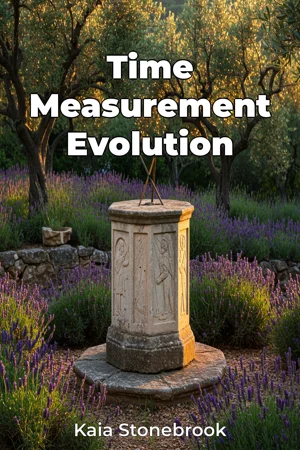
How did humanity transition from observing the sun's journey across the sky to employing atomic clocks capable of measuring time with unparalleled precision? "Time Measurement Evolution" delves into the captivating history of timekeeping, exploring the ingenuity and persistent curiosity that have driven our quest to quantify and understand time. This book examines the critical stages in the development of timekeeping: the invention of early calendars and sundials, the mechanical clock revolution, and the advent of atomic timekeeping. Understanding these developments is crucial because our ability to measure time precisely underpins many aspects of modern life, from global communication networks to scientific experimentation and financial markets. The book provides historical, social, and scientific context. A basic understanding of physics and astronomy is helpful, but we make complex topics accessible to a broad audience. The central argument of "Time Measurement Evolution" is that the methods we use to measure time have not only reflected our technological capabilities but have profoundly shaped our perception of reality and societal structures. This argument is important because it allows us to appreciate that time is not a static, universally understood concept, but a fluid construct molded by human innovation. The book unfolds in three major sections. First, it introduces the earliest attempts to measure time, covering the development of lunar and solar calendars in ancient civilizations like Egypt and Mesopotamia, and the invention of sundials and water clocks. Second, "Time Measurement Evolution" studies the impact of mechanical clocks in medieval Europe, detailing the technological innovations that made them possible, and the sweeping social and economic changes they encouraged. Finally, we scrutinize the modern era of timekeeping, beginning with the discovery of quartz clocks to the development of atomic clocks, and their role in synchronizing global systems. The book relies on a variety of evidence, including archaeological finds, surviving historical documents, and the technical specifications of early clocks and timekeeping devices. It contains data from scientific studies detailing the accuracy of various timekeeping methods throughout history. This historical study connects to the fields of astronomy, physics, and sociology. Astronomy provides the foundation for understanding celestial mechanics and the earliest timekeeping methods. Physics explains the scientific principles behind mechanical and atomic clocks. Sociology examines how changing perceptions of time influenced social organization and labor practices. "Time Measurement Evolution" offers a unique perspective by examining the interplay between technological innovation and societal change throughout the evolution of timekeeping. It avoids a purely technical approach, choosing instead to explore the human stories and cultural contexts that enabled each significant advance. The book presents information in a clear, organized, and accessible style, aiming to inform and engage readers, without overwhelming them with technical jargon. The target audience includes anyone interested in the history of science and technology, as well as readers interested in the evolution of human culture and society. As a work of history and science, "Time Measurement Evolution" adheres to rigorous standards of academic integrity, presenting well-researched information and clearly citing sources. While the book strives for comprehensive coverage, it focuses primarily on advancements in timekeeping within Western civilizations, acknowledging that other cultures developed unique and equally valid systems. The information presented in "Time Measurement Evolution" has real-world applications. Understanding the history of timekeeping can help us appreciate the complexity of modern time synchronization systems and their importance in our daily lives. Furthermore, the book indirectly addresses the ongoing debate about the nature of time itself, prompting readers to consider the philosophical implications.
How did humanity transition from observing the sun's journey across the sky to employing atomic clocks capable of measuring time with unparalleled precision? "Time Measurement Evolution" delves into the captivating history of timekeeping, exploring the ingenuity and persistent curiosity that have driven our quest to quantify and understand time. This book examines the critical stages in the development of timekeeping: the invention of early calendars and sundials, the mechanical clock revolution, and the advent of atomic timekeeping. Understanding these developments is crucial because our ability to measure time precisely underpins many aspects of modern life, from global communication networks to scientific experimentation and financial markets. The book provides historical, social, and scientific context. A basic understanding of physics and astronomy is helpful, but we make complex topics accessible to a broad audience. The central argument of "Time Measurement Evolution" is that the methods we use to measure time have not only reflected our technological capabilities but have profoundly shaped our perception of reality and societal structures. This argument is important because it allows us to appreciate that time is not a static, universally understood concept, but a fluid construct molded by human innovation. The book unfolds in three major sections. First, it introduces the earliest attempts to measure time, covering the development of lunar and solar calendars in ancient civilizations like Egypt and Mesopotamia, and the invention of sundials and water clocks. Second, "Time Measurement Evolution" studies the impact of mechanical clocks in medieval Europe, detailing the technological innovations that made them possible, and the sweeping social and economic changes they encouraged. Finally, we scrutinize the modern era of timekeeping, beginning with the discovery of quartz clocks to the development of atomic clocks, and their role in synchronizing global systems. The book relies on a variety of evidence, including archaeological finds, surviving historical documents, and the technical specifications of early clocks and timekeeping devices. It contains data from scientific studies detailing the accuracy of various timekeeping methods throughout history. This historical study connects to the fields of astronomy, physics, and sociology. Astronomy provides the foundation for understanding celestial mechanics and the earliest timekeeping methods. Physics explains the scientific principles behind mechanical and atomic clocks. Sociology examines how changing perceptions of time influenced social organization and labor practices. "Time Measurement Evolution" offers a unique perspective by examining the interplay between technological innovation and societal change throughout the evolution of timekeeping. It avoids a purely technical approach, choosing instead to explore the human stories and cultural contexts that enabled each significant advance. The book presents information in a clear, organized, and accessible style, aiming to inform and engage readers, without overwhelming them with technical jargon. The target audience includes anyone interested in the history of science and technology, as well as readers interested in the evolution of human culture and society. As a work of history and science, "Time Measurement Evolution" adheres to rigorous standards of academic integrity, presenting well-researched information and clearly citing sources. While the book strives for comprehensive coverage, it focuses primarily on advancements in timekeeping within Western civilizations, acknowledging that other cultures developed unique and equally valid systems. The information presented in "Time Measurement Evolution" has real-world applications. Understanding the history of timekeeping can help us appreciate the complexity of modern time synchronization systems and their importance in our daily lives. Furthermore, the book indirectly addresses the ongoing debate about the nature of time itself, prompting readers to consider the philosophical implications.
"Time Measurement Evolution" explores the fascinating journey of how humans have measured time, from ancient sundials to modern atomic clocks. It highlights how our perception of time has been shaped by technological advancements and societal shifts, emphasizing that time isn't a static concept but a fluid construct influenced by innovation. The book examines the development of calendars and early timekeeping devices, revealing how ancient civilizations like Egypt and Mesopotamia first attempted to quantify time through astronomical observations. The book progresses chronologically, first exploring the development of early timekeeping methods, like lunar and solar calendars. It then transitions to the mechanical clock revolution in medieval Europe, detailing the technological innovations that made them possible and the profound economic and social changes that followed. Did you know that the ability to measure time accurately underpins global communication networks, scientific experimentation, and financial markets? The final section delves into the modern era, scrutinizing the discovery of quartz and atomic clocks and their crucial role in synchronizing global systems. By connecting history, science, and society, "Time Measurement Evolution" provides a unique perspective on how timekeeping has evolved alongside human culture and technological capabilities. The book avoids being overly technical, focusing instead on the human stories and cultural contexts that drove each significant advancement.
Book Details
ISBN
9788235210746
Publisher
Publifye AS
Your Licenses
You don't own any licenses for this book
Purchase a license below to unlock this book and download the EPUB.
Purchase License
Select a tier to unlock this book
Need bulk licensing?
Contact us for enterprise agreements.