
About This Book
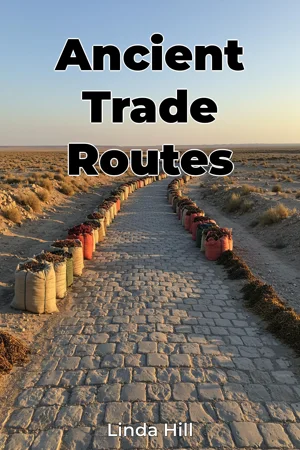
How did threads of commerce weave the fabric of civilization, connecting disparate cultures and shaping the world we know today? Ancient Trade Routes delves into the intricate networks of exchange that flourished in antiquity, exploring their profound economic and societal impact. This book focuses on understanding the mechanisms that fueled these early forms of globalization, the goods that drove them, and the lasting consequences they had on the participating societies. We will examine the role of trade in the rise and fall of empires, the spread of ideas and technologies, and the creation of cultural hybridity. Central to our exploration are the Silk Road, the maritime Spice Routes, and the trans-Saharan trade networks. These arteries of commerce weren’t merely conduits for goods; they were pathways for cultural exchange, technological diffusion, and the movement of people. Understanding these routes is crucial for grasping the interconnectedness of ancient civilizations and how they influenced each other. This book provides necessary geographical, historical, and economic context, assuming a basic familiarity with ancient history but offering detailed explanations of key concepts and regions. The central argument of Ancient Trade Routes is that commerce was not simply an economic activity, but a transformative force that shaped political landscapes, fostered cultural interactions, and spurred technological innovation across the ancient world. This argument is significant because it challenges traditional, politically-focused narratives of history and highlights the agency of merchants, travelers, and diverse communities in shaping global events. This book is structured to provide a comprehensive understanding of ancient trade. It begins by introducing the fundamental concepts of trade, supply, and demand in the ancient world, establishing the theoretical groundwork for understanding the mechanics of these routes. It then progresses through detailed analyses of the Silk Road, examining goods like silk, spices, and precious metals. A chapter will be dedicated to maritime trade including the Spice Routes. The book then pivots to the trans-Saharan trade networks. The culmination of the book synthesizes the findings from each route, drawing comparisons and highlighting the shared characteristics and unique features of these networks. Finally, the book explores the modern implications of these ancient trade routes, examining their legacy on contemporary globalization and cultural exchange. The evidence presented in this book relies heavily on archaeological records, including excavated sites, shipwrecks, and material artifacts. Literary sources, such as travelogues, administrative texts, and inscriptions, also provide valuable insights into the organization and operation of these trade networks. Furthermore, the book considers interdisciplinary perspectives from archaeology, anthropology, economics, and geography to provide a nuanced understanding of ancient trade. This book connects to the fields of economics by examining the fundamental principles of supply and demand, market dynamics, and economic growth in ancient societies. It interfaces with anthropology by exploring the cultural interactions and exchanges facilitated by trade, while the geographical component analyzes the impact of environmental factors and spatial dynamics on trade route development. This book stands apart by integrating a global perspective, presenting a comparative analysis of multiple trade routes, and offering an interdisciplinary approach that combines archaeological data with economic and social analysis. The tone is scholarly yet accessible, aiming to appeal to both academics and general readers interested in history and archaeology. Ancient Trade Routes is intended for a broad audience, including students, researchers, and anyone with an interest in world history, economic history, or archaeology. This book offers valuable information about ancient civilizations, the development of trade, and the interconnectedness of human societies. The scope of this book encompasses the major trade routes of Eurasia and Africa from the Bronze Age to the early medieval period. While focusing on these key networks, the book acknowledges the existence of other regional trade routes. The book may touch on controversies surrounding the interpretation such as the reliability of certain sources or the extent of trade’s influence The content can be applied to understand modern supply chains, globalization, cross cultural exchanges, and international business.
How did threads of commerce weave the fabric of civilization, connecting disparate cultures and shaping the world we know today? Ancient Trade Routes delves into the intricate networks of exchange that flourished in antiquity, exploring their profound economic and societal impact. This book focuses on understanding the mechanisms that fueled these early forms of globalization, the goods that drove them, and the lasting consequences they had on the participating societies. We will examine the role of trade in the rise and fall of empires, the spread of ideas and technologies, and the creation of cultural hybridity. Central to our exploration are the Silk Road, the maritime Spice Routes, and the trans-Saharan trade networks. These arteries of commerce weren’t merely conduits for goods; they were pathways for cultural exchange, technological diffusion, and the movement of people. Understanding these routes is crucial for grasping the interconnectedness of ancient civilizations and how they influenced each other. This book provides necessary geographical, historical, and economic context, assuming a basic familiarity with ancient history but offering detailed explanations of key concepts and regions. The central argument of Ancient Trade Routes is that commerce was not simply an economic activity, but a transformative force that shaped political landscapes, fostered cultural interactions, and spurred technological innovation across the ancient world. This argument is significant because it challenges traditional, politically-focused narratives of history and highlights the agency of merchants, travelers, and diverse communities in shaping global events. This book is structured to provide a comprehensive understanding of ancient trade. It begins by introducing the fundamental concepts of trade, supply, and demand in the ancient world, establishing the theoretical groundwork for understanding the mechanics of these routes. It then progresses through detailed analyses of the Silk Road, examining goods like silk, spices, and precious metals. A chapter will be dedicated to maritime trade including the Spice Routes. The book then pivots to the trans-Saharan trade networks. The culmination of the book synthesizes the findings from each route, drawing comparisons and highlighting the shared characteristics and unique features of these networks. Finally, the book explores the modern implications of these ancient trade routes, examining their legacy on contemporary globalization and cultural exchange. The evidence presented in this book relies heavily on archaeological records, including excavated sites, shipwrecks, and material artifacts. Literary sources, such as travelogues, administrative texts, and inscriptions, also provide valuable insights into the organization and operation of these trade networks. Furthermore, the book considers interdisciplinary perspectives from archaeology, anthropology, economics, and geography to provide a nuanced understanding of ancient trade. This book connects to the fields of economics by examining the fundamental principles of supply and demand, market dynamics, and economic growth in ancient societies. It interfaces with anthropology by exploring the cultural interactions and exchanges facilitated by trade, while the geographical component analyzes the impact of environmental factors and spatial dynamics on trade route development. This book stands apart by integrating a global perspective, presenting a comparative analysis of multiple trade routes, and offering an interdisciplinary approach that combines archaeological data with economic and social analysis. The tone is scholarly yet accessible, aiming to appeal to both academics and general readers interested in history and archaeology. Ancient Trade Routes is intended for a broad audience, including students, researchers, and anyone with an interest in world history, economic history, or archaeology. This book offers valuable information about ancient civilizations, the development of trade, and the interconnectedness of human societies. The scope of this book encompasses the major trade routes of Eurasia and Africa from the Bronze Age to the early medieval period. While focusing on these key networks, the book acknowledges the existence of other regional trade routes. The book may touch on controversies surrounding the interpretation such as the reliability of certain sources or the extent of trade’s influence The content can be applied to understand modern supply chains, globalization, cross cultural exchanges, and international business.
"Ancient Trade Routes" explores the vital role of commerce in shaping ancient civilizations. Examining networks like the Silk Road, Spice Routes, and Trans-Saharan trade, the book reveals how these pathways facilitated not just the exchange of goods, but also the spread of ideas, technologies, and cultural practices. It highlights that the rise and fall of empires were often intertwined with their ability to control or participate in these trade networks, leading to the interconnectedness of societies across vast distances. The book progresses from foundational concepts of supply and demand to detailed analyses of each major trade route, using archaeological records and literary sources to support its arguments. It demonstrates that ancient commerce was a transformative force, impacting political landscapes, fostering cultural interactions, and spurring technological innovation. For example, the demand for silk spurred technological advancements in China, while the spice trade influenced maritime exploration. Ultimately, "Ancient Trade Routes" argues that commerce was a driving force in shaping the ancient world, challenging traditional narratives focused solely on political events. Its interdisciplinary approach, combining insights from archaeology, economics, and anthropology, provides a comprehensive understanding of how these trade networks influenced globalization and cultural exchange, leaving a lasting legacy on contemporary society.
Book Details
ISBN
9788235210623
Publisher
Publifye AS
Your Licenses
You don't own any licenses for this book
Purchase a license below to unlock this book and download the EPUB.
Purchase License
Select a tier to unlock this book
Need bulk licensing?
Contact us for enterprise agreements.