
About This Book
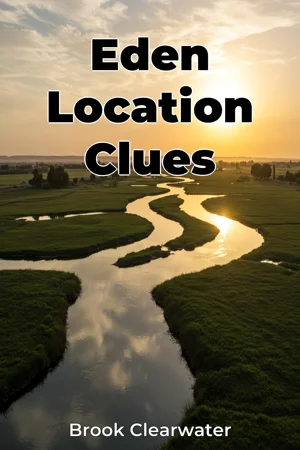
Could the geographical location of the Garden of Eden, a foundational story in the Book of Genesis, be more than just a myth? "Eden Location Clues" delves into this enduring question by meticulously examining the geographical descriptions within Genesis and comparing them against known Mesopotamian river systems and geological data. This book is important because it bridges the gap between biblical narrative and scientific inquiry, offering fresh perspectives on a topic that has fascinated scholars and theologians for centuries. This book explores two primary topics: the geographical markers provided in the Genesis account of Eden, and the fluvial geomorphology of ancient Mesopotamia. Understanding the changes in river courses, sea levels, and landscapes over millennia is essential to interpreting the biblical text within a real-world context. Readers should have a basic familiarity with the Old Testament and a general interest in geography, although no prior expertise in either field is required. The central argument of "Eden Location Clues" is that the Genesis account contains specific, testable geographic details that, when analyzed through the lens of Earth Sciences Geography, point to a plausible location in ancient Mesopotamia. This argument's importance lies in its potential to enrich our understanding of the relationship between ancient texts and the physical world, offering a new avenue for interpreting biblical narratives. The book is structured into three major sections. The first section introduces the key geographical elements in the Genesis description of Eden, including the four rivers (Pishon, Gihon, Tigris, and Euphrates), and addresses the challenges in reconciling these descriptions with modern geography. The second section focuses on the geological history of Mesopotamia, particularly the dynamic nature of its river systems, using archaeological and geological data to reconstruct ancient landscapes. This section includes an analysis of satellite imagery, core samples, and historical texts to map changes in river courses and coastlines. The third section presents a detailed comparative analysis, matching the biblical descriptions of Eden's rivers, land features, and resources with the reconstructed Mesopotamian landscape. It culminates in a synthesis of evidence, proposing a specific region that aligns with the biblical criteria and discussing the implications of this proposed location for our understanding of Genesis. The evidence presented includes detailed analysis of Mesopotamian river data from geological surveys, archaeological findings related to ancient settlements and trade routes, and comparative linguistic analysis of river names and place names. Unique data sources include recently declassified satellite imagery revealing ancient riverbeds and advanced digital elevation models (DEMs) that allow for high-resolution mapping of the region. "Eden Location Clues" draws connections to the fields of archaeology, particularly the study of ancient Mesopotamia, and linguistics, through the analysis of ancient place names and their possible connections to the biblical narrative. These interdisciplinary connections strengthen the book's argument by providing converging lines of evidence from different fields of study. The book’s innovative approach lies in its integration of biblical text with cutting-edge geospatial technologies and geological research. Rather than relying solely on theological or mythological interpretations, it adopts a scientific methodology to evaluate the geographical claims within Genesis. The tone is scholarly yet accessible, aiming to engage both academics and general readers interested in biblical studies and Earth Sciences. The writing style balances detailed analysis with clear explanations, making complex scientific concepts understandable to a non-specialist audience. The target audience includes students and scholars of biblical studies, theologians, geologists, archaeologists, and general readers interested in ancient history and the intersection of science and religion. This book would be valuable to them because it offers a fresh perspective on a well-known story, grounded in scientific evidence and rigorous analysis. As a work of Biblical Studies General and Earth Sciences Geography, "Eden Location Clues" adheres to the conventions of academic rigor, providing clear citations, detailed methodologies, and critical engagement with existing scholarship. One of the book's limitations is the inherent challenge in definitively proving a location based on ancient texts and incomplete geological records. The book acknowledges this limitation and emphasizes the probabilistic nature of its conclusions. The real-world application of the book's findings extends to informing archaeological research, promoting interdisciplinary collaboration, and fostering a deeper understanding of the complex relationship between humanity and the environment in ancient times. The book addresses ongoing debates within biblical scholarship regarding the historicity of Genesis and the interpretation of its geographical descriptions. It also acknowledges controversies surrounding the use of scientific methods to interpret religious texts, presenting a balanced perspective that respects both scientific and theological viewpoints.
Could the geographical location of the Garden of Eden, a foundational story in the Book of Genesis, be more than just a myth? "Eden Location Clues" delves into this enduring question by meticulously examining the geographical descriptions within Genesis and comparing them against known Mesopotamian river systems and geological data. This book is important because it bridges the gap between biblical narrative and scientific inquiry, offering fresh perspectives on a topic that has fascinated scholars and theologians for centuries. This book explores two primary topics: the geographical markers provided in the Genesis account of Eden, and the fluvial geomorphology of ancient Mesopotamia. Understanding the changes in river courses, sea levels, and landscapes over millennia is essential to interpreting the biblical text within a real-world context. Readers should have a basic familiarity with the Old Testament and a general interest in geography, although no prior expertise in either field is required. The central argument of "Eden Location Clues" is that the Genesis account contains specific, testable geographic details that, when analyzed through the lens of Earth Sciences Geography, point to a plausible location in ancient Mesopotamia. This argument's importance lies in its potential to enrich our understanding of the relationship between ancient texts and the physical world, offering a new avenue for interpreting biblical narratives. The book is structured into three major sections. The first section introduces the key geographical elements in the Genesis description of Eden, including the four rivers (Pishon, Gihon, Tigris, and Euphrates), and addresses the challenges in reconciling these descriptions with modern geography. The second section focuses on the geological history of Mesopotamia, particularly the dynamic nature of its river systems, using archaeological and geological data to reconstruct ancient landscapes. This section includes an analysis of satellite imagery, core samples, and historical texts to map changes in river courses and coastlines. The third section presents a detailed comparative analysis, matching the biblical descriptions of Eden's rivers, land features, and resources with the reconstructed Mesopotamian landscape. It culminates in a synthesis of evidence, proposing a specific region that aligns with the biblical criteria and discussing the implications of this proposed location for our understanding of Genesis. The evidence presented includes detailed analysis of Mesopotamian river data from geological surveys, archaeological findings related to ancient settlements and trade routes, and comparative linguistic analysis of river names and place names. Unique data sources include recently declassified satellite imagery revealing ancient riverbeds and advanced digital elevation models (DEMs) that allow for high-resolution mapping of the region. "Eden Location Clues" draws connections to the fields of archaeology, particularly the study of ancient Mesopotamia, and linguistics, through the analysis of ancient place names and their possible connections to the biblical narrative. These interdisciplinary connections strengthen the book's argument by providing converging lines of evidence from different fields of study. The book’s innovative approach lies in its integration of biblical text with cutting-edge geospatial technologies and geological research. Rather than relying solely on theological or mythological interpretations, it adopts a scientific methodology to evaluate the geographical claims within Genesis. The tone is scholarly yet accessible, aiming to engage both academics and general readers interested in biblical studies and Earth Sciences. The writing style balances detailed analysis with clear explanations, making complex scientific concepts understandable to a non-specialist audience. The target audience includes students and scholars of biblical studies, theologians, geologists, archaeologists, and general readers interested in ancient history and the intersection of science and religion. This book would be valuable to them because it offers a fresh perspective on a well-known story, grounded in scientific evidence and rigorous analysis. As a work of Biblical Studies General and Earth Sciences Geography, "Eden Location Clues" adheres to the conventions of academic rigor, providing clear citations, detailed methodologies, and critical engagement with existing scholarship. One of the book's limitations is the inherent challenge in definitively proving a location based on ancient texts and incomplete geological records. The book acknowledges this limitation and emphasizes the probabilistic nature of its conclusions. The real-world application of the book's findings extends to informing archaeological research, promoting interdisciplinary collaboration, and fostering a deeper understanding of the complex relationship between humanity and the environment in ancient times. The book addresses ongoing debates within biblical scholarship regarding the historicity of Genesis and the interpretation of its geographical descriptions. It also acknowledges controversies surrounding the use of scientific methods to interpret religious texts, presenting a balanced perspective that respects both scientific and theological viewpoints.
"Eden Location Clues" explores the enduring mystery of the Garden of Eden's location, blending Biblical Studies with Earth Sciences Geography. By examining the geographical details within Genesis and comparing them to Mesopotamian river systems and geological data, the book offers a fresh perspective on this foundational story. Intriguingly, the Genesis account provides specific geographical markers, such as the four rivers, which, when analyzed through geospatial analysis, may point to a plausible location. The book uniquely bridges biblical narrative and scientific inquiry, appealing to both scholars and general readers interested in this intersection. The book progresses systematically, first introducing the key geographical elements from Genesis, including the challenges in reconciling these descriptions with modern geography. It then delves into the geological history of Mesopotamia, reconstructing ancient landscapes using archaeological and geological data. This section uses data like satellite imagery to map changes in river courses. Finally, it presents a comparative analysis, matching biblical descriptions with the reconstructed Mesopotamian landscape, proposing a specific region that aligns with the biblical criteria. This approach offers a new avenue for interpreting biblical narratives.
Book Details
ISBN
9788235209764
Publisher
Publifye AS
Your Licenses
You don't own any licenses for this book
Purchase a license below to unlock this book and download the EPUB.
Purchase License
Select a tier to unlock this book
Need bulk licensing?
Contact us for enterprise agreements.