
About This Book
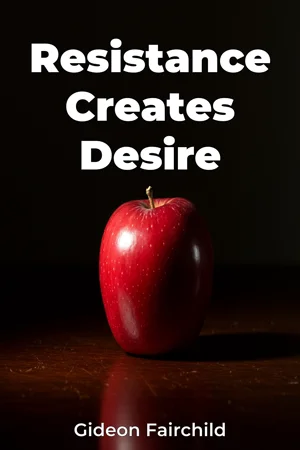
Imagine wanting something more when told you can't have it. Why does resistance so often ignite our desire? This book, *Resistance Creates Desire*, delves into the fascinating intersection of psychology and economics to explore how obstacles and limitations unexpectedly amplify motivation and longing. We will examine the core principles that explain why, counterintuitively, things become more appealing when they are scarce, forbidden, or difficult to obtain. These principles are not mere quirks of human behavior; they are deeply rooted in our psychological makeup and have profound implications for understanding human motivation and decision-making. Our journey begins with the scarcity principle, a cornerstone of behavioral economics, demonstrating how limited availability enhances perceived value. Next, we explore psychological reactance, the human tendency to resist attempts to control or restrict freedom. This is not just about rebellious teenagers; our in-depth exploration shows how reactance is a fundamental aspect of human nature that influences choices across various domains. We will also discuss the forbidden fruit effect, examining how prohibition increases desirability, often irrespective of the inherent value of the restricted object or activity. The book's central argument is that resistance, in its various forms, acts as a catalyst for desire. It posits that psychological and economic principles interact to create a powerful dynamic where obstacles not only fail to deter us but actively fuel our pursuit of a goal or object. Comprehending this dynamic is crucial for individuals seeking to understand their own motivations and for professionals aiming to influence behavior ethically and effectively. The book is structured to provide a clear and compelling narrative. The introduction lays the groundwork by presenting the core concepts of scarcity, reactance, and the forbidden fruit effect, supported by established research. Subsequent sections develop these ideas through real-world examples and case studies, illustrating how these principles operate in diverse contexts, from marketing and sales to interpersonal relationships and political movements. We will analyze classic experiments in psychology, economic models of consumer behavior, and historical examples of social phenomena. The concluding chapters synthesize the arguments and explore the practical implications of understanding resistance-driven desire. The evidence presented throughout the book draws from diverse sources, including experimental studies in social psychology, quantitative analyses of market behavior, and qualitative case studies of historical events. Each chapter incorporates findings from peer-reviewed academic journals and seminal works in behavioral economics and psychology. This book connects to several interdisciplinary fields. It draws heavily on marketing, analyzing how businesses utilize scarcity and limited-time offers to drive consumer demand. It also connects to political science, examining how governments and social movements use resistance to mobilize support and create social change. Finally, the book has relevance to sociology, exploring how social norms and cultural taboos shape individual desires and collective behavior. A unique perspective offered is a synthesized framework combining insights from both economics and psychology to provide a holistic understanding of resistance-driven desire. This interdisciplinary approach allows us to move beyond simplistic explanations and appreciate the complex interplay of cognitive, emotional, and social factors that shape our motivations. The book is written in an accessible yet authoritative tone, aiming to bridge the gap between academic research and practical application. It is intended for a broad audience, including students and researchers in psychology, economics, marketing, and related fields, as well as anyone interested in understanding human motivation and behavior. The book's scope is intentionally broad, covering a wide range of contexts and applications. However, it does not delve into specific clinical applications related to compulsive behaviors or addictions, focusing instead on the general principles that drive desire in more common scenarios. Readers will gain tools to critically evaluate marketing strategies that leverage scarcity and restrictions. They will develop a deeper understanding of their own motivations and how resistance shapes their choices. Furthermore, the insights from this book can inform strategies for effective communication, negotiation, and leadership. The book addresses ongoing debates regarding the ethical implications of using scarcity and resistance to influence behavior. It encourages readers to consider the potential for manipulation and to promote transparency and fairness in their interactions.
Imagine wanting something more when told you can't have it. Why does resistance so often ignite our desire? This book, *Resistance Creates Desire*, delves into the fascinating intersection of psychology and economics to explore how obstacles and limitations unexpectedly amplify motivation and longing. We will examine the core principles that explain why, counterintuitively, things become more appealing when they are scarce, forbidden, or difficult to obtain. These principles are not mere quirks of human behavior; they are deeply rooted in our psychological makeup and have profound implications for understanding human motivation and decision-making. Our journey begins with the scarcity principle, a cornerstone of behavioral economics, demonstrating how limited availability enhances perceived value. Next, we explore psychological reactance, the human tendency to resist attempts to control or restrict freedom. This is not just about rebellious teenagers; our in-depth exploration shows how reactance is a fundamental aspect of human nature that influences choices across various domains. We will also discuss the forbidden fruit effect, examining how prohibition increases desirability, often irrespective of the inherent value of the restricted object or activity. The book's central argument is that resistance, in its various forms, acts as a catalyst for desire. It posits that psychological and economic principles interact to create a powerful dynamic where obstacles not only fail to deter us but actively fuel our pursuit of a goal or object. Comprehending this dynamic is crucial for individuals seeking to understand their own motivations and for professionals aiming to influence behavior ethically and effectively. The book is structured to provide a clear and compelling narrative. The introduction lays the groundwork by presenting the core concepts of scarcity, reactance, and the forbidden fruit effect, supported by established research. Subsequent sections develop these ideas through real-world examples and case studies, illustrating how these principles operate in diverse contexts, from marketing and sales to interpersonal relationships and political movements. We will analyze classic experiments in psychology, economic models of consumer behavior, and historical examples of social phenomena. The concluding chapters synthesize the arguments and explore the practical implications of understanding resistance-driven desire. The evidence presented throughout the book draws from diverse sources, including experimental studies in social psychology, quantitative analyses of market behavior, and qualitative case studies of historical events. Each chapter incorporates findings from peer-reviewed academic journals and seminal works in behavioral economics and psychology. This book connects to several interdisciplinary fields. It draws heavily on marketing, analyzing how businesses utilize scarcity and limited-time offers to drive consumer demand. It also connects to political science, examining how governments and social movements use resistance to mobilize support and create social change. Finally, the book has relevance to sociology, exploring how social norms and cultural taboos shape individual desires and collective behavior. A unique perspective offered is a synthesized framework combining insights from both economics and psychology to provide a holistic understanding of resistance-driven desire. This interdisciplinary approach allows us to move beyond simplistic explanations and appreciate the complex interplay of cognitive, emotional, and social factors that shape our motivations. The book is written in an accessible yet authoritative tone, aiming to bridge the gap between academic research and practical application. It is intended for a broad audience, including students and researchers in psychology, economics, marketing, and related fields, as well as anyone interested in understanding human motivation and behavior. The book's scope is intentionally broad, covering a wide range of contexts and applications. However, it does not delve into specific clinical applications related to compulsive behaviors or addictions, focusing instead on the general principles that drive desire in more common scenarios. Readers will gain tools to critically evaluate marketing strategies that leverage scarcity and restrictions. They will develop a deeper understanding of their own motivations and how resistance shapes their choices. Furthermore, the insights from this book can inform strategies for effective communication, negotiation, and leadership. The book addresses ongoing debates regarding the ethical implications of using scarcity and resistance to influence behavior. It encourages readers to consider the potential for manipulation and to promote transparency and fairness in their interactions.
"Resistance Creates Desire" explores why obstacles and limitations often amplify our longing and motivation. It examines the counterintuitive ways scarcity, prohibition, and difficulty enhance appeal, rooted in our psychological makeup. Delving into principles like scarcity (a cornerstone of *behavioral economics*), *psychological reactance* (our resistance to controlled freedom), and the *forbidden fruit effect*, the book reveals how these drive our decisions in unexpected ways. For example, limited-time offers in marketing leverage scarcity to boost *consumer behavior*, while censorship can inadvertently increase interest in the banned material. The book uniquely synthesizes insights from *psychology* and *economics* to provide a holistic understanding of resistance-driven *desire*. Beginning with core concepts supported by research, subsequent sections use real-world examples and case studies to demonstrate how these principles operate in diverse contexts. The narrative progresses from analyzing classic experiments to exploring practical implications, equipping readers with tools to critically evaluate manipulative strategies and understand their own motivations. This interdisciplinary approach offers a fresh perspective on *human motivation* and *decision-making*.
Book Details
ISBN
9788235208903
Publisher
Publifye AS
Your Licenses
You don't own any licenses for this book
Purchase a license below to unlock this book and download the EPUB.
Purchase License
Select a tier to unlock this book
Need bulk licensing?
Contact us for enterprise agreements.