
About This Book
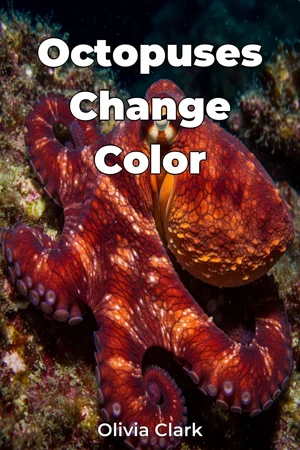
Have you ever wondered how octopuses vanish before your very eyes, seamlessly blending into their surroundings? This book, "Octopuses Change Color," delves into the science behind this remarkable ability, exploring the intricate mechanisms of cephalopod camouflage and its significance in the marine world. We will examine how these masters of disguise employ specialized pigment-containing cells called chromatophores to achieve such rapid and dramatic transformations. Understanding this process offers valuable insights into the fields of marine biology, neuroscience, and even materials science. This book stands as a comprehensive study of cephalopod camouflage, placing it within a historical and scientific context. We will begin by reviewing the early scientific observations of cephalopod color change, tracing the evolution of our understanding from simple descriptions to complex physiological models. No prior expertise is required; we will build foundational knowledge about marine ecosystems, cell biology, and basic optics before diving into the intricacies of chromatophore function. At its core, "Octopuses Change Color" argues that cephalopod camouflage represents a pinnacle of evolutionary adaptation, showcasing the profound interplay between genetics, environment, and behavior. This assertion is vital because it highlights the power of natural selection in shaping complex biological systems and offers potential bio-inspired solutions for technological advancements. The book unfolds in a structured way. First, we introduce the diversity of cephalopods and their habitats, emphasizing the ecological pressures that have driven the evolution of camouflage. Next, we explore the cellular mechanisms of color change, focusing on the structure and function of chromatophores, iridophores, and leucophores – the key players in this visual deception. We then examine the neural control of these cells, detailing how the octopus brain orchestrates rapid and coordinated changes in skin patterns. The culmination of these discussions lies in an analysis of the behavioral ecology of camouflage, demonstrating how octopuses use their color-changing abilities to evade predators, ambush prey, and communicate with one another. Our arguments are grounded in rigorous scientific research, drawing upon a wealth of data from laboratory experiments, field observations, and cutting-edge imaging techniques. We present original analyses of high-resolution video recordings of octopus camouflage, providing compelling visual evidence of the speed and precision of these transformations. The book also incorporates data from genomic studies, shedding light on the genetic basis of chromatophore development and function. This study has interdisciplinary connections. Firstly, with neuroscience, exploring the complex neural pathways that control color change. Secondly, with materials science, where the unique properties of cephalopod skin inspire the development of novel camouflage technologies. We offer a unique perspective by integrating multiple levels of analysis, from molecular mechanisms to ecological consequences. This holistic approach provides a more complete understanding of cephalopod camouflage than traditional reductionist studies. The writing style maintains a balance between scientific rigor and accessibility, making the book suitable for a broad audience. We explain complex concepts in a clear and concise manner, using illustrative examples and engaging visuals to enhance understanding. "Octopuses Change Color" is targeted towards students, researchers, and anyone with a passion for marine biology, animal behavior, or evolutionary biology. The book provides a valuable resource for educators seeking to incorporate cutting-edge research into their curricula. As a work of science, this book adheres to standards of accuracy, objectivity, and evidence-based reasoning. We acknowledge the limitations of current knowledge and identify areas for future research. While the book focuses on the visual aspects of camouflage, it acknowledges other sensory modalities involved in predator-prey interactions, such as chemoreception and mechanoreception. The book's exploration of cephalopod camouflage has real-world implications, informing the development of improved camouflage materials for military and civilian applications. The principles of cephalopod skin design can also be applied to the creation of adaptive optics and smart textiles. While the mechanisms of chromatophore control are relatively well understood, debates persist regarding the role of peripheral feedback in fine-tuning camouflage patterns. We acknowledge these ongoing discussions and present alternative viewpoints, fostering a spirit of critical inquiry.
Have you ever wondered how octopuses vanish before your very eyes, seamlessly blending into their surroundings? This book, "Octopuses Change Color," delves into the science behind this remarkable ability, exploring the intricate mechanisms of cephalopod camouflage and its significance in the marine world. We will examine how these masters of disguise employ specialized pigment-containing cells called chromatophores to achieve such rapid and dramatic transformations. Understanding this process offers valuable insights into the fields of marine biology, neuroscience, and even materials science. This book stands as a comprehensive study of cephalopod camouflage, placing it within a historical and scientific context. We will begin by reviewing the early scientific observations of cephalopod color change, tracing the evolution of our understanding from simple descriptions to complex physiological models. No prior expertise is required; we will build foundational knowledge about marine ecosystems, cell biology, and basic optics before diving into the intricacies of chromatophore function. At its core, "Octopuses Change Color" argues that cephalopod camouflage represents a pinnacle of evolutionary adaptation, showcasing the profound interplay between genetics, environment, and behavior. This assertion is vital because it highlights the power of natural selection in shaping complex biological systems and offers potential bio-inspired solutions for technological advancements. The book unfolds in a structured way. First, we introduce the diversity of cephalopods and their habitats, emphasizing the ecological pressures that have driven the evolution of camouflage. Next, we explore the cellular mechanisms of color change, focusing on the structure and function of chromatophores, iridophores, and leucophores – the key players in this visual deception. We then examine the neural control of these cells, detailing how the octopus brain orchestrates rapid and coordinated changes in skin patterns. The culmination of these discussions lies in an analysis of the behavioral ecology of camouflage, demonstrating how octopuses use their color-changing abilities to evade predators, ambush prey, and communicate with one another. Our arguments are grounded in rigorous scientific research, drawing upon a wealth of data from laboratory experiments, field observations, and cutting-edge imaging techniques. We present original analyses of high-resolution video recordings of octopus camouflage, providing compelling visual evidence of the speed and precision of these transformations. The book also incorporates data from genomic studies, shedding light on the genetic basis of chromatophore development and function. This study has interdisciplinary connections. Firstly, with neuroscience, exploring the complex neural pathways that control color change. Secondly, with materials science, where the unique properties of cephalopod skin inspire the development of novel camouflage technologies. We offer a unique perspective by integrating multiple levels of analysis, from molecular mechanisms to ecological consequences. This holistic approach provides a more complete understanding of cephalopod camouflage than traditional reductionist studies. The writing style maintains a balance between scientific rigor and accessibility, making the book suitable for a broad audience. We explain complex concepts in a clear and concise manner, using illustrative examples and engaging visuals to enhance understanding. "Octopuses Change Color" is targeted towards students, researchers, and anyone with a passion for marine biology, animal behavior, or evolutionary biology. The book provides a valuable resource for educators seeking to incorporate cutting-edge research into their curricula. As a work of science, this book adheres to standards of accuracy, objectivity, and evidence-based reasoning. We acknowledge the limitations of current knowledge and identify areas for future research. While the book focuses on the visual aspects of camouflage, it acknowledges other sensory modalities involved in predator-prey interactions, such as chemoreception and mechanoreception. The book's exploration of cephalopod camouflage has real-world implications, informing the development of improved camouflage materials for military and civilian applications. The principles of cephalopod skin design can also be applied to the creation of adaptive optics and smart textiles. While the mechanisms of chromatophore control are relatively well understood, debates persist regarding the role of peripheral feedback in fine-tuning camouflage patterns. We acknowledge these ongoing discussions and present alternative viewpoints, fostering a spirit of critical inquiry.
"Octopuses Change Color" explores the fascinating science behind cephalopod camouflage, revealing how these marine creatures use specialized cells called chromatophores to instantaneously blend into their surroundings. This remarkable ability, driven by evolutionary adaptation and natural selection, allows octopuses to evade predators and ambush prey, showcasing a sophisticated interplay between genetics, environment, and behavior. Delving into the intricacies of marine biology and neuroscience, the book highlights how the octopus brain orchestrates rapid color changes, offering valuable insights into visual deception. The book begins by tracing the history of understanding cephalopod color change, building foundational knowledge of marine ecosystems and optics before diving into cellular mechanisms. It examines the structure and function of chromatophores, iridophores, and leucophores, and how their neural control allows octopuses to master visual deception. Through laboratory experiments and field observations, "Octopuses Change Color" presents compelling evidence of the speed and precision of these transformations, even incorporating genomic studies that shed light on chromatophore development. This comprehensive study integrates multiple levels of analysis, from molecular mechanisms to ecological consequences, providing a holistic understanding of cephalopod camouflage. Its exploration has interdisciplinary connections with neuroscience and materials science, where properties of cephalopod skin inspire novel camouflage technologies. Targeted toward students, researchers, and enthusiasts of marine biology, the book offers a balanced approach, maintaining scientific rigor while remaining accessible and engaging.
Book Details
ISBN
9788235208460
Publisher
Publifye AS
Your Licenses
You don't own any licenses for this book
Purchase a license below to unlock this book and download the EPUB.
Purchase License
Select a tier to unlock this book
Need bulk licensing?
Contact us for enterprise agreements.