
About This Book
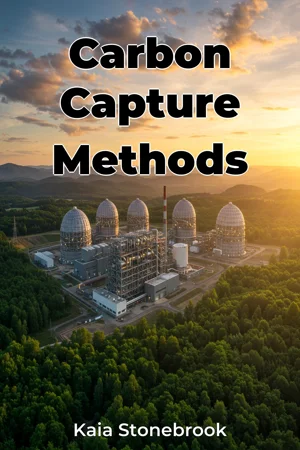
Can humanity effectively reverse its impact on the Earth's climate before irreversible damage is done? "Carbon Capture Methods" provides a comprehensive investigation into the technologies currently being developed and deployed to mitigate the escalating crisis of carbon emissions. This book addresses two central questions: what are the most promising carbon capture technologies, and how can these methods be implemented effectively and equitably on a global scale? The book delves into three main areas crucial to understanding carbon capture: point-source capture, direct air capture, and carbon utilization and storage. Point-source capture, the process of trapping carbon dioxide emissions directly from industrial sources like power plants and factories, is examined in detail, including assessments of various absorbent materials and technological designs. Direct air capture, a more nascent but potentially transformative technology, which involves extracting carbon dioxide directly from the atmosphere, is analyzed, focusing on the energy requirements and scalability challenges. The often-overlooked facet of the carbon cycle, utilization and storage, forms the third pillar, with chapters dedicated to converting captured carbon into valuable products and securely storing it underground to prevent re-entry into the atmosphere. Understanding the urgency of climate change requires appreciating the context of historical carbon emissions and the role of industrialization in accelerating this process. The book provides a concise historical overview of these developments, setting the stage for understanding how the concentration of atmospheric carbon dioxide has reached levels unprecedented in human history. The central argument of "Carbon Capture Methods" asserts that a multi-faceted approach, combining technological innovation with thoughtful policy implementation, is essential for successfully mitigating climate change. The book advances this argument by presenting a systematic analysis of the scientific literature, technological advancements, and potential economic and societal impacts of carbon capture technologies. The book begins by establishing a scientific foundation for understanding carbon cycles and the greenhouse effect. Following this introduction, it systematically examines the three main domains of carbon capture: point-source capture technologies, direct air capture technologies, and methods for carbon utilization and storage. Each section includes technological descriptions, efficiency analyses, cost evaluations, and discussions of environmental impact. It culminates in a chapter on policy recommendations and proposes incentive structures to encourage widespread adoption and innovation. The book relies on a broad array of empirical data, including peer-reviewed scientific studies, government reports, and industry data. Technology performance is assessed through engineering simulations and field test results. Economic factors are examined using cost-benefit analyses, considering both direct costs and externalities such as environmental impacts. "Carbon Capture Methods" draws connections between environmental science, engineering, economics, and policy. Environmental science provides the foundation for understanding the urgency of carbon reduction. Engineering provides the toolkit for analyzing and developing technology solutions. Economics informs the discussion of cost-effectiveness and policy incentives. Policy provides frameworks for global and effective deployment of carbon capture methods. This book stands apart by offering an integrated perspective that bridges the gap between theoretical research and practical implementation. It provides a balanced assessment of various proposed technologies, acknowledging challenges and limitations alongside potential benefits, rather than advocating for one single solution. The book uses a scientific, and non-sensational tone throughout and is designed for a diverse audience, including students, researchers, policymakers, and environmentally conscious citizens. A basic understanding of scientific principles is helpful, but a conscious effort is made to explain complex concepts accessibly. The book’s target readership includes advanced undergraduate and graduate students in environmental science, engineering, and related fields; policy analysts working on climate change mitigation strategies; and individuals in the private sector involved in developing and implementing carbon capture technologies. For students, it provides a comprehensive overview of the field, highlighting the latest research and technological advancements. For policy analysts, it offers an evidence-based assessment of various policy options. For professionals, it offers a practical guide to implementing carbon capture technologies. The book consciously limits its scope to the technological and policy aspects of carbon capture, while acknowledging the broader social and ethical considerations that are also crucial for addressing climate change. The information presented in "Carbon Capture Methods" has direct real-world applications: Engineers can use it to inform the design and development of new carbon capture technologies; policymakers can use it to develop effective incentives and regulations; and investors can use it to identify promising technologies and investment opportunities. The book addresses ongoing debates within the field, such as the cost-effectiveness of direct air capture compared to point-source capture, the environmental impacts of different storage methods, and the ethical implications of relying on carbon capture as a substitute for reducing emissions.
Can humanity effectively reverse its impact on the Earth's climate before irreversible damage is done? "Carbon Capture Methods" provides a comprehensive investigation into the technologies currently being developed and deployed to mitigate the escalating crisis of carbon emissions. This book addresses two central questions: what are the most promising carbon capture technologies, and how can these methods be implemented effectively and equitably on a global scale? The book delves into three main areas crucial to understanding carbon capture: point-source capture, direct air capture, and carbon utilization and storage. Point-source capture, the process of trapping carbon dioxide emissions directly from industrial sources like power plants and factories, is examined in detail, including assessments of various absorbent materials and technological designs. Direct air capture, a more nascent but potentially transformative technology, which involves extracting carbon dioxide directly from the atmosphere, is analyzed, focusing on the energy requirements and scalability challenges. The often-overlooked facet of the carbon cycle, utilization and storage, forms the third pillar, with chapters dedicated to converting captured carbon into valuable products and securely storing it underground to prevent re-entry into the atmosphere. Understanding the urgency of climate change requires appreciating the context of historical carbon emissions and the role of industrialization in accelerating this process. The book provides a concise historical overview of these developments, setting the stage for understanding how the concentration of atmospheric carbon dioxide has reached levels unprecedented in human history. The central argument of "Carbon Capture Methods" asserts that a multi-faceted approach, combining technological innovation with thoughtful policy implementation, is essential for successfully mitigating climate change. The book advances this argument by presenting a systematic analysis of the scientific literature, technological advancements, and potential economic and societal impacts of carbon capture technologies. The book begins by establishing a scientific foundation for understanding carbon cycles and the greenhouse effect. Following this introduction, it systematically examines the three main domains of carbon capture: point-source capture technologies, direct air capture technologies, and methods for carbon utilization and storage. Each section includes technological descriptions, efficiency analyses, cost evaluations, and discussions of environmental impact. It culminates in a chapter on policy recommendations and proposes incentive structures to encourage widespread adoption and innovation. The book relies on a broad array of empirical data, including peer-reviewed scientific studies, government reports, and industry data. Technology performance is assessed through engineering simulations and field test results. Economic factors are examined using cost-benefit analyses, considering both direct costs and externalities such as environmental impacts. "Carbon Capture Methods" draws connections between environmental science, engineering, economics, and policy. Environmental science provides the foundation for understanding the urgency of carbon reduction. Engineering provides the toolkit for analyzing and developing technology solutions. Economics informs the discussion of cost-effectiveness and policy incentives. Policy provides frameworks for global and effective deployment of carbon capture methods. This book stands apart by offering an integrated perspective that bridges the gap between theoretical research and practical implementation. It provides a balanced assessment of various proposed technologies, acknowledging challenges and limitations alongside potential benefits, rather than advocating for one single solution. The book uses a scientific, and non-sensational tone throughout and is designed for a diverse audience, including students, researchers, policymakers, and environmentally conscious citizens. A basic understanding of scientific principles is helpful, but a conscious effort is made to explain complex concepts accessibly. The book’s target readership includes advanced undergraduate and graduate students in environmental science, engineering, and related fields; policy analysts working on climate change mitigation strategies; and individuals in the private sector involved in developing and implementing carbon capture technologies. For students, it provides a comprehensive overview of the field, highlighting the latest research and technological advancements. For policy analysts, it offers an evidence-based assessment of various policy options. For professionals, it offers a practical guide to implementing carbon capture technologies. The book consciously limits its scope to the technological and policy aspects of carbon capture, while acknowledging the broader social and ethical considerations that are also crucial for addressing climate change. The information presented in "Carbon Capture Methods" has direct real-world applications: Engineers can use it to inform the design and development of new carbon capture technologies; policymakers can use it to develop effective incentives and regulations; and investors can use it to identify promising technologies and investment opportunities. The book addresses ongoing debates within the field, such as the cost-effectiveness of direct air capture compared to point-source capture, the environmental impacts of different storage methods, and the ethical implications of relying on carbon capture as a substitute for reducing emissions.
"Carbon Capture Methods" offers a comprehensive look at the technologies designed to combat rising carbon emissions and mitigate climate change. This book dives into the science, engineering, and policy surrounding carbon capture, addressing how these methods can be effectively implemented on a global scale. It explores point-source capture, which traps carbon dioxide from industrial sources, and direct air capture, extracting CO2 directly from the atmosphere, highlighting the challenges and potential of each. The book further examines carbon utilization and storage, an often-overlooked part of the carbon cycle, crucial for converting captured carbon into valuable products and safely storing it. The book uniquely bridges the gap between research and real-world application, systematically analyzing scientific literature, technological advancements, and the economic impacts of carbon capture. Readers gain insights into the historical context of carbon emissions and the environmental impact of the greenhouse effect. Beginning with a scientific foundation on carbon cycles, the book progresses through technological descriptions, efficiency analyses, cost evaluations, and policy recommendations, providing a balanced assessment of various technologies and acknowledging their limitations alongside potential benefits. Ultimately, "Carbon Capture Methods" argues for a multi-faceted approach, combining technological innovation with thoughtful policy implementation. It draws from environmental science, engineering, and economics to provide an integrated perspective, making it a valuable resource for students, researchers, policymakers, and anyone interested in understanding and addressing the climate crisis.
Book Details
ISBN
9788235208248
Publisher
Publifye AS
Your Licenses
You don't own any licenses for this book
Purchase a license below to unlock this book and download the EPUB.
Purchase License
Select a tier to unlock this book
Need bulk licensing?
Contact us for enterprise agreements.