
About This Book
Have you ever considered the critical role fog plays in the survival of coastal plant life? "Fog Drinks Plants" delves into the fascinating world of how specific flora in coastal regions have evolved to absorb and utilize moisture directly from fog, a phenomenon vital to their existence and the broader ecosystem. This exploration moves beyond a simple observation to uncover intricate biological mechanisms and ecological dependencies. Our investigation centers on two primary topics: the physiological adaptations of plants enabling fog capture and the ecological significance of fog as a water source in water-limited coastal environments. Understanding these topics is crucial because it reshapes our perception of water availability in seemingly arid landscapes and highlights the vulnerability of these unique ecosystems to climate change. Historically, the reliance of certain plant species on non-traditional water sources like fog was often overlooked. Traditional botanical studies focused primarily on root-based water uptake, neglecting the contribution of aerial moisture. However, recent advancements in plant physiology and ecohydrology have shed light on the importance of fog interception, especially in regions with limited rainfall. A basic understanding of plant anatomy, particularly leaf structures and water transport mechanisms, is beneficial for appreciating the intricacies discussed. The central argument of "Fog Drinks Plants" posits that fog interception represents a pivotal adaptation strategy for coastal flora, directly influencing their distribution, abundance, and resilience. We demonstrate that fog, rather than being a mere atmospheric phenomenon, is a critical driver of ecological processes in these areas. This argument holds significant implications for conservation efforts, as it underscores the need to protect fog-dependent ecosystems from habitat destruction and altered climate patterns. The book unfolds in a structured manner, beginning with an introduction to the concept of atmospheric water harvesting by plants. We then explore the morphological and physiological adaptations that enable efficient fog capture, with dedicated chapters examining specialized leaf structures, such as trichomes and waxy coatings, and their roles in water condensation and absorption. Following this, we analyze the ecological implications of fog as a water source, focusing on species-specific dependencies and the broader community-level effects. The book culminates in a discussion of the threats posed by climate change and habitat degradation to fog-dependent ecosystems, and proposes management strategies for their conservation. The evidence presented is drawn from a combination of field observations, controlled experiments, and laboratory analyses. Unique data sources include isotopic analyses of plant tissues to trace the origin of water, micrometeorological measurements of fog deposition rates, and comparative studies of plant performance under varying fog regimes. “Fog Drinks Plants” connects to several interdisciplinary fields, including atmospheric science (studying fog formation and distribution), hydrology (examining water cycling in ecosystems), and climate change ecology (assessing the impacts of altered fog patterns on plant communities). These connections demonstrate the far-reaching nature of our topic. Our approach stands out due to its integration of physiological, ecological, and climatological perspectives. We present a comprehensive overview of fog interception by plants, moving beyond descriptive accounts to unveil the underlying mechanisms and ecological consequences. The writing style balances scientific rigor with accessibility, making the content engaging for both academic researchers and environmentally conscious readers. The target audience includes botanists, ecologists, conservation biologists, environmental scientists, and anyone interested in plant adaptations and coastal ecosystems. This book offers valuable insights into the ecological importance of fog and the challenges facing fog-dependent plant communities. Conforming to the conventions of the scientific non-fiction genre, the book provides comprehensive references and detailed methodologies to substantiate its claims. The scope of the book is intentionally limited to coastal fog-dependent ecosystems, focusing primarily on plant adaptations and ecological processes. While we acknowledge the role of fog in other environments, such as cloud forests, these are not the primary focus. The information in "Fog Drinks Plants" can be applied in practical ways, such as guiding conservation efforts, informing land management practices, and developing strategies for mitigating the impacts of climate change on coastal ecosystems. Finally, this book addresses ongoing debates regarding the relative contribution of fog versus other water sources to plant water budgets, providing new data and insights to resolve conflicting viewpoints.
Have you ever considered the critical role fog plays in the survival of coastal plant life? "Fog Drinks Plants" delves into the fascinating world of how specific flora in coastal regions have evolved to absorb and utilize moisture directly from fog, a phenomenon vital to their existence and the broader ecosystem. This exploration moves beyond a simple observation to uncover intricate biological mechanisms and ecological dependencies. Our investigation centers on two primary topics: the physiological adaptations of plants enabling fog capture and the ecological significance of fog as a water source in water-limited coastal environments. Understanding these topics is crucial because it reshapes our perception of water availability in seemingly arid landscapes and highlights the vulnerability of these unique ecosystems to climate change. Historically, the reliance of certain plant species on non-traditional water sources like fog was often overlooked. Traditional botanical studies focused primarily on root-based water uptake, neglecting the contribution of aerial moisture. However, recent advancements in plant physiology and ecohydrology have shed light on the importance of fog interception, especially in regions with limited rainfall. A basic understanding of plant anatomy, particularly leaf structures and water transport mechanisms, is beneficial for appreciating the intricacies discussed. The central argument of "Fog Drinks Plants" posits that fog interception represents a pivotal adaptation strategy for coastal flora, directly influencing their distribution, abundance, and resilience. We demonstrate that fog, rather than being a mere atmospheric phenomenon, is a critical driver of ecological processes in these areas. This argument holds significant implications for conservation efforts, as it underscores the need to protect fog-dependent ecosystems from habitat destruction and altered climate patterns. The book unfolds in a structured manner, beginning with an introduction to the concept of atmospheric water harvesting by plants. We then explore the morphological and physiological adaptations that enable efficient fog capture, with dedicated chapters examining specialized leaf structures, such as trichomes and waxy coatings, and their roles in water condensation and absorption. Following this, we analyze the ecological implications of fog as a water source, focusing on species-specific dependencies and the broader community-level effects. The book culminates in a discussion of the threats posed by climate change and habitat degradation to fog-dependent ecosystems, and proposes management strategies for their conservation. The evidence presented is drawn from a combination of field observations, controlled experiments, and laboratory analyses. Unique data sources include isotopic analyses of plant tissues to trace the origin of water, micrometeorological measurements of fog deposition rates, and comparative studies of plant performance under varying fog regimes. “Fog Drinks Plants” connects to several interdisciplinary fields, including atmospheric science (studying fog formation and distribution), hydrology (examining water cycling in ecosystems), and climate change ecology (assessing the impacts of altered fog patterns on plant communities). These connections demonstrate the far-reaching nature of our topic. Our approach stands out due to its integration of physiological, ecological, and climatological perspectives. We present a comprehensive overview of fog interception by plants, moving beyond descriptive accounts to unveil the underlying mechanisms and ecological consequences. The writing style balances scientific rigor with accessibility, making the content engaging for both academic researchers and environmentally conscious readers. The target audience includes botanists, ecologists, conservation biologists, environmental scientists, and anyone interested in plant adaptations and coastal ecosystems. This book offers valuable insights into the ecological importance of fog and the challenges facing fog-dependent plant communities. Conforming to the conventions of the scientific non-fiction genre, the book provides comprehensive references and detailed methodologies to substantiate its claims. The scope of the book is intentionally limited to coastal fog-dependent ecosystems, focusing primarily on plant adaptations and ecological processes. While we acknowledge the role of fog in other environments, such as cloud forests, these are not the primary focus. The information in "Fog Drinks Plants" can be applied in practical ways, such as guiding conservation efforts, informing land management practices, and developing strategies for mitigating the impacts of climate change on coastal ecosystems. Finally, this book addresses ongoing debates regarding the relative contribution of fog versus other water sources to plant water budgets, providing new data and insights to resolve conflicting viewpoints.
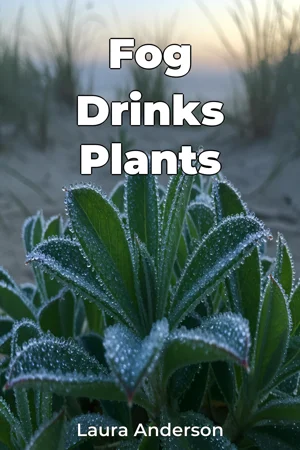
"Fog Drinks Plants" explores the remarkable adaptations of coastal plants that allow them to thrive by capturing moisture directly from fog. This vital, yet often overlooked, water source plays a critical role in these ecosystems. Understanding the biological mechanisms behind fog interception reveals how specialized leaf structures, like tiny hairs and waxy coatings, enable plants to condense and absorb water from the air, offering a unique insight into plant physiology and water availability in arid landscapes. The book examines the ecological significance of fog, demonstrating its influence on plant distribution, abundance, and overall resilience in water-limited coastal environments. It highlights how these fog-dependent ecosystems are particularly vulnerable to climate change and habitat destruction. Progressing from an introduction to atmospheric water harvesting, the book delves into morphological adaptations, ecological implications, and concludes with a discussion on conservation strategies, offering a comprehensive view of fog's importance. This book stands out by integrating physiological, ecological, and climatological perspectives, presenting a holistic understanding of fog interception. By combining field observations with laboratory analyses, "Fog Drinks Plants" emphasizes the need to protect these unique ecosystems, making it valuable for both researchers and anyone interested in botany, environmental science, and the intricate relationship between nature and plant adaptations.
Book Details
ISBN
9788235207678
Publisher
Publifye AS
Your Licenses
You don't own any licenses for this book
Purchase a license below to unlock this book and download the EPUB.
Purchase License
Select a tier to unlock this book
Need bulk licensing?
Contact us for enterprise agreements.