
About This Book
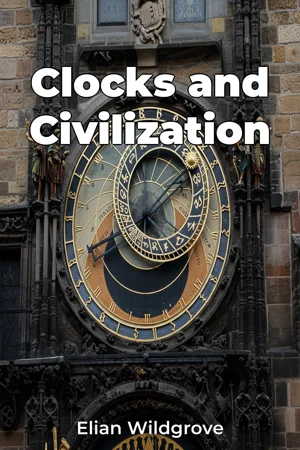
How did the measurement of something as intangible as time come to define civilization itself? "Clocks and Civilization" explores the fascinating interplay between timekeeping technologies and the evolution of societies, examining how innovations in measuring time have not only shaped our daily routines but also driven economic, social, and cultural transformations across history. This book delves into three central themes: the technological advancements in clockmaking from antiquity to the digital age, the profound impact of standardized time on industries such as transportation and manufacturing, and the ways in which societal norms and power structures have been influenced by the synchronization of human activities. Understanding the history of timekeeping requires appreciating the pre-clock world, where daily life was governed by natural rhythms and localized events. The development of mechanical clocks in medieval Europe marked a significant departure, enabling a more abstract and universally applicable concept of time. This shift laid the groundwork for the scientific revolution and the subsequent industrial era, demanding precise coordination and scheduling. The central argument of "Clocks and Civilization" is that timekeeping technologies are not merely tools for measuring duration; they are powerful forces that have fundamentally reshaped human organization and perception. By tracing the evolution of clocks and calendars, the book demonstrates how these innovations have driven efficiency, fostered interconnectedness, and, at times, reinforced social control. This argument is crucial for understanding how deeply embedded time management is in our modern world and its continuing influence on our future. The book is structured to guide readers through a chronological journey, starting with an examination of early timekeeping methods like sundials and water clocks, setting the stage for the emergence of mechanical clockwork. Subsequent chapters delve into the rise of precision horology and its impact on navigation, trade, and scientific discovery. The narrative progresses to explore the introduction of standardized time zones and the challenges of synchronizing global activities in the 19th and 20th centuries. Finally, the book addresses the digital revolution and its implications for the future of time, considering the potential for both increased efficiency and new forms of temporal disruption. The analysis presented in "Clocks and Civilization" relies on diverse sources, including historical clockmakers' archives, patent records, scientific publications, and sociological studies of time management. It also draws on the work of historians and philosophers who have explored the cultural and psychological dimensions of time. This book makes interdisciplinary connections across technology, history, and sociology. Exploring the history of technology provides a rich context for understanding the mechanical ingenuity behind clocks. Historical analysis reveals how timekeeping practices have influenced social structures and power dynamics. Sociological insights offer a framework for understanding how individuals and communities experience and negotiate the temporal demands of modern life. "Clocks and Civilization" offers a unique perspective by integrating technical details of clockmaking with broader social and cultural analyses. This integrated approach challenges traditional disciplinary boundaries and provides a more holistic understanding of time's impact. This book is written in a clear and accessible style, suitable for a broad audience. The intended readership includes students of history, technology enthusiasts, and anyone interested in understanding the hidden forces that shape modern society. It avoids technical jargon and presents complex ideas in an engaging and thought-provoking manner. As a work of non-fiction, "Clocks and Civilization" adheres to the genre's emphasis on factual accuracy, clear argumentation, and evidence-based analysis. While the book covers a wide range of historical periods and geographical regions, the emphasis remains on Western civilization's experience with timekeeping innovations, acknowledging the potential for further research into non-Western traditions. The information in this book has real-world applications for professionals in fields such as project management, logistics, and public policy. By understanding the historical roots of our time-conscious culture, readers can gain valuable insights into the challenges and opportunities of managing time in an increasingly complex and interconnected world. Finally, "Clocks and Civilization" addresses ongoing debates about the nature of time, including questions about the impact of digital technologies on our perception of duration and the potential for alternative models of time management that prioritize well-being over efficiency.
How did the measurement of something as intangible as time come to define civilization itself? "Clocks and Civilization" explores the fascinating interplay between timekeeping technologies and the evolution of societies, examining how innovations in measuring time have not only shaped our daily routines but also driven economic, social, and cultural transformations across history. This book delves into three central themes: the technological advancements in clockmaking from antiquity to the digital age, the profound impact of standardized time on industries such as transportation and manufacturing, and the ways in which societal norms and power structures have been influenced by the synchronization of human activities. Understanding the history of timekeeping requires appreciating the pre-clock world, where daily life was governed by natural rhythms and localized events. The development of mechanical clocks in medieval Europe marked a significant departure, enabling a more abstract and universally applicable concept of time. This shift laid the groundwork for the scientific revolution and the subsequent industrial era, demanding precise coordination and scheduling. The central argument of "Clocks and Civilization" is that timekeeping technologies are not merely tools for measuring duration; they are powerful forces that have fundamentally reshaped human organization and perception. By tracing the evolution of clocks and calendars, the book demonstrates how these innovations have driven efficiency, fostered interconnectedness, and, at times, reinforced social control. This argument is crucial for understanding how deeply embedded time management is in our modern world and its continuing influence on our future. The book is structured to guide readers through a chronological journey, starting with an examination of early timekeeping methods like sundials and water clocks, setting the stage for the emergence of mechanical clockwork. Subsequent chapters delve into the rise of precision horology and its impact on navigation, trade, and scientific discovery. The narrative progresses to explore the introduction of standardized time zones and the challenges of synchronizing global activities in the 19th and 20th centuries. Finally, the book addresses the digital revolution and its implications for the future of time, considering the potential for both increased efficiency and new forms of temporal disruption. The analysis presented in "Clocks and Civilization" relies on diverse sources, including historical clockmakers' archives, patent records, scientific publications, and sociological studies of time management. It also draws on the work of historians and philosophers who have explored the cultural and psychological dimensions of time. This book makes interdisciplinary connections across technology, history, and sociology. Exploring the history of technology provides a rich context for understanding the mechanical ingenuity behind clocks. Historical analysis reveals how timekeeping practices have influenced social structures and power dynamics. Sociological insights offer a framework for understanding how individuals and communities experience and negotiate the temporal demands of modern life. "Clocks and Civilization" offers a unique perspective by integrating technical details of clockmaking with broader social and cultural analyses. This integrated approach challenges traditional disciplinary boundaries and provides a more holistic understanding of time's impact. This book is written in a clear and accessible style, suitable for a broad audience. The intended readership includes students of history, technology enthusiasts, and anyone interested in understanding the hidden forces that shape modern society. It avoids technical jargon and presents complex ideas in an engaging and thought-provoking manner. As a work of non-fiction, "Clocks and Civilization" adheres to the genre's emphasis on factual accuracy, clear argumentation, and evidence-based analysis. While the book covers a wide range of historical periods and geographical regions, the emphasis remains on Western civilization's experience with timekeeping innovations, acknowledging the potential for further research into non-Western traditions. The information in this book has real-world applications for professionals in fields such as project management, logistics, and public policy. By understanding the historical roots of our time-conscious culture, readers can gain valuable insights into the challenges and opportunities of managing time in an increasingly complex and interconnected world. Finally, "Clocks and Civilization" addresses ongoing debates about the nature of time, including questions about the impact of digital technologies on our perception of duration and the potential for alternative models of time management that prioritize well-being over efficiency.
"Clocks and Civilization" explores how timekeeping technologies have profoundly shaped societies. It examines the evolution of clocks, from ancient sundials to digital devices, highlighting how these advancements have affected everything from daily routines to global industries. One intriguing insight is how the development of mechanical clocks in medieval Europe spurred the scientific revolution by enabling precise coordination. The book also delves into the social impact of time, illustrating how standardized time zones revolutionized transportation and manufacturing. The book traces this history chronologically, beginning with early methods of time measurement and progressing through the rise of mechanical clockwork and precision horology. It then examines the introduction of standardized time and the challenges of global synchronization. The narrative culminates with an exploration of the digital revolution and its implications for our perception of time. By integrating technological details with social and cultural analyses, "Clocks and Civilization" offers a unique perspective on how time measurement has become a driving force in human organization and culture, influencing even our social structures.
Book Details
ISBN
9788235206442
Publisher
Publifye AS
Your Licenses
You don't own any licenses for this book
Purchase a license below to unlock this book and download the EPUB.
Purchase License
Select a tier to unlock this book
Need bulk licensing?
Contact us for enterprise agreements.