
About This Book
In an era defined by increasing concerns about food access and environmental sustainability, can community gardens offer a tangible solution? "Community Garden Growth" explores the multifaceted role of community gardens in bolstering food security, examining their social, economic, and environmental impacts within the context of both local communities and broader social systems. This book argues that community gardens, while often perceived as localized initiatives, represent a significant, scalable strategy for enhancing food security and promoting community resilience. This book delves into three key areas: the historical evolution of community gardens, their impact on household food security, and their potential as tools for community development. Understanding the roots of the community garden movement, from their emergence during wartime to their contemporary resurgence, is crucial for appreciating their current form and function. The analysis of household food security examines the extent to which participation in community gardens can alleviate food insecurity, particularly among vulnerable populations. Finally, the exploration of community development potential assesses how these gardens can foster social cohesion, promote healthy lifestyles, and contribute to local economic growth. The book will provide a historical overview of the community garden movement, tracing its development from the Victory Gardens of World War I and II to the urban agriculture initiatives of today. This historical context provides a foundation for understanding the social and political forces that have shaped the movement and continue to influence its trajectory. We will also examine the social and economic factors that contribute to food insecurity, including poverty, unemployment, and lack of access to affordable, nutritious food. This background is essential for understanding the challenges that community gardens seek to address. "Community Garden Growth" presents the argument that community gardens are not merely aesthetically pleasing spaces; they are vital components of a sustainable food system, contributing significantly to enhanced food access. This argument is supported by a detailed analysis of existing research, case studies of successful community garden initiatives, and original survey data collected from community gardeners across diverse socioeconomic backgrounds. The book's structure progresses logically, beginning with an introduction to the core concepts of food security and community gardening. It moves through an examination of the historical and social context of the movement. Subsequent sections offer in-depth analyses of the impact of community gardens on household food security, community development, and environmental sustainability. The book culminates with a discussion of policy recommendations and practical strategies for promoting the growth and sustainability of community gardens. We will offer detailed examples of successful programs and policies, providing a roadmap for communities seeking to implement or expand their own gardening initiatives. The evidence presented includes statistical data on food insecurity rates, nutritional analyses of garden produce, and qualitative data gathered through interviews and focus groups with community gardeners and stakeholders. Moreover, the book draws upon interdisciplinary research from fields such as sociology, environmental science, public health, and urban planning to provide a holistic understanding of the role of community gardens. This book connects to fields such as environmental studies through its examination of sustainable agriculture practices; public health via its assessment of the nutritional benefits of gardening; and urban planning by considering the integration of gardens into urban landscapes. These interdisciplinary connections enrich the analysis and highlight the broad relevance of community gardens. The book adopts a balanced, evidence-based approach, presenting both the benefits and limitations of community gardens as a strategy for promoting food security. It avoids overly optimistic or simplistic portrayals, instead offering a nuanced perspective grounded in empirical research and real-world experience. The conversational yet academic tone invites a broad audience. The target audience includes academics, students, policymakers, community organizers, and anyone interested in sustainable food systems and community development. This book would be valuable to those researching food security, urban agriculture, or community development, as well as practitioners seeking to implement or improve community garden initiatives. As a work of social science and gardening, it seeks to ground theoretical insights in practical applications, and is structured to appeal to readers interested in both academic rigor and practical guidance. The scope of the book is limited to community gardens in developed countries, primarily focusing on the United States and Europe. While the principles discussed may be applicable to other contexts, the specific case studies and policy recommendations are tailored to these regions. The strategies and information can be directly applied to establishing new community gardens, improving the operation of existing ones, or advocating for policies that support urban agriculture. Furthermore, it is relevant to ongoing debates about the most effective strategies for addressing food insecurity and promoting sustainable, resilient communities.
In an era defined by increasing concerns about food access and environmental sustainability, can community gardens offer a tangible solution? "Community Garden Growth" explores the multifaceted role of community gardens in bolstering food security, examining their social, economic, and environmental impacts within the context of both local communities and broader social systems. This book argues that community gardens, while often perceived as localized initiatives, represent a significant, scalable strategy for enhancing food security and promoting community resilience. This book delves into three key areas: the historical evolution of community gardens, their impact on household food security, and their potential as tools for community development. Understanding the roots of the community garden movement, from their emergence during wartime to their contemporary resurgence, is crucial for appreciating their current form and function. The analysis of household food security examines the extent to which participation in community gardens can alleviate food insecurity, particularly among vulnerable populations. Finally, the exploration of community development potential assesses how these gardens can foster social cohesion, promote healthy lifestyles, and contribute to local economic growth. The book will provide a historical overview of the community garden movement, tracing its development from the Victory Gardens of World War I and II to the urban agriculture initiatives of today. This historical context provides a foundation for understanding the social and political forces that have shaped the movement and continue to influence its trajectory. We will also examine the social and economic factors that contribute to food insecurity, including poverty, unemployment, and lack of access to affordable, nutritious food. This background is essential for understanding the challenges that community gardens seek to address. "Community Garden Growth" presents the argument that community gardens are not merely aesthetically pleasing spaces; they are vital components of a sustainable food system, contributing significantly to enhanced food access. This argument is supported by a detailed analysis of existing research, case studies of successful community garden initiatives, and original survey data collected from community gardeners across diverse socioeconomic backgrounds. The book's structure progresses logically, beginning with an introduction to the core concepts of food security and community gardening. It moves through an examination of the historical and social context of the movement. Subsequent sections offer in-depth analyses of the impact of community gardens on household food security, community development, and environmental sustainability. The book culminates with a discussion of policy recommendations and practical strategies for promoting the growth and sustainability of community gardens. We will offer detailed examples of successful programs and policies, providing a roadmap for communities seeking to implement or expand their own gardening initiatives. The evidence presented includes statistical data on food insecurity rates, nutritional analyses of garden produce, and qualitative data gathered through interviews and focus groups with community gardeners and stakeholders. Moreover, the book draws upon interdisciplinary research from fields such as sociology, environmental science, public health, and urban planning to provide a holistic understanding of the role of community gardens. This book connects to fields such as environmental studies through its examination of sustainable agriculture practices; public health via its assessment of the nutritional benefits of gardening; and urban planning by considering the integration of gardens into urban landscapes. These interdisciplinary connections enrich the analysis and highlight the broad relevance of community gardens. The book adopts a balanced, evidence-based approach, presenting both the benefits and limitations of community gardens as a strategy for promoting food security. It avoids overly optimistic or simplistic portrayals, instead offering a nuanced perspective grounded in empirical research and real-world experience. The conversational yet academic tone invites a broad audience. The target audience includes academics, students, policymakers, community organizers, and anyone interested in sustainable food systems and community development. This book would be valuable to those researching food security, urban agriculture, or community development, as well as practitioners seeking to implement or improve community garden initiatives. As a work of social science and gardening, it seeks to ground theoretical insights in practical applications, and is structured to appeal to readers interested in both academic rigor and practical guidance. The scope of the book is limited to community gardens in developed countries, primarily focusing on the United States and Europe. While the principles discussed may be applicable to other contexts, the specific case studies and policy recommendations are tailored to these regions. The strategies and information can be directly applied to establishing new community gardens, improving the operation of existing ones, or advocating for policies that support urban agriculture. Furthermore, it is relevant to ongoing debates about the most effective strategies for addressing food insecurity and promoting sustainable, resilient communities.
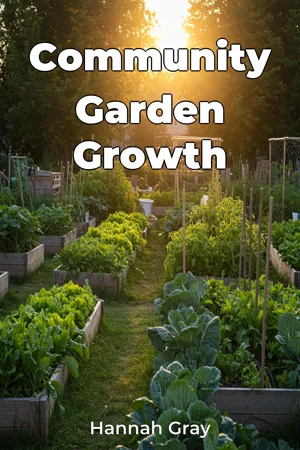
"Community Garden Growth" explores how community gardens address food security, community development, and environmental sustainability. It argues that these gardens are more than just green spaces; they're scalable solutions for boosting food access and community resilience. The book delves into the history of community gardens, tracing their evolution from wartime "Victory Gardens" to modern urban agriculture, revealing how social and political forces have shaped their purpose. The book examines the impact of community gardens on household food security, particularly for vulnerable populations. It also assesses their potential to foster social cohesion, promote healthier lifestyles, and contribute to local economies. Using research, case studies, and survey data, it offers a balanced view of the benefits and limitations, highlighting the role of sustainable food systems in enhancing food access. The book progresses from introducing core concepts to exploring historical and social contexts, then offering in-depth analyses of the gardens' impact. It concludes with policy recommendations and practical strategies for promoting community garden growth, providing a roadmap for communities aiming to implement or expand their own gardening initiatives.
Book Details
ISBN
9788235206381
Publisher
Publifye AS
Your Licenses
You don't own any licenses for this book
Purchase a license below to unlock this book and download the EPUB.
Purchase License
Select a tier to unlock this book
Need bulk licensing?
Contact us for enterprise agreements.