
About This Book
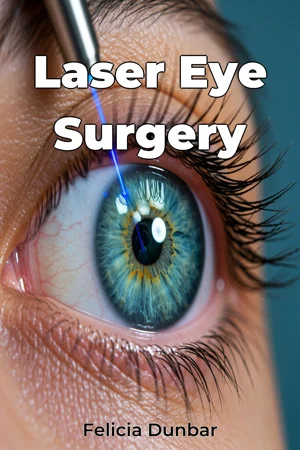
Imagine a world where glasses and contacts are relics of the past. This book, "Laser Eye Surgery," explores the science and medical applications of lasers in correcting vision impairments, offering readers a comprehensive understanding of this transformative technology. We delve into the core principles underlying laser eye surgery, its historical progression, and its potential future, while equipping you with the knowledge to make informed decisions about vision correction options. This book revolves around three central themes: understanding the refractive errors of the eye, the technological advancements in laser surgery, and the practical considerations for patients considering these procedures. First, a thorough understanding of myopia, hyperopia, and astigmatism is crucial. We will explore how these conditions impact vision and how they are traditionally corrected. Second, we examine the evolution of laser technology used in vision correction, from early excimer lasers to the advanced femtosecond lasers of today, detailing how these tools precisely reshape the cornea. Finally, we address the practical aspects such as patient selection, pre-operative assessments, surgical techniques, post-operative care, potential risks and complications, and long-term outcomes. The historical development of laser eye surgery is marked by significant breakthroughs. Early attempts at corneal reshaping paved the way for the development of photorefractive keratectomy (PRK) and laser-assisted in situ keratomileusis (LASIK). This book traces this timeline, highlighting the key researchers and clinical trials that shaped the field. A basic understanding of optics and corneal anatomy will be beneficial, but the book is designed to be accessible to readers without specialized scientific backgrounds. The central argument of "Laser Eye Surgery" is that while laser eye surgery offers a viable and often highly successful solution for correcting refractive errors, it is essential for both patients and practitioners to have a complete and balanced understanding of the technology, procedures, and potential outcomes. This knowledge empowers patients to make informed decisions and enables surgeons to optimize treatment plans and manage expectations realistically. The book begins by introducing the anatomy of the eye and the physics of light, explaining how refractive errors occur. It then transitions to the history of refractive surgery, outlining the development of different laser techniques. The core of the book focuses on detailed descriptions of LASIK, PRK, SMILE (small incision lenticule extraction), and other emerging laser procedures. Post-operative care, potential complications, and managing patient expectations are discussed at length. The book culminates with a look at the future of refractive surgery, exploring new technologies and potential advancements. Support for the arguments presented comes from a wide range of sources, including peer-reviewed scientific publications, clinical trial data, and expert opinions from leading refractive surgeons. We reference landmark studies and meta-analyses to provide an evidence-based perspective on the efficacy and safety of different laser eye surgery techniques. "Laser Eye Surgery" connects to several other fields. Firstly, it is fundamentally linked to optics and physics, as the behavior of light and the principles of refraction are essential to understanding how lasers correct vision. Secondly, it intersects with biomedical engineering, as the development and refinement of laser technology require advanced engineering solutions. Finally, it relates to medical ethics and patient communication, as informed consent and realistic expectations are crucial aspects of refractive surgery. This book provides an unbiased and comprehensive overview of laser eye surgery, presenting both the benefits and limitations of the procedures. We aim to equip readers with the knowledge needed to navigate the complex landscape of vision correction options. The tone is informative and objective, providing a balanced perspective on the advantages and disadvantages of laser eye surgery. The writing style is clear and accessible, avoiding technical jargon where possible and providing explanations of complex concepts. The target audience includes individuals considering laser eye surgery, as well as healthcare professionals, students in related fields, and anyone interested in the science of vision correction. This book provides valuable information in a single, focused resource. As a work in the 'Medical General' and 'Science' genres, this book adheres to the conventions of presenting factual information accurately and objectively, citing sources appropriately, and avoiding sensationalism. The book focuses specifically on laser-based vision correction techniques, without delving into other surgical options such as intraocular lens implants, except for comparative purposes. The knowledge gained from this book empowers readers to engage in informed conversations with eye care professionals, understand the risks and benefits of different procedures, and make confident decisions about their vision correction options. The book addresses the ongoing debates surrounding the relative merits of different laser eye surgery techniques, such as LASIK versus PRK versus SMILE, discussing the factors that influence surgical outcomes and patient satisfaction.
Imagine a world where glasses and contacts are relics of the past. This book, "Laser Eye Surgery," explores the science and medical applications of lasers in correcting vision impairments, offering readers a comprehensive understanding of this transformative technology. We delve into the core principles underlying laser eye surgery, its historical progression, and its potential future, while equipping you with the knowledge to make informed decisions about vision correction options. This book revolves around three central themes: understanding the refractive errors of the eye, the technological advancements in laser surgery, and the practical considerations for patients considering these procedures. First, a thorough understanding of myopia, hyperopia, and astigmatism is crucial. We will explore how these conditions impact vision and how they are traditionally corrected. Second, we examine the evolution of laser technology used in vision correction, from early excimer lasers to the advanced femtosecond lasers of today, detailing how these tools precisely reshape the cornea. Finally, we address the practical aspects such as patient selection, pre-operative assessments, surgical techniques, post-operative care, potential risks and complications, and long-term outcomes. The historical development of laser eye surgery is marked by significant breakthroughs. Early attempts at corneal reshaping paved the way for the development of photorefractive keratectomy (PRK) and laser-assisted in situ keratomileusis (LASIK). This book traces this timeline, highlighting the key researchers and clinical trials that shaped the field. A basic understanding of optics and corneal anatomy will be beneficial, but the book is designed to be accessible to readers without specialized scientific backgrounds. The central argument of "Laser Eye Surgery" is that while laser eye surgery offers a viable and often highly successful solution for correcting refractive errors, it is essential for both patients and practitioners to have a complete and balanced understanding of the technology, procedures, and potential outcomes. This knowledge empowers patients to make informed decisions and enables surgeons to optimize treatment plans and manage expectations realistically. The book begins by introducing the anatomy of the eye and the physics of light, explaining how refractive errors occur. It then transitions to the history of refractive surgery, outlining the development of different laser techniques. The core of the book focuses on detailed descriptions of LASIK, PRK, SMILE (small incision lenticule extraction), and other emerging laser procedures. Post-operative care, potential complications, and managing patient expectations are discussed at length. The book culminates with a look at the future of refractive surgery, exploring new technologies and potential advancements. Support for the arguments presented comes from a wide range of sources, including peer-reviewed scientific publications, clinical trial data, and expert opinions from leading refractive surgeons. We reference landmark studies and meta-analyses to provide an evidence-based perspective on the efficacy and safety of different laser eye surgery techniques. "Laser Eye Surgery" connects to several other fields. Firstly, it is fundamentally linked to optics and physics, as the behavior of light and the principles of refraction are essential to understanding how lasers correct vision. Secondly, it intersects with biomedical engineering, as the development and refinement of laser technology require advanced engineering solutions. Finally, it relates to medical ethics and patient communication, as informed consent and realistic expectations are crucial aspects of refractive surgery. This book provides an unbiased and comprehensive overview of laser eye surgery, presenting both the benefits and limitations of the procedures. We aim to equip readers with the knowledge needed to navigate the complex landscape of vision correction options. The tone is informative and objective, providing a balanced perspective on the advantages and disadvantages of laser eye surgery. The writing style is clear and accessible, avoiding technical jargon where possible and providing explanations of complex concepts. The target audience includes individuals considering laser eye surgery, as well as healthcare professionals, students in related fields, and anyone interested in the science of vision correction. This book provides valuable information in a single, focused resource. As a work in the 'Medical General' and 'Science' genres, this book adheres to the conventions of presenting factual information accurately and objectively, citing sources appropriately, and avoiding sensationalism. The book focuses specifically on laser-based vision correction techniques, without delving into other surgical options such as intraocular lens implants, except for comparative purposes. The knowledge gained from this book empowers readers to engage in informed conversations with eye care professionals, understand the risks and benefits of different procedures, and make confident decisions about their vision correction options. The book addresses the ongoing debates surrounding the relative merits of different laser eye surgery techniques, such as LASIK versus PRK versus SMILE, discussing the factors that influence surgical outcomes and patient satisfaction.
"Laser Eye Surgery" offers a comprehensive exploration of vision correction through laser technology. It elucidates how conditions like myopia, hyperopia, and astigmatism are addressed by reshaping the cornea using advanced tools like excimer and femtosecond lasers. The book traces the evolution of refractive surgery, from early PRK techniques to the more recent SMILE procedure, providing insights into the science of corneal reshaping. Readers gain an understanding of the underlying optics involved in correcting vision impairments. This book uniquely balances technological detail with practical considerations for patients. It covers patient selection, pre-operative assessments, surgical techniques, and post-operative care, emphasizing realistic expectations and potential risks. The book progresses systematically, beginning with the anatomy of the eye and the physics of light, then transitions to the history of refractive surgery, followed by detailed descriptions of various laser techniques. Ultimately, "Laser Eye Surgery" aims to empower readers with the knowledge needed to make informed decisions about vision correction. By presenting a balanced view of the benefits and limitations of laser eye surgery, it serves as a valuable resource for anyone considering refractive surgery or seeking a deeper understanding of this transformative medical field.
Book Details
ISBN
9788235206107
Publisher
Publifye AS
Your Licenses
You don't own any licenses for this book
Purchase a license below to unlock this book and download the EPUB.
Purchase License
Select a tier to unlock this book
Need bulk licensing?
Contact us for enterprise agreements.