
About This Book
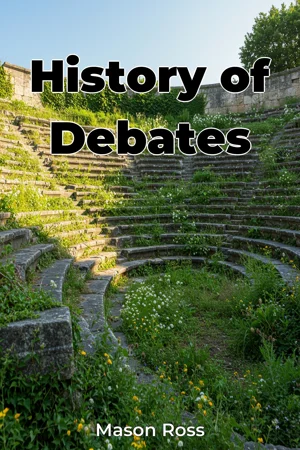
Can the art of persuasive discourse truly sculpt intellect and shape societies? "History of Debates" delves into the multifaceted role of debates across millennia, from their origins in ancient philosophical inquiries to their modern incarnation as structured academic competitions. This book explores how the practice of formalized argumentation has served as a crucible for critical thinking, intellectual growth, and societal evolution. This book will navigate three pivotal themes. First, it examines the historical evolution of debate, tracing its trajectory from the Socratic dialogues of ancient Greece, where rigorous questioning was employed to expose contradictions and arrive at truth, to the scholastic disputations of the medieval period, where religious and philosophical doctrines were meticulously analyzed. Second, the book analyzes the structure and function of debates as pedagogical tools, investigating how they foster research skills, public speaking proficiency, and the ability to synthesize complex information under pressure. Finally, "History of Debates" considers the impact of debates on social and political discourse, examining how formalized arguments have shaped public policy, influenced social movements, and provided platforms for diverse voices to challenge established norms. The historical context is essential. Debates, in their various forms, have mirrored and often influenced the intellectual currents of their time. Understanding the social and political climates in which debates flourished is key to appreciating their significance. The central argument posits that debates, far from being mere exercises in rhetoric, are fundamental drivers of intellectual and social progress. They compel participants to rigorously examine their assumptions, articulate their reasoning, and engage with opposing viewpoints, leading to a more nuanced understanding of complex issues. The book begins by laying a theoretical foundation, defining the core elements of debate and outlining its historical roots. It then explores specific historical case studies, dedicating chapters to: (1) Ancient Greece and the birth of dialectic; (2) The medieval universities and the development of scholastic debate; (3) The Enlightenment and the rise of public discourse; (4) Modern academic debate and its impact on education. The culmination of the argument demonstrates how the principles of effective debate can be applied in various professional and civic contexts, fostering constructive dialogue and informed decision-making. "History of Debates" draws on a wide array of primary and secondary sources, including transcriptions of historical debates, philosophical treatises on argumentation, pedagogical studies on the effectiveness of debate as a teaching method, and analyses of the role of rhetoric in shaping public opinion. This book connects to several disciplines, including: (1) History, by providing a chronological account of the evolution of debate; (2) Education, by exploring the pedagogical benefits of debate as a learning tool; and (3) Political Science, by examining the role of debate in shaping public policy and political discourse. "History of Debates" offers a comprehensive and nuanced perspective on the enduring relevance of debates in shaping intellectual thought and societal progress. The book adopts an academic tone, presenting information in a clear, concise, and well-documented manner. While grounded in rigorous scholarship, the writing style is accessible to a broad audience. The target audience includes students, educators, historians, political scientists, and anyone interested in the history of ideas and the art of persuasive communication. This book offers valuable insights into the power of reasoned argumentation and its potential to foster critical thinking and constructive dialogue. Adhering to the conventions of academic non-fiction, "History of Debates" provides comprehensive citations, a detailed bibliography, and a thorough index to facilitate further research. The book's scope is intentionally broad, covering a wide range of historical periods and geographical regions. However, it focuses primarily on the Western tradition of debate, acknowledging that other cultures have their own distinct forms of argumentation. The principles of effective debate outlined in this book have practical applications in various fields, from law and politics to business and education. The book addresses ongoing debates about the role of rhetoric in shaping public opinion. It acknowledges the potential for debates to be used for manipulative purposes but argues that, when conducted ethically and responsibly, they can be powerful tools for promoting understanding and resolving conflict.
Can the art of persuasive discourse truly sculpt intellect and shape societies? "History of Debates" delves into the multifaceted role of debates across millennia, from their origins in ancient philosophical inquiries to their modern incarnation as structured academic competitions. This book explores how the practice of formalized argumentation has served as a crucible for critical thinking, intellectual growth, and societal evolution. This book will navigate three pivotal themes. First, it examines the historical evolution of debate, tracing its trajectory from the Socratic dialogues of ancient Greece, where rigorous questioning was employed to expose contradictions and arrive at truth, to the scholastic disputations of the medieval period, where religious and philosophical doctrines were meticulously analyzed. Second, the book analyzes the structure and function of debates as pedagogical tools, investigating how they foster research skills, public speaking proficiency, and the ability to synthesize complex information under pressure. Finally, "History of Debates" considers the impact of debates on social and political discourse, examining how formalized arguments have shaped public policy, influenced social movements, and provided platforms for diverse voices to challenge established norms. The historical context is essential. Debates, in their various forms, have mirrored and often influenced the intellectual currents of their time. Understanding the social and political climates in which debates flourished is key to appreciating their significance. The central argument posits that debates, far from being mere exercises in rhetoric, are fundamental drivers of intellectual and social progress. They compel participants to rigorously examine their assumptions, articulate their reasoning, and engage with opposing viewpoints, leading to a more nuanced understanding of complex issues. The book begins by laying a theoretical foundation, defining the core elements of debate and outlining its historical roots. It then explores specific historical case studies, dedicating chapters to: (1) Ancient Greece and the birth of dialectic; (2) The medieval universities and the development of scholastic debate; (3) The Enlightenment and the rise of public discourse; (4) Modern academic debate and its impact on education. The culmination of the argument demonstrates how the principles of effective debate can be applied in various professional and civic contexts, fostering constructive dialogue and informed decision-making. "History of Debates" draws on a wide array of primary and secondary sources, including transcriptions of historical debates, philosophical treatises on argumentation, pedagogical studies on the effectiveness of debate as a teaching method, and analyses of the role of rhetoric in shaping public opinion. This book connects to several disciplines, including: (1) History, by providing a chronological account of the evolution of debate; (2) Education, by exploring the pedagogical benefits of debate as a learning tool; and (3) Political Science, by examining the role of debate in shaping public policy and political discourse. "History of Debates" offers a comprehensive and nuanced perspective on the enduring relevance of debates in shaping intellectual thought and societal progress. The book adopts an academic tone, presenting information in a clear, concise, and well-documented manner. While grounded in rigorous scholarship, the writing style is accessible to a broad audience. The target audience includes students, educators, historians, political scientists, and anyone interested in the history of ideas and the art of persuasive communication. This book offers valuable insights into the power of reasoned argumentation and its potential to foster critical thinking and constructive dialogue. Adhering to the conventions of academic non-fiction, "History of Debates" provides comprehensive citations, a detailed bibliography, and a thorough index to facilitate further research. The book's scope is intentionally broad, covering a wide range of historical periods and geographical regions. However, it focuses primarily on the Western tradition of debate, acknowledging that other cultures have their own distinct forms of argumentation. The principles of effective debate outlined in this book have practical applications in various fields, from law and politics to business and education. The book addresses ongoing debates about the role of rhetoric in shaping public opinion. It acknowledges the potential for debates to be used for manipulative purposes but argues that, when conducted ethically and responsibly, they can be powerful tools for promoting understanding and resolving conflict.
"History of Debates" explores the evolution and impact of formalized argumentation across history. From ancient Socratic dialogues, where questioning exposed contradictions, to medieval scholastic disputations meticulously analyzing doctrines, the book traces debate's profound influence. It highlights debate as a crucible for critical thinking, showcasing its role in shaping social and political discourse, influencing public policy, and providing platforms for diverse voices. The book uniquely investigates debates as pedagogical tools, fostering research skills and public speaking proficiency. It argues that debates are not mere rhetoric but drivers of intellectual and social progress, compelling participants to examine assumptions and engage with opposing viewpoints. Each chapter delves into specific historical case studies, such as the birth of dialectic in Ancient Greece and the rise of public discourse during the Enlightenment, showcasing the principles of effective debate applicable in various contexts.
Book Details
ISBN
9788235205483
Publisher
Publifye AS
Your Licenses
You don't own any licenses for this book
Purchase a license below to unlock this book and download the EPUB.
Purchase License
Select a tier to unlock this book
Need bulk licensing?
Contact us for enterprise agreements.