
About This Book
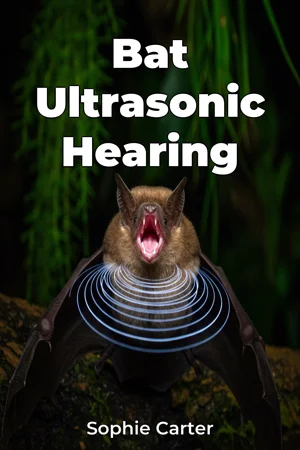
Have you ever wondered how bats navigate the world in complete darkness? "Bat Ultrasonic Hearing" unravels the mysteries of echolocation, the sophisticated sonar system that allows bats to "see" with sound. This ability, honed over millions of years, relies on their exceptional capacity to both emit and interpret high-frequency sound waves, far beyond the range of human hearing. Delving into this fascinating biological phenomenon, we explore not only the mechanics of bat echolocation but also its profound implications for understanding sensory perception and neural processing. This book will primarily address three central topics: the biophysics of ultrasonic sound production in bats, the neurobiology of how bats process these returning echoes, and the ecological significance of echolocation in their survival and evolution. These topics are vital because they provide insights into how animals adapt to their environments, the limits and versatility of sensory systems, and the intricate relationship between physical structures, neural function, and behavior. Understanding echolocation reveals key principles about sensory biology applicable to a wide range of species. The study of bat echolocation has a rich history, dating back to experiments conducted in the 1930s that first demonstrated its existence. Early research focused on the physics of sound and the anatomy of bat ears. This book builds upon this foundation, incorporating recent advances in neurophysiology, molecular biology, and computational modeling. Some familiarity with basic physics (sound waves) and biology (neuroscience) will be beneficial, but not essential, for understanding the material. The central argument of "Bat Ultrasonic Hearing" is that the evolution of echolocation represents a remarkable example of convergent evolution and adaptive specialization, showcasing the power of natural selection in shaping sensory systems. This argument is important because it emphasizes the role of sensory ecology in driving evolutionary change and highlights the intricate interplay between an animal’s sensory abilities and its environment. The book unfolds in a logical progression. Initially, we introduce the fundamental concepts of sound and ultrasound, detailing how bats generate and control their vocalizations. We then examine the anatomy and physiology of the bat auditory system, from the specialized structures of the inner ear to the complex neural circuits in the brain that process echolocation signals. Major sections will cover: (1) detailed analyses of different types of bat calls and their functions, (2) comparative studies of echolocation across different bat species, and (3) a thorough investigation into the neural mechanisms underlying target localization and identification by bats. The book culminates with a discussion of the practical applications of our understanding of bat echolocation, including the development of bio-inspired sonar technologies and conservation strategies for bats. Support for our arguments comes from a variety of sources, including: acoustic recordings of bats in their natural habitats, detailed anatomical studies of bat ears and brains, neurophysiological experiments that map the activity of neurons during echolocation, and behavioral experiments that test the ability of bats to discriminate between different targets. We will also incorporate data from comparative genomics to trace the evolutionary history of echolocation genes. "Bat Ultrasonic Hearing" also connects to several other fields of study. Bioacoustics examines the broader role of sound in animal communication and behavior, while neuroscience provides the tools to understand the neural basis of sensory processing. Engineering draws inspiration from bat echolocation to develop sophisticated sonar systems. These interdisciplinary connections enhance our understanding of echolocation by placing it in a broader context. This book offers a unique perspective by integrating acoustic analyses, neurophysiological data, and evolutionary insights to provide a holistic view of bat echolocation. We emphasize the cognitive aspects of echolocation, exploring how bats actively interpret and make decisions based on the information they gather from their surroundings. The tone of this book is accessible and informative, aiming to explain complex scientific concepts in a clear and engaging manner. While grounded in rigorous science, the writing style is designed to be approachable for a broad audience with an interest in natural history and sensory biology. The target audience includes students, researchers, and anyone fascinated by animal behavior, sensory systems, or the natural world. It will be valuable to those seeking a comprehensive and up-to-date overview of bat echolocation, its underlying mechanisms, and its ecological significance. As a work intended as a Life Science exploration, it examines not just the physical processes involved in echolocation, but also the behavioral adaptations that have arisen as a result. The scope of this book is intentionally focused on the mechanisms and ecology of bat echolocation, with limited attention given to the broader topic of animal navigation. While covering a wide range of bat species, we focus primarily on those for which extensive scientific data are available. The information presented has real-world applications. Bio-inspired sonar, based on bat echolocation principles, is being developed for use in autonomous vehicles and underwater navigation. Understanding bat echolocation is also essential for developing effective conservation strategies to protect these ecologically important animals. While the basic principles of bat echolocation are well established, ongoing debates exist regarding the relative importance of different acoustic cues in target localization and the precise neural circuits involved in processing echolocation signals. This book addresses these controversies and presents the latest research findings.
Have you ever wondered how bats navigate the world in complete darkness? "Bat Ultrasonic Hearing" unravels the mysteries of echolocation, the sophisticated sonar system that allows bats to "see" with sound. This ability, honed over millions of years, relies on their exceptional capacity to both emit and interpret high-frequency sound waves, far beyond the range of human hearing. Delving into this fascinating biological phenomenon, we explore not only the mechanics of bat echolocation but also its profound implications for understanding sensory perception and neural processing. This book will primarily address three central topics: the biophysics of ultrasonic sound production in bats, the neurobiology of how bats process these returning echoes, and the ecological significance of echolocation in their survival and evolution. These topics are vital because they provide insights into how animals adapt to their environments, the limits and versatility of sensory systems, and the intricate relationship between physical structures, neural function, and behavior. Understanding echolocation reveals key principles about sensory biology applicable to a wide range of species. The study of bat echolocation has a rich history, dating back to experiments conducted in the 1930s that first demonstrated its existence. Early research focused on the physics of sound and the anatomy of bat ears. This book builds upon this foundation, incorporating recent advances in neurophysiology, molecular biology, and computational modeling. Some familiarity with basic physics (sound waves) and biology (neuroscience) will be beneficial, but not essential, for understanding the material. The central argument of "Bat Ultrasonic Hearing" is that the evolution of echolocation represents a remarkable example of convergent evolution and adaptive specialization, showcasing the power of natural selection in shaping sensory systems. This argument is important because it emphasizes the role of sensory ecology in driving evolutionary change and highlights the intricate interplay between an animal’s sensory abilities and its environment. The book unfolds in a logical progression. Initially, we introduce the fundamental concepts of sound and ultrasound, detailing how bats generate and control their vocalizations. We then examine the anatomy and physiology of the bat auditory system, from the specialized structures of the inner ear to the complex neural circuits in the brain that process echolocation signals. Major sections will cover: (1) detailed analyses of different types of bat calls and their functions, (2) comparative studies of echolocation across different bat species, and (3) a thorough investigation into the neural mechanisms underlying target localization and identification by bats. The book culminates with a discussion of the practical applications of our understanding of bat echolocation, including the development of bio-inspired sonar technologies and conservation strategies for bats. Support for our arguments comes from a variety of sources, including: acoustic recordings of bats in their natural habitats, detailed anatomical studies of bat ears and brains, neurophysiological experiments that map the activity of neurons during echolocation, and behavioral experiments that test the ability of bats to discriminate between different targets. We will also incorporate data from comparative genomics to trace the evolutionary history of echolocation genes. "Bat Ultrasonic Hearing" also connects to several other fields of study. Bioacoustics examines the broader role of sound in animal communication and behavior, while neuroscience provides the tools to understand the neural basis of sensory processing. Engineering draws inspiration from bat echolocation to develop sophisticated sonar systems. These interdisciplinary connections enhance our understanding of echolocation by placing it in a broader context. This book offers a unique perspective by integrating acoustic analyses, neurophysiological data, and evolutionary insights to provide a holistic view of bat echolocation. We emphasize the cognitive aspects of echolocation, exploring how bats actively interpret and make decisions based on the information they gather from their surroundings. The tone of this book is accessible and informative, aiming to explain complex scientific concepts in a clear and engaging manner. While grounded in rigorous science, the writing style is designed to be approachable for a broad audience with an interest in natural history and sensory biology. The target audience includes students, researchers, and anyone fascinated by animal behavior, sensory systems, or the natural world. It will be valuable to those seeking a comprehensive and up-to-date overview of bat echolocation, its underlying mechanisms, and its ecological significance. As a work intended as a Life Science exploration, it examines not just the physical processes involved in echolocation, but also the behavioral adaptations that have arisen as a result. The scope of this book is intentionally focused on the mechanisms and ecology of bat echolocation, with limited attention given to the broader topic of animal navigation. While covering a wide range of bat species, we focus primarily on those for which extensive scientific data are available. The information presented has real-world applications. Bio-inspired sonar, based on bat echolocation principles, is being developed for use in autonomous vehicles and underwater navigation. Understanding bat echolocation is also essential for developing effective conservation strategies to protect these ecologically important animals. While the basic principles of bat echolocation are well established, ongoing debates exist regarding the relative importance of different acoustic cues in target localization and the precise neural circuits involved in processing echolocation signals. This book addresses these controversies and presents the latest research findings.
"Bat Ultrasonic Hearing" unveils the fascinating world of bat echolocation, a sophisticated sensory system enabling bats to navigate and hunt in darkness. This book explores how bats emit ultrasonic sound waves and interpret the returning echoes to "see" their surroundings, revealing insights into sensory perception and neural processing. One intriguing fact is that bats can discriminate between different targets based on subtle variations in the returning sound waves, showcasing the remarkable precision of their auditory system. The book delves into the biophysics of sound production, the neurobiology of echo processing, and the ecological significance of echolocation. It highlights the adaptive specialization of bats’ sensory systems, demonstrating how natural selection has shaped their unique abilities. "Bat Ultrasonic Hearing" progresses from fundamental concepts of sound to detailed analyses of bat calls, comparative studies across species, and investigations into neural mechanisms. It offers a unique perspective by integrating acoustic analyses, neurophysiological data, and evolutionary insights to provide a holistic view. The approach emphasizes clear explanations of complex scientific concepts, making it accessible to a broad audience interested in nature, science, and biology. By exploring the cognitive aspects of echolocation, the book reveals how bats actively interpret and make decisions based on their sensory input. Ultimately, understanding bat echolocation has practical applications, including bio-inspired sonar technology and conservation strategies for these vital creatures.
Book Details
ISBN
9788235204752
Publisher
Publifye AS
Your Licenses
You don't own any licenses for this book
Purchase a license below to unlock this book and download the EPUB.
Purchase License
Select a tier to unlock this book
Need bulk licensing?
Contact us for enterprise agreements.