
About This Book
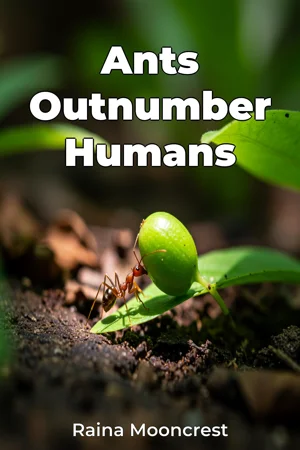
Did you know that for every human on Earth, there are potentially over 1.2 million ants? "Ants Outnumber Humans" delves into the world of ants, exploring their astounding prevalence, their intricate societies, and their profound impact on our planet's ecosystems. This book aims to provide a comprehensive understanding of these often-overlooked creatures, revealing the hidden complexities of their lives and their surprising connections to our own. We will explore three key topics. First, we investigate the sheer scale of ant populations, relying on established entomological counts and extrapolations to estimate their global numbers. This involves examining the methodologies used to arrive at these figures and acknowledging the inherent challenges in quantifying such a vast population. Second, the book explores the fascinating social structures of ant colonies, from the division of labor to their sophisticated communication methods. We address how these colonies function as superorganisms, exhibiting collective intelligence and problem-solving abilities that rival those of individual animals. Finally, we will detail the ecological roles ants play, covering their contributions to soil aeration, seed dispersal, and nutrient cycling, as well as their interactions with other species, both beneficial and detrimental. Understanding these roles is critical for grasping the broader implications of ant behavior for ecosystem health. A historical perspective is provided through an overview of the scientific study of ants, from early naturalists to modern-day entomologists. We will also touch upon the evolutionary history of ants, tracing their origins and diversification over millions of years. The book asserts that ants, due to their vast numbers and crucial ecological functions, are not merely insects of minor interest, but rather key players in the Earth's biosphere. It is our thesis that a deeper appreciation of ants and their global impact is essential for informed environmental stewardship. The book is structured to guide the reader through a progressive understanding of ant biology and ecology. It begins by introducing the sheer magnitude of ant populations and the methods scientists have used to estimate their numbers. We then delve into their social organization, exploring topics such as caste systems, pheromone communication, and colony behavior. The central chapters examine the ecological roles of ants, detailing their impact on various ecosystems and their interactions with other organisms. The book culminates by discussing the implications of ant populations for human society, including their impact on agriculture, their role in disease transmission, and their potential use in bio-inspired technologies. Evidence presented will include data from published scientific studies, field observations, and laboratory experiments. The book draws upon a wide range of sources, including peer-reviewed articles, books, and reports from entomological societies. We will highlight the scientific rigor behind the findings and acknowledge any limitations in the available data. Interdisciplinary connections are made to fields such as ecology, evolutionary biology, and computer science. The ecological aspects of ant behavior are directly relevant to conservation efforts and ecosystem management. The evolutionary history of ants sheds light on broader patterns of biodiversity and adaptation. Their collective behavior and communication strategies have inspired algorithms and approaches in artificial intelligence. This book stands out by providing a comprehensive and integrated perspective on ants, combining population estimates, social behavior, and ecological roles into a single cohesive narrative. While the writing style will be accessible to a general audience, it maintains scientific accuracy and rigor. The target audience includes anyone with an interest in natural history, ecology, or entomology. This book would be valuable to students, researchers, and anyone seeking a deeper understanding of the natural world. The book presents scientific information in a clear and engaging manner, avoiding jargon and technical language where possible, while remaining true to the data. "Ants Outnumber Humans" offers a balanced and objective view of ants, acknowledging both their positive and negative impacts on the environment and society. The scope is global, covering ant species from various regions and ecosystems, while acknowledging that some areas are better studied than others. Practical applications of the information in the book include strategies for managing ant infestations in agricultural settings and using ants as bioindicators of environmental health. The book also touches upon ongoing debates regarding the impact of climate change on ant populations and their role in invasive species dynamics.
Did you know that for every human on Earth, there are potentially over 1.2 million ants? "Ants Outnumber Humans" delves into the world of ants, exploring their astounding prevalence, their intricate societies, and their profound impact on our planet's ecosystems. This book aims to provide a comprehensive understanding of these often-overlooked creatures, revealing the hidden complexities of their lives and their surprising connections to our own. We will explore three key topics. First, we investigate the sheer scale of ant populations, relying on established entomological counts and extrapolations to estimate their global numbers. This involves examining the methodologies used to arrive at these figures and acknowledging the inherent challenges in quantifying such a vast population. Second, the book explores the fascinating social structures of ant colonies, from the division of labor to their sophisticated communication methods. We address how these colonies function as superorganisms, exhibiting collective intelligence and problem-solving abilities that rival those of individual animals. Finally, we will detail the ecological roles ants play, covering their contributions to soil aeration, seed dispersal, and nutrient cycling, as well as their interactions with other species, both beneficial and detrimental. Understanding these roles is critical for grasping the broader implications of ant behavior for ecosystem health. A historical perspective is provided through an overview of the scientific study of ants, from early naturalists to modern-day entomologists. We will also touch upon the evolutionary history of ants, tracing their origins and diversification over millions of years. The book asserts that ants, due to their vast numbers and crucial ecological functions, are not merely insects of minor interest, but rather key players in the Earth's biosphere. It is our thesis that a deeper appreciation of ants and their global impact is essential for informed environmental stewardship. The book is structured to guide the reader through a progressive understanding of ant biology and ecology. It begins by introducing the sheer magnitude of ant populations and the methods scientists have used to estimate their numbers. We then delve into their social organization, exploring topics such as caste systems, pheromone communication, and colony behavior. The central chapters examine the ecological roles of ants, detailing their impact on various ecosystems and their interactions with other organisms. The book culminates by discussing the implications of ant populations for human society, including their impact on agriculture, their role in disease transmission, and their potential use in bio-inspired technologies. Evidence presented will include data from published scientific studies, field observations, and laboratory experiments. The book draws upon a wide range of sources, including peer-reviewed articles, books, and reports from entomological societies. We will highlight the scientific rigor behind the findings and acknowledge any limitations in the available data. Interdisciplinary connections are made to fields such as ecology, evolutionary biology, and computer science. The ecological aspects of ant behavior are directly relevant to conservation efforts and ecosystem management. The evolutionary history of ants sheds light on broader patterns of biodiversity and adaptation. Their collective behavior and communication strategies have inspired algorithms and approaches in artificial intelligence. This book stands out by providing a comprehensive and integrated perspective on ants, combining population estimates, social behavior, and ecological roles into a single cohesive narrative. While the writing style will be accessible to a general audience, it maintains scientific accuracy and rigor. The target audience includes anyone with an interest in natural history, ecology, or entomology. This book would be valuable to students, researchers, and anyone seeking a deeper understanding of the natural world. The book presents scientific information in a clear and engaging manner, avoiding jargon and technical language where possible, while remaining true to the data. "Ants Outnumber Humans" offers a balanced and objective view of ants, acknowledging both their positive and negative impacts on the environment and society. The scope is global, covering ant species from various regions and ecosystems, while acknowledging that some areas are better studied than others. Practical applications of the information in the book include strategies for managing ant infestations in agricultural settings and using ants as bioindicators of environmental health. The book also touches upon ongoing debates regarding the impact of climate change on ant populations and their role in invasive species dynamics.
"Ants Outnumber Humans" explores the fascinating world of ants, highlighting their staggering numbers and crucial roles in ecosystems. It reveals how these tiny creatures, often overlooked, profoundly impact our planet. For every human, there could be over a million ants, showcasing their dominance in the biosphere. These insects exhibit complex social structures, functioning almost as superorganisms with sophisticated communication and problem-solving skills. The book investigates ant societies, delving into their division of labor and collective intelligence. It also details their ecological contributions, such as soil aeration, seed dispersal, and nutrient cycling, demonstrating their importance to environmental health. By examining ant populations, social behaviors, and ecological roles, the book provides a complete picture of these insects. Progressing from population estimates to social organization and ecological impacts, "Ants Outnumber Humans" presents scientific information in an accessible manner. The book connects ant behavior to broader implications for human society and environmental stewardship, making it valuable for anyone interested in nature or biology.
Book Details
ISBN
9788235204332
Publisher
Publifye AS
Your Licenses
You don't own any licenses for this book
Purchase a license below to unlock this book and download the EPUB.
Purchase License
Select a tier to unlock this book
Need bulk licensing?
Contact us for enterprise agreements.