
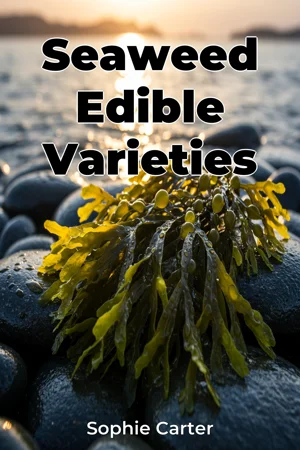
About This Book
Have you ever considered the ocean's nutritional bounty and the intricate relationships humans have cultivated with it for millennia? "Seaweed Edible Varieties" delves into the rich history and scientific underpinnings of seaweed harvesting and consumption across diverse cultures, primarily focusing on Japanese, Korean, and Irish traditions. This book bridges the gap between biology, culinary arts, and cultural anthropology, offering a comprehensive exploration of this often-overlooked food source. We address two central topics: the biological diversity of edible seaweed species and the traditional methods employed in their cultivation and preparation. Understanding these aspects is crucial for appreciating seaweed's potential as a sustainable food source and for preserving the cultural heritage associated with its use. We provide the necessary historical and scientific context to fully understand the complex relationship between humans and marine algae. No prior in-depth knowledge of marine biology or culinary practices is required; however, a general interest in food history and the natural sciences will enhance the reader's experience. The central argument posits that the sustainable harvesting and informed consumption of seaweed represent a valuable intersection of ecological awareness, nutritional science, and cultural preservation. This argument's relevance stems from the growing need for sustainable food sources and an increasing appreciation for traditional ecological knowledge. The book is structured to guide the reader through a comprehensive exploration of edible seaweed. First, we introduce the key concepts of algal biology, taxonomy, and nutritional properties. Next, we devote individual sections to the seaweed traditions of Japan, Korea, and Ireland. Each cultural section will cover the specific edible species utilized, traditional harvesting techniques, culinary preparations, and the cultural significance of seaweed in those societies. This development of ideas leads to a culminating analysis of the commonalities and differences among these traditions, highlighting the ecological adaptations and cultural innovations that have shaped their respective practices. Finally, we explore the practical applications of this knowledge, focusing on sustainable harvesting practices, modern culinary uses, and the potential health benefits of incorporating seaweed into contemporary diets. The book utilizes a wide range of evidence, including historical documents, ethnobotanical studies, and scientific analyses of seaweed composition. We draw upon unique data sources such as traditional harvesting manuals, historical cookbooks, and recent ecological surveys of coastal regions. "Seaweed Edible Varieties" connects to several interdisciplinary areas. Its botanical aspects link to marine biology and ecology, while its investigation into traditional practices aligns with anthropology and cultural studies. Furthermore, the discussion of nutritional benefits and culinary applications intersects with food science and nutrition. These interdisciplinary connections enrich the argument by providing a holistic perspective on the subject. This work offers a unique perspective by combining a detailed scientific examination of seaweed species with an in-depth exploration of the cultural contexts in which they are harvested and consumed. The overall tone is informative and accessible, aiming to bridge the gap between scientific rigor and general interest. The writing style is clear and concise, making complex topics understandable to a broad audience. The target audience includes students and researchers in marine biology, food science, and cultural studies, as well as chefs, food enthusiasts, and anyone interested in sustainable food sources and traditional ecological knowledge. As a work of non-fiction, "Seaweed Edible Varieties" adheres to the genre's conventions of accuracy, objectivity, and evidence-based arguments. It presents information in a well-organized and accessible manner, providing clear citations for all sources. The scope of the book is limited to the edible seaweed varieties and associated practices within the Japanese, Korean, and Irish traditions. While acknowledging the broader global context of seaweed consumption, we intentionally focus on these three regions to provide in-depth coverage. The information presented can be applied practically by readers interested in incorporating seaweed into their diets, developing sustainable harvesting practices, or learning more about the cultural significance of this versatile food source. While the nutritional benefits of seaweed are widely recognized, debates exist regarding the sustainability of certain harvesting practices and the potential environmental impacts of large-scale seaweed farming. The book addresses these controversies by presenting a balanced perspective and emphasizing the importance of responsible stewardship.
Have you ever considered the ocean's nutritional bounty and the intricate relationships humans have cultivated with it for millennia? "Seaweed Edible Varieties" delves into the rich history and scientific underpinnings of seaweed harvesting and consumption across diverse cultures, primarily focusing on Japanese, Korean, and Irish traditions. This book bridges the gap between biology, culinary arts, and cultural anthropology, offering a comprehensive exploration of this often-overlooked food source. We address two central topics: the biological diversity of edible seaweed species and the traditional methods employed in their cultivation and preparation. Understanding these aspects is crucial for appreciating seaweed's potential as a sustainable food source and for preserving the cultural heritage associated with its use. We provide the necessary historical and scientific context to fully understand the complex relationship between humans and marine algae. No prior in-depth knowledge of marine biology or culinary practices is required; however, a general interest in food history and the natural sciences will enhance the reader's experience. The central argument posits that the sustainable harvesting and informed consumption of seaweed represent a valuable intersection of ecological awareness, nutritional science, and cultural preservation. This argument's relevance stems from the growing need for sustainable food sources and an increasing appreciation for traditional ecological knowledge. The book is structured to guide the reader through a comprehensive exploration of edible seaweed. First, we introduce the key concepts of algal biology, taxonomy, and nutritional properties. Next, we devote individual sections to the seaweed traditions of Japan, Korea, and Ireland. Each cultural section will cover the specific edible species utilized, traditional harvesting techniques, culinary preparations, and the cultural significance of seaweed in those societies. This development of ideas leads to a culminating analysis of the commonalities and differences among these traditions, highlighting the ecological adaptations and cultural innovations that have shaped their respective practices. Finally, we explore the practical applications of this knowledge, focusing on sustainable harvesting practices, modern culinary uses, and the potential health benefits of incorporating seaweed into contemporary diets. The book utilizes a wide range of evidence, including historical documents, ethnobotanical studies, and scientific analyses of seaweed composition. We draw upon unique data sources such as traditional harvesting manuals, historical cookbooks, and recent ecological surveys of coastal regions. "Seaweed Edible Varieties" connects to several interdisciplinary areas. Its botanical aspects link to marine biology and ecology, while its investigation into traditional practices aligns with anthropology and cultural studies. Furthermore, the discussion of nutritional benefits and culinary applications intersects with food science and nutrition. These interdisciplinary connections enrich the argument by providing a holistic perspective on the subject. This work offers a unique perspective by combining a detailed scientific examination of seaweed species with an in-depth exploration of the cultural contexts in which they are harvested and consumed. The overall tone is informative and accessible, aiming to bridge the gap between scientific rigor and general interest. The writing style is clear and concise, making complex topics understandable to a broad audience. The target audience includes students and researchers in marine biology, food science, and cultural studies, as well as chefs, food enthusiasts, and anyone interested in sustainable food sources and traditional ecological knowledge. As a work of non-fiction, "Seaweed Edible Varieties" adheres to the genre's conventions of accuracy, objectivity, and evidence-based arguments. It presents information in a well-organized and accessible manner, providing clear citations for all sources. The scope of the book is limited to the edible seaweed varieties and associated practices within the Japanese, Korean, and Irish traditions. While acknowledging the broader global context of seaweed consumption, we intentionally focus on these three regions to provide in-depth coverage. The information presented can be applied practically by readers interested in incorporating seaweed into their diets, developing sustainable harvesting practices, or learning more about the cultural significance of this versatile food source. While the nutritional benefits of seaweed are widely recognized, debates exist regarding the sustainability of certain harvesting practices and the potential environmental impacts of large-scale seaweed farming. The book addresses these controversies by presenting a balanced perspective and emphasizing the importance of responsible stewardship.
"Seaweed Edible Varieties" explores the fascinating world of edible seaweed, bridging the gap between marine biology, cooking, and cultural traditions. Focusing primarily on Japanese, Korean, and Irish practices, the book examines the biological diversity of seaweed species and the traditional methods of harvesting and preparation. Did you know that seaweed cultivation dates back centuries, with specific species holding significant cultural importance in various societies? Understanding these practices offers insights into sustainable food sources and the preservation of cultural heritage. The book progresses systematically, beginning with an introduction to algal biology, taxonomy, and nutritional properties. It then delves into the seaweed traditions of Japan, Korea, and Ireland, detailing specific species used, harvesting techniques, culinary preparations, and cultural significance. By drawing on historical documents, ethnobotanical studies, and scientific analyses, the book reveals the unique ecological adaptations and cultural innovations that have shaped these traditions. This approach allows readers to appreciate seaweed's potential as a sustainable food source and its rich history. Ultimately, the book emphasizes the importance of sustainable harvesting and informed consumption of seaweed, highlighting the intersection of ecological awareness, nutritional science, and cultural preservation. It offers a unique perspective by combining scientific examination with cultural exploration, making it valuable for anyone interested in biology, food science, or sustainable living.
Book Details
ISBN
9788235203861
Publisher
Publifye AS
Your Licenses
You don't own any licenses for this book
Purchase a license below to unlock this book and download the EPUB.
Purchase License
Select a tier to unlock this book
Need bulk licensing?
Contact us for enterprise agreements.