
About This Book
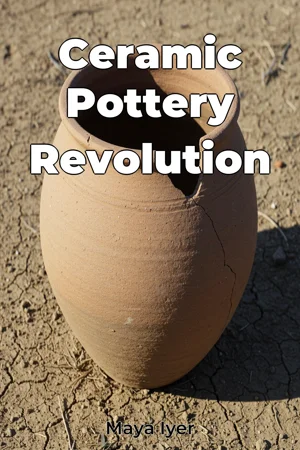
How did a simple mixture of earth and water transform human civilization? "Ceramic Pottery Revolution" delves into the profound impact of fired clay containers on societies across the globe, exploring how this technology reshaped food storage, cooking techniques, artistic expression, and trade networks. This book argues that the development and widespread adoption of ceramic pottery represents a pivotal moment in human history, enabling a shift from nomadic lifestyles to settled agriculture and complex social structures. This investigation centers on three core themes: the evolution of ceramic technology, its role in shaping culinary practices and food security, and its function as a medium for artistic and cultural representation. These themes are crucial to understanding the multifaceted influence of pottery, demonstrating its importance beyond mere utility. The narrative unfolds against a backdrop of archaeological discoveries, anthropological studies, and materials science, building a rich and detailed context for understanding the innovation. The book's central argument posits that ceramic pottery was not merely a useful invention, but a transformative technology that fundamentally altered human behavior and societal organization. Pottery enabled long-term food storage, reducing spoilage and fostering more settled lifestyles. It also facilitated new cooking methods, such as boiling and stewing, which increased the nutritional value of available foods. The aesthetic dimensions of ceramics allowed for the expression of cultural identity and artistic skill, providing invaluable insights into the beliefs and values of past civilizations. "Ceramic Pottery Revolution" is structured to guide the reader through a comprehensive exploration of this topic. It begins by tracing the origins of pottery-making across different regions, examining the diverse materials and techniques employed. The following sections detail how pottery revolutionized food preparation and storage, exploring its impact on agriculture, trade, and population growth. The book then turns to the artistic and symbolic aspects of ceramics, analyzing the various forms, decorations, and uses of pottery in ritual and everyday life. Finally, the analysis culminates in an assessment of the lasting legacy of ceramic pottery, emphasizing its continued relevance in contemporary society. The book draws on a wide array of evidence, including archaeological finds, ethnographic studies, and scientific analyses of ceramic materials. It incorporates data from excavations at key sites around the world, as well as insights from experimental archaeology, which seeks to recreate ancient pottery-making processes. The research utilizes both qualitative and quantitative data, providing a robust and multi-faceted perspective on the subject. The study of ceramic pottery naturally intersects with other disciplines, including archaeology, anthropology, materials science, and art history. Archaeology provides the raw data for understanding the historical distribution and use of pottery. Anthropology offers insights into the social and cultural contexts in which pottery was produced and used. Materials science helps us understand the properties of ceramic materials and the technological innovations that drove their development. Art history sheds light on the aesthetic and symbolic dimensions of pottery, revealing its role in expressing cultural identity and artistic skill. This book stands apart by taking a holistic approach, integrating technological, economic, social, and artistic perspectives. It moves beyond a simple description of pottery types to explore the profound ways in which ceramics shaped human civilization. The writing style is accessible and engaging, designed to appeal to a broad audience. "Ceramic Pottery Revolution" is intended for anyone interested in archaeology, history, anthropology, or art. It offers valuable insights for students, researchers, and general readers alike, providing a comprehensive and engaging overview of the profound impact of ceramic pottery on human society. As a work of non-fiction, it adheres to the highest standards of accuracy and objectivity, presenting evidence-based arguments and balanced perspectives. The book's scope is intentionally broad, encompassing a global perspective on the development and use of ceramic pottery. However, it acknowledges certain limitations, focusing primarily on the Neolithic period through the pre-industrial era. While modern ceramics are discussed briefly, the emphasis remains on the historical impact of pottery on early civilizations. The insights from this analysis have practical application, allowing readers to understand the fundamental connection between technological innovation, cultural development, food systems, and artistry. It also offers a deeper understanding of the material culture and artistic expression of past societies, fostering a greater appreciation for the diversity of human experience. The book also addresses debates surrounding the interpretation of archaeological evidence and the reconstruction of past behaviors. It acknowledges differing viewpoints on the role of pottery in shaping social hierarchies and economic systems, presenting a balanced and nuanced perspective on these complex issues.
How did a simple mixture of earth and water transform human civilization? "Ceramic Pottery Revolution" delves into the profound impact of fired clay containers on societies across the globe, exploring how this technology reshaped food storage, cooking techniques, artistic expression, and trade networks. This book argues that the development and widespread adoption of ceramic pottery represents a pivotal moment in human history, enabling a shift from nomadic lifestyles to settled agriculture and complex social structures. This investigation centers on three core themes: the evolution of ceramic technology, its role in shaping culinary practices and food security, and its function as a medium for artistic and cultural representation. These themes are crucial to understanding the multifaceted influence of pottery, demonstrating its importance beyond mere utility. The narrative unfolds against a backdrop of archaeological discoveries, anthropological studies, and materials science, building a rich and detailed context for understanding the innovation. The book's central argument posits that ceramic pottery was not merely a useful invention, but a transformative technology that fundamentally altered human behavior and societal organization. Pottery enabled long-term food storage, reducing spoilage and fostering more settled lifestyles. It also facilitated new cooking methods, such as boiling and stewing, which increased the nutritional value of available foods. The aesthetic dimensions of ceramics allowed for the expression of cultural identity and artistic skill, providing invaluable insights into the beliefs and values of past civilizations. "Ceramic Pottery Revolution" is structured to guide the reader through a comprehensive exploration of this topic. It begins by tracing the origins of pottery-making across different regions, examining the diverse materials and techniques employed. The following sections detail how pottery revolutionized food preparation and storage, exploring its impact on agriculture, trade, and population growth. The book then turns to the artistic and symbolic aspects of ceramics, analyzing the various forms, decorations, and uses of pottery in ritual and everyday life. Finally, the analysis culminates in an assessment of the lasting legacy of ceramic pottery, emphasizing its continued relevance in contemporary society. The book draws on a wide array of evidence, including archaeological finds, ethnographic studies, and scientific analyses of ceramic materials. It incorporates data from excavations at key sites around the world, as well as insights from experimental archaeology, which seeks to recreate ancient pottery-making processes. The research utilizes both qualitative and quantitative data, providing a robust and multi-faceted perspective on the subject. The study of ceramic pottery naturally intersects with other disciplines, including archaeology, anthropology, materials science, and art history. Archaeology provides the raw data for understanding the historical distribution and use of pottery. Anthropology offers insights into the social and cultural contexts in which pottery was produced and used. Materials science helps us understand the properties of ceramic materials and the technological innovations that drove their development. Art history sheds light on the aesthetic and symbolic dimensions of pottery, revealing its role in expressing cultural identity and artistic skill. This book stands apart by taking a holistic approach, integrating technological, economic, social, and artistic perspectives. It moves beyond a simple description of pottery types to explore the profound ways in which ceramics shaped human civilization. The writing style is accessible and engaging, designed to appeal to a broad audience. "Ceramic Pottery Revolution" is intended for anyone interested in archaeology, history, anthropology, or art. It offers valuable insights for students, researchers, and general readers alike, providing a comprehensive and engaging overview of the profound impact of ceramic pottery on human society. As a work of non-fiction, it adheres to the highest standards of accuracy and objectivity, presenting evidence-based arguments and balanced perspectives. The book's scope is intentionally broad, encompassing a global perspective on the development and use of ceramic pottery. However, it acknowledges certain limitations, focusing primarily on the Neolithic period through the pre-industrial era. While modern ceramics are discussed briefly, the emphasis remains on the historical impact of pottery on early civilizations. The insights from this analysis have practical application, allowing readers to understand the fundamental connection between technological innovation, cultural development, food systems, and artistry. It also offers a deeper understanding of the material culture and artistic expression of past societies, fostering a greater appreciation for the diversity of human experience. The book also addresses debates surrounding the interpretation of archaeological evidence and the reconstruction of past behaviors. It acknowledges differing viewpoints on the role of pottery in shaping social hierarchies and economic systems, presenting a balanced and nuanced perspective on these complex issues.
"Ceramic Pottery Revolution" explores the transformative role of ceramic pottery in shaping ancient civilizations. More than just simple containers, these fired clay vessels revolutionized food storage, enabling settled agriculture and complex societies. The book reveals how pottery influenced cooking techniques, allowing for new methods that enhanced nutritional value. The study examines the evolution of ceramic technology, highlighting its impact on culinary practices, artistic expression, and cultural representation. By integrating archaeological discoveries, anthropological studies, and materials science, the book provides a rich understanding of pottery's multifaceted influence. For example, the aesthetic dimensions of ceramics offer invaluable insights into the beliefs and values of past civilizations through decoration and form. Beginning with the origins of pottery-making across different regions, the book progresses to detail its impact on food preparation, storage, and artistic symbolism. It concludes with an assessment of pottery's enduring legacy and its continued relevance today, making it a valuable resource for anyone interested in art, history, and ancient cultures.
Book Details
ISBN
9788235203670
Publisher
Publifye AS
Your Licenses
You don't own any licenses for this book
Purchase a license below to unlock this book and download the EPUB.
Purchase License
Select a tier to unlock this book
Need bulk licensing?
Contact us for enterprise agreements.