
About This Book
Have you ever stopped to consider the humble stapler, that ubiquitous tool found in nearly every office, and its fascinating history? "Staplers in Workplaces" delves into the surprising evolution and intricate mechanics of this seemingly simple device, revealing its pivotal role in shaping modern office culture and efficiency. This book explores not only the stapler’s technological development but also its profound impact on the organization and management of information within workplaces. This book will cover three main topics. First, it traces the origins of the stapler, from its earliest manual forms to the sophisticated automated models of today. This historical journey illuminates the crucial innovations that transformed the stapler from a luxury item to an indispensable tool. Second, it examines the mechanics of various stapler types, dissecting the engineering principles behind their design and functionality. Understanding these mechanics provides insight into the precision and ingenuity involved in creating a reliable fastening solution. Third, it analyzes the stapler’s societal impact, exploring how its widespread adoption revolutionized document management, office workflows, and even our perception of organization. These topics are vital because the stapler’s story reflects broader trends in industrial design, technological advancement, and the ever-evolving nature of work itself. The book argues that the stapler, far from being a mere office supply, is a significant artifact of the modern workplace. Its evolution mirrors the development of industrial processes, and its presence has shaped the way we handle, store, and process information. The stapler is also a cultural icon, representing efficiency, order, and the very essence of office life. The book begins with an introduction to the pre-stapler era, highlighting the methods used to fasten documents before its invention. Part one then presents a chronological exploration of the stapler’s history, from early hand-operated devices to the invention of modern, mass-produced models. This section will showcase the key inventors, patents, and manufacturing processes that drove the stapler's evolution. Part two dissects the mechanics of various stapler types, explaining the physics and engineering principles behind their operation. This section will use diagrams and illustrations to clarify complex mechanisms. Part three analyzes the impact of the stapler on workplace efficiency, document management, and organizational culture, including an exploration of the environmental impact of widespread stapler use and the move to staple-free alternatives. The book concludes with a discussion of the stapler's future, considering advancements in fastening technology and the potential for sustainable alternatives. The evidence presented will include historical documents, patent records, technical schematics, and case studies of workplaces that have adopted and adapted stapler technology over time. The research also incorporates an analysis of advertising campaigns that promoted staplers, reflecting cultural attitudes towards efficiency and organization. The book connects to fields such as industrial design, business management, and environmental studies. Industrial design principles are used to analyze the stapler's form and function. Business management theories help understand how staplers improved productivity. Environmental studies provide context for evaluating the ecological impact of stapler production and waste. "Staplers in Workplaces" stands apart by integrating technological history with social and cultural analysis to offer a comprehensive understanding of this ubiquitous tool. The writing style is accessible and engaging, designed to appeal to a broad audience while maintaining scholarly rigor. The target audience includes anyone interested in the history of technology, office management, or the cultural impact of everyday objects. It would also be valuable for business students, engineers, and anyone working in office environments. The book’s systematic approach to non-fiction writing ensures that the information is presented clearly, logically, and engagingly. While the book focuses primarily on the stapler's history and mechanics within Western workplaces, it acknowledges the limitations of this scope and suggests avenues for future research to explore its global adoption. The information in this book can be applied to improve practices, streamline workflows, and make informed decisions about adopting new fastening technologies. It also encourages readers to appreciate the ingenuity behind commonplace objects. The book briefly addresses the ongoing debate between traditional stapling and staple-free alternatives, acknowledging the pros and cons of each approach.
Have you ever stopped to consider the humble stapler, that ubiquitous tool found in nearly every office, and its fascinating history? "Staplers in Workplaces" delves into the surprising evolution and intricate mechanics of this seemingly simple device, revealing its pivotal role in shaping modern office culture and efficiency. This book explores not only the stapler’s technological development but also its profound impact on the organization and management of information within workplaces. This book will cover three main topics. First, it traces the origins of the stapler, from its earliest manual forms to the sophisticated automated models of today. This historical journey illuminates the crucial innovations that transformed the stapler from a luxury item to an indispensable tool. Second, it examines the mechanics of various stapler types, dissecting the engineering principles behind their design and functionality. Understanding these mechanics provides insight into the precision and ingenuity involved in creating a reliable fastening solution. Third, it analyzes the stapler’s societal impact, exploring how its widespread adoption revolutionized document management, office workflows, and even our perception of organization. These topics are vital because the stapler’s story reflects broader trends in industrial design, technological advancement, and the ever-evolving nature of work itself. The book argues that the stapler, far from being a mere office supply, is a significant artifact of the modern workplace. Its evolution mirrors the development of industrial processes, and its presence has shaped the way we handle, store, and process information. The stapler is also a cultural icon, representing efficiency, order, and the very essence of office life. The book begins with an introduction to the pre-stapler era, highlighting the methods used to fasten documents before its invention. Part one then presents a chronological exploration of the stapler’s history, from early hand-operated devices to the invention of modern, mass-produced models. This section will showcase the key inventors, patents, and manufacturing processes that drove the stapler's evolution. Part two dissects the mechanics of various stapler types, explaining the physics and engineering principles behind their operation. This section will use diagrams and illustrations to clarify complex mechanisms. Part three analyzes the impact of the stapler on workplace efficiency, document management, and organizational culture, including an exploration of the environmental impact of widespread stapler use and the move to staple-free alternatives. The book concludes with a discussion of the stapler's future, considering advancements in fastening technology and the potential for sustainable alternatives. The evidence presented will include historical documents, patent records, technical schematics, and case studies of workplaces that have adopted and adapted stapler technology over time. The research also incorporates an analysis of advertising campaigns that promoted staplers, reflecting cultural attitudes towards efficiency and organization. The book connects to fields such as industrial design, business management, and environmental studies. Industrial design principles are used to analyze the stapler's form and function. Business management theories help understand how staplers improved productivity. Environmental studies provide context for evaluating the ecological impact of stapler production and waste. "Staplers in Workplaces" stands apart by integrating technological history with social and cultural analysis to offer a comprehensive understanding of this ubiquitous tool. The writing style is accessible and engaging, designed to appeal to a broad audience while maintaining scholarly rigor. The target audience includes anyone interested in the history of technology, office management, or the cultural impact of everyday objects. It would also be valuable for business students, engineers, and anyone working in office environments. The book’s systematic approach to non-fiction writing ensures that the information is presented clearly, logically, and engagingly. While the book focuses primarily on the stapler's history and mechanics within Western workplaces, it acknowledges the limitations of this scope and suggests avenues for future research to explore its global adoption. The information in this book can be applied to improve practices, streamline workflows, and make informed decisions about adopting new fastening technologies. It also encourages readers to appreciate the ingenuity behind commonplace objects. The book briefly addresses the ongoing debate between traditional stapling and staple-free alternatives, acknowledging the pros and cons of each approach.
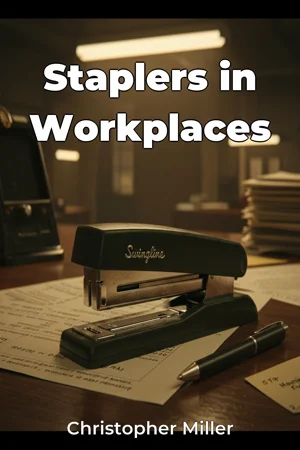
"Staplers in Workplaces" explores the unexpectedly rich history and mechanics of the stapler, a seemingly mundane tool that has profoundly shaped modern office culture. This book reveals how the stapler, initially a luxury item, evolved into an indispensable component of efficient document management and office workflows. It examines the stapler’s transition from early manual forms to sophisticated automated models, highlighting key innovations and their impact. The book dissects the mechanics of various stapler types, offering insights into the engineering principles behind their design. It also analyzes the stapler's broader societal impact, demonstrating how its adoption revolutionized organization and our perception of efficiency. For example, early staplers were handmade, making them expensive and exclusive to the wealthy, while mass production made staplers affordable and ubiquitous. Through a chronological exploration, "Staplers in Workplaces" traces the stapler's development, dissects its mechanics with diagrams, and analyzes its impact on workplace efficiency. By integrating technological history with social and cultural analysis, this book offers a comprehensive understanding of a tool we often take for granted, examining its environmental impact and staple-free alternatives.
Book Details
ISBN
9788235203106
Publisher
Publifye AS
Your Licenses
You don't own any licenses for this book
Purchase a license below to unlock this book and download the EPUB.
Purchase License
Select a tier to unlock this book
Need bulk licensing?
Contact us for enterprise agreements.