
About This Book
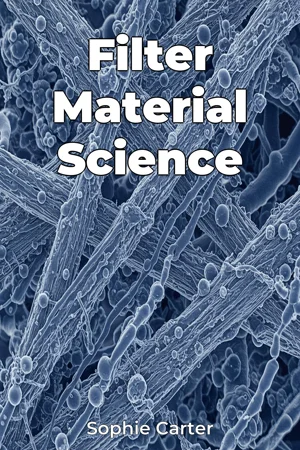
In an era increasingly defined by airborne pollutants and the critical need for clean environments, how do we truly understand the science behind the materials that protect us? "Filter Material Science" delves into the intricate world of filtration, providing a comprehensive analysis of the materials, manufacturing techniques, and performance metrics that define this vital field. This book unpacks the complexities of filter technology, emphasizing the relationship between material properties and filtration efficiency. This book primarily focuses on three core themes: fiber composition and its impact on filtration, encompassing natural, synthetic, and hybrid materials; manufacturing methodologies, detailing the processes involved in creating effective filter structures; and methods for the measurement and evaluation of filtration performance, including particle capture, pressure drop, and lifespan. These topics are critical as they directly influence the effectiveness, cost, and sustainability of filtration solutions across various industries. The book's context is rooted in the historical development of filtration technologies, beginning with simple woven fabrics and progressing to today's sophisticated nonwoven structures and membrane technologies. Understanding the advancements in material science, chemical engineering, and nanotechnology is vital for appreciating the nuances of modern filtration. While a background in basic physics and chemistry would be beneficial, the book is structured to gradually introduce necessary concepts. The central argument of "Filter Material Science" posits that a thorough understanding of the material science principles underlying filter design and manufacturing is essential for optimizing filtration performance and developing innovative solutions to meet evolving environmental and health challenges. This argument is paramount because it shifts the focus from purely empirical testing to a more informed, science-driven approach, allowing for targeted improvements and new material development. The book begins by introducing fundamental concepts in materials science, fluid dynamics, and particle physics as they relate to filtration. It proceeds to explore various fiber types, including cellulose, glass, polymers like polypropylene and polyester, and advanced materials like nanofibers and activated carbon. Each material is examined in terms of its chemical properties, physical structure, and suitability for different filtration applications. Manufacturing techniques are discussed in detail, covering processes such as weaving, knitting, melt blowing, electrospinning, and lamination. The book dedicates significant attention to performance evaluation, discussing standardized testing methods (e.g., ISO, ASTM), experimental setups for measuring particle capture efficiency, pressure drop characteristics, and filter lifespan. Finally, the book culminates by exploring emerging trends in filtration, such as self-cleaning filters, bio-based materials, and smart filtration systems. The evidence presented relies heavily on experimental data from published research, case studies of industrial applications, and theoretical models developed through computational fluid dynamics and materials simulation. Unique data sources include microscopic imaging of filter structures, detailed chemical analyses of fiber compositions, and comparative performance data across a wide range of filter materials. This book connects to several other fields, including environmental engineering (addressing air and water quality), biomedical engineering (designing filters for medical devices), and chemical engineering (optimizing filtration processes in industrial settings). These interdisciplinary connections enrich the book’s argument by demonstrating the broad applicability of filtration science. A notable aspect is its integration of both theoretical analyses and practical applications. It provides a bridge between fundamental materials science and real-world filter design, offering a holistic view that is often lacking in more specialized texts. The tone is academic yet accessible, aiming to provide a rigorous scientific foundation while remaining understandable to a broad audience. The writing style balances technical detail with clear explanations and illustrative examples. The target audience includes engineers, scientists, researchers, and students working in fields related to filtration, separation, materials science, and environmental science. It would be valuable to those involved in filter design, manufacturing, testing, or application, as well as those seeking a comprehensive overview of the subject. As a science and technology book, it aligns with genre expectations by providing factual, evidence-based information, rigorous analysis, and clear explanations of complex concepts. The scope is broad, covering a wide range of filter materials, manufacturing techniques, and performance metrics. However, it is intentionally limited to the science of filter materials, rather than focusing on specific applications or regulatory standards in detail. The information presented can be applied to optimize filter design for various applications, select appropriate materials for specific filtration challenges, and develop innovative filtration solutions that are both effective and sustainable. It should allow the reader to develop novel high-performance filters for demanding applications. While the book aims to present a balanced perspective, it will engage with ongoing debates regarding the relative merits of different filter materials, the accuracy of various testing methods, and the environmental impact of filter disposal.
In an era increasingly defined by airborne pollutants and the critical need for clean environments, how do we truly understand the science behind the materials that protect us? "Filter Material Science" delves into the intricate world of filtration, providing a comprehensive analysis of the materials, manufacturing techniques, and performance metrics that define this vital field. This book unpacks the complexities of filter technology, emphasizing the relationship between material properties and filtration efficiency. This book primarily focuses on three core themes: fiber composition and its impact on filtration, encompassing natural, synthetic, and hybrid materials; manufacturing methodologies, detailing the processes involved in creating effective filter structures; and methods for the measurement and evaluation of filtration performance, including particle capture, pressure drop, and lifespan. These topics are critical as they directly influence the effectiveness, cost, and sustainability of filtration solutions across various industries. The book's context is rooted in the historical development of filtration technologies, beginning with simple woven fabrics and progressing to today's sophisticated nonwoven structures and membrane technologies. Understanding the advancements in material science, chemical engineering, and nanotechnology is vital for appreciating the nuances of modern filtration. While a background in basic physics and chemistry would be beneficial, the book is structured to gradually introduce necessary concepts. The central argument of "Filter Material Science" posits that a thorough understanding of the material science principles underlying filter design and manufacturing is essential for optimizing filtration performance and developing innovative solutions to meet evolving environmental and health challenges. This argument is paramount because it shifts the focus from purely empirical testing to a more informed, science-driven approach, allowing for targeted improvements and new material development. The book begins by introducing fundamental concepts in materials science, fluid dynamics, and particle physics as they relate to filtration. It proceeds to explore various fiber types, including cellulose, glass, polymers like polypropylene and polyester, and advanced materials like nanofibers and activated carbon. Each material is examined in terms of its chemical properties, physical structure, and suitability for different filtration applications. Manufacturing techniques are discussed in detail, covering processes such as weaving, knitting, melt blowing, electrospinning, and lamination. The book dedicates significant attention to performance evaluation, discussing standardized testing methods (e.g., ISO, ASTM), experimental setups for measuring particle capture efficiency, pressure drop characteristics, and filter lifespan. Finally, the book culminates by exploring emerging trends in filtration, such as self-cleaning filters, bio-based materials, and smart filtration systems. The evidence presented relies heavily on experimental data from published research, case studies of industrial applications, and theoretical models developed through computational fluid dynamics and materials simulation. Unique data sources include microscopic imaging of filter structures, detailed chemical analyses of fiber compositions, and comparative performance data across a wide range of filter materials. This book connects to several other fields, including environmental engineering (addressing air and water quality), biomedical engineering (designing filters for medical devices), and chemical engineering (optimizing filtration processes in industrial settings). These interdisciplinary connections enrich the book’s argument by demonstrating the broad applicability of filtration science. A notable aspect is its integration of both theoretical analyses and practical applications. It provides a bridge between fundamental materials science and real-world filter design, offering a holistic view that is often lacking in more specialized texts. The tone is academic yet accessible, aiming to provide a rigorous scientific foundation while remaining understandable to a broad audience. The writing style balances technical detail with clear explanations and illustrative examples. The target audience includes engineers, scientists, researchers, and students working in fields related to filtration, separation, materials science, and environmental science. It would be valuable to those involved in filter design, manufacturing, testing, or application, as well as those seeking a comprehensive overview of the subject. As a science and technology book, it aligns with genre expectations by providing factual, evidence-based information, rigorous analysis, and clear explanations of complex concepts. The scope is broad, covering a wide range of filter materials, manufacturing techniques, and performance metrics. However, it is intentionally limited to the science of filter materials, rather than focusing on specific applications or regulatory standards in detail. The information presented can be applied to optimize filter design for various applications, select appropriate materials for specific filtration challenges, and develop innovative filtration solutions that are both effective and sustainable. It should allow the reader to develop novel high-performance filters for demanding applications. While the book aims to present a balanced perspective, it will engage with ongoing debates regarding the relative merits of different filter materials, the accuracy of various testing methods, and the environmental impact of filter disposal.
"Filter Material Science" explores the science of filtration, focusing on the materials and methods used to create effective filters. It emphasizes the critical link between a filter's material properties, such as fiber composition (natural, synthetic, or hybrid), and its overall filtration efficiency, highlighting how advancements in material science and nanotechnology are shaping modern filtration technologies. The book delves into manufacturing methodologies like weaving, knitting, and electrospinning, which are vital for producing filters capable of capturing airborne pollutants and other contaminants. The book examines different filter materials, including cellulose, polymers, and nanofibers, detailing their chemical properties and suitability for specific applications. Performance evaluation is a key focus, with discussions on standardized testing methods used to measure particle capture efficiency and filter lifespan. "Filter Material Science" progresses from fundamental concepts in materials science and fluid dynamics to advanced topics like self-cleaning filters and bio-based materials, offering a holistic view of the field. The book's approach integrates theoretical analyses with practical applications, bridging the gap between materials science and real-world filter design. It progresses through chapters, each focusing on a specific aspect of filter material science, from material properties to manufacturing techniques and performance evaluation, ultimately presenting emerging trends and innovations in filtration technology.
Book Details
ISBN
9788235202918
Publisher
Publifye AS
Your Licenses
You don't own any licenses for this book
Purchase a license below to unlock this book and download the EPUB.
Purchase License
Select a tier to unlock this book
Need bulk licensing?
Contact us for enterprise agreements.