
About This Book
What lies beneath the ocean's surface, hidden from view, shapes our planet as profoundly as the visible landscapes above? "Ocean Hides Mountains" unveils the submerged geological wonders of our world, focusing particularly on underwater mountain ranges like the Mid-Atlantic Ridge, and detailing how sonar technology revolutionized their discovery and mapping. This book explores the geological processes that formed these underwater features, their ecological significance, and the ongoing scientific endeavors to comprehend their impact on Earth's systems. The book's main topics are the formation and structure of underwater mountain ranges, the technological advancements in ocean mapping (primarily sonar), and the biodiversity sustained by these unique environments. These topics matter because understanding these submerged landscapes is crucial for comprehending plate tectonics, ocean currents, climate regulation, and the distribution of marine life. Historically, understanding of the ocean floor was rudimentary, relying on sparse depth soundings. The development of sonar during the 20th century dramatically changed our ability to "see" beneath the waves, revealing previously unknown geological structures. No prior knowledge is absolutely necessary, as the book builds from basic geological principles and technological explanations. The central argument of "Ocean Hides Mountains" asserts that underwater mountain ranges are not merely submerged geological features but are integral components of Earth's dynamic systems, influencing everything from ocean chemistry to global climate patterns. This argument is important because it challenges the traditional land-centric view of geological processes and highlights the interconnectedness of the planet. The book begins by introducing the basic concepts of plate tectonics and seafloor spreading. It then delves into the history and development of sonar technology, explaining how it works and its role in mapping the ocean floor. The core of the book focuses on the Mid-Atlantic Ridge as a case study, detailing its geological formation, hydrothermal vent systems, and unique biological communities. The book culminates by examining the broader implications of underwater mountain ranges for climate change research, resource management, and conservation efforts, thus presenting practical applications of understanding these deep ocean systems. Evidence and research presented include bathymetric data collected by sonar surveys, geological samples retrieved from the ocean floor, and biological studies of vent ecosystems. The book draws from publicly available datasets from organizations like NOAA and utilizes scientific publications in oceanography, geology, and marine biology. Detailed illustrations and maps will visually support the textual explanations. Interdisciplinary connections include links to climatology (understanding ocean currents and heat distribution), biology (studying unique ecosystems), and environmental science (assessing the impact of human activities on these environments). These connections strengthen the argument by demonstrating the far-reaching influence of underwater mountain ranges. The book offers a comprehensive overview of the topic, combining geological explanations with technological history and ecological insights. The writing style is accessible and informative, aiming to explain complex scientific concepts in a clear and engaging manner for a broad audience. The target audience includes students, science enthusiasts, and anyone interested in learning more about the hidden wonders of the ocean. It would be valuable to readers seeking a deeper understanding of Earth's geological processes and marine ecosystems. It aligns with the conventions of popular science writing, emphasizing clarity, accuracy, and engagement. While the book provides a comprehensive overview of underwater mountain ranges, it primarily focuses on the Mid-Atlantic Ridge and does not delve deeply into the specific geological characteristics of every underwater mountain range worldwide. Its scope is limited to non-technical explanations. Understanding the formation and dynamics of underwater mountain ranges and their associated hydrothermal vent systems can inform strategies for deep-sea resource management and conservation of unique marine ecosystems. While there is broad scientific consensus on the basic processes involved in seafloor spreading and plate tectonics, debates continue regarding the precise mechanisms of mantle convection and the long-term effects of hydrothermal vent activity on ocean chemistry. The book addresses these ongoing discussions by presenting different viewpoints and highlighting areas of active research.
What lies beneath the ocean's surface, hidden from view, shapes our planet as profoundly as the visible landscapes above? "Ocean Hides Mountains" unveils the submerged geological wonders of our world, focusing particularly on underwater mountain ranges like the Mid-Atlantic Ridge, and detailing how sonar technology revolutionized their discovery and mapping. This book explores the geological processes that formed these underwater features, their ecological significance, and the ongoing scientific endeavors to comprehend their impact on Earth's systems. The book's main topics are the formation and structure of underwater mountain ranges, the technological advancements in ocean mapping (primarily sonar), and the biodiversity sustained by these unique environments. These topics matter because understanding these submerged landscapes is crucial for comprehending plate tectonics, ocean currents, climate regulation, and the distribution of marine life. Historically, understanding of the ocean floor was rudimentary, relying on sparse depth soundings. The development of sonar during the 20th century dramatically changed our ability to "see" beneath the waves, revealing previously unknown geological structures. No prior knowledge is absolutely necessary, as the book builds from basic geological principles and technological explanations. The central argument of "Ocean Hides Mountains" asserts that underwater mountain ranges are not merely submerged geological features but are integral components of Earth's dynamic systems, influencing everything from ocean chemistry to global climate patterns. This argument is important because it challenges the traditional land-centric view of geological processes and highlights the interconnectedness of the planet. The book begins by introducing the basic concepts of plate tectonics and seafloor spreading. It then delves into the history and development of sonar technology, explaining how it works and its role in mapping the ocean floor. The core of the book focuses on the Mid-Atlantic Ridge as a case study, detailing its geological formation, hydrothermal vent systems, and unique biological communities. The book culminates by examining the broader implications of underwater mountain ranges for climate change research, resource management, and conservation efforts, thus presenting practical applications of understanding these deep ocean systems. Evidence and research presented include bathymetric data collected by sonar surveys, geological samples retrieved from the ocean floor, and biological studies of vent ecosystems. The book draws from publicly available datasets from organizations like NOAA and utilizes scientific publications in oceanography, geology, and marine biology. Detailed illustrations and maps will visually support the textual explanations. Interdisciplinary connections include links to climatology (understanding ocean currents and heat distribution), biology (studying unique ecosystems), and environmental science (assessing the impact of human activities on these environments). These connections strengthen the argument by demonstrating the far-reaching influence of underwater mountain ranges. The book offers a comprehensive overview of the topic, combining geological explanations with technological history and ecological insights. The writing style is accessible and informative, aiming to explain complex scientific concepts in a clear and engaging manner for a broad audience. The target audience includes students, science enthusiasts, and anyone interested in learning more about the hidden wonders of the ocean. It would be valuable to readers seeking a deeper understanding of Earth's geological processes and marine ecosystems. It aligns with the conventions of popular science writing, emphasizing clarity, accuracy, and engagement. While the book provides a comprehensive overview of underwater mountain ranges, it primarily focuses on the Mid-Atlantic Ridge and does not delve deeply into the specific geological characteristics of every underwater mountain range worldwide. Its scope is limited to non-technical explanations. Understanding the formation and dynamics of underwater mountain ranges and their associated hydrothermal vent systems can inform strategies for deep-sea resource management and conservation of unique marine ecosystems. While there is broad scientific consensus on the basic processes involved in seafloor spreading and plate tectonics, debates continue regarding the precise mechanisms of mantle convection and the long-term effects of hydrothermal vent activity on ocean chemistry. The book addresses these ongoing discussions by presenting different viewpoints and highlighting areas of active research.
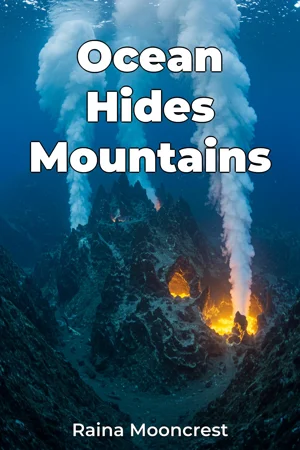
"Ocean Hides Mountains" explores the hidden world of underwater mountain ranges and their profound impact on our planet. Using sonar technology, scientists have unveiled these submerged geological wonders, like the Mid-Atlantic Ridge, revealing how they influence plate tectonics and seafloor spreading. These ranges aren't just static formations; they're integral to Earth's systems, affecting ocean currents and even climate regulation. The book highlights the unique ecosystems thriving around hydrothermal vents, showcasing the remarkable biodiversity these underwater mountains support. Beginning with basic geological principles and the history of sonar, the narrative progresses to examine the Mid-Atlantic Ridge as a key example. It then broadens to discuss the implications of these deep-sea environments for climate change research and resource management, offering a comprehensive look at these often-overlooked Earth sciences.
Book Details
ISBN
9788235200754
Publisher
Publifye AS
Your Licenses
You don't own any licenses for this book
Purchase a license below to unlock this book and download the EPUB.
Purchase License
Select a tier to unlock this book
Need bulk licensing?
Contact us for enterprise agreements.