
About This Book
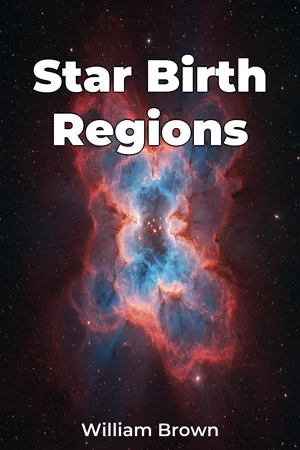
Have you ever wondered where stars come from, and what conditions allow them to ignite and shine? "Star Birth Regions" delves into the heart of these cosmic questions, exploring the fascinating environments where stars are born. This book examines the physics governing the formation of stars, focusing on the dense molecular clouds that serve as stellar nurseries. These regions, often obscured by dust, are where gravity overcomes pressure, leading to the collapse of gas and the eventual ignition of a star. We will explore the critical aspects of star formation, from the initial collapse of molecular clouds and fragmentation to the accretion of material onto protostars and the eventual dispersal of leftover gas and dust. Understanding these processes is essential for comprehending the evolution of galaxies and the prevalence of planetary systems. This book is divided into three major sections. The first section introduces the properties of molecular clouds: their composition, temperature structure, and the role of turbulence and magnetic fields. We will discuss how these factors influence the cloud's stability and susceptibility to collapse. The second section focuses on the collapse process itself, including the formation of protostars, accretion disks, and bipolar outflows. We examine the physics of radiative transfer and how it impacts the temperature and density profiles of collapsing clouds. The role of angular momentum and its transport via magnetic fields and turbulence are also analyzed. The final section explores the evolution of young stars, including their interaction with their surrounding environment and the formation of planetary systems. We will examine the evidence for circumstellar disks and the processes that lead to planet formation, such as dust coagulation and planetesimal accretion. The central argument of this book is that star formation is a complex interplay of gravity, turbulence, magnetic fields, and radiation, each playing a critical yet not fully understood part. Identifying the dominant processes in different environments will help us understand the variety of stars and planetary systems that populate the universe. The evidence presented in this book draws heavily from observational data obtained by telescopes across the electromagnetic spectrum, from radio waves to X-rays. We will analyze data from ground-based observatories such as ALMA (Atacama Large Millimeter/submillimeter Array) and space-based telescopes such as the James Webb Space Telescope and Hubble Space Telescope. These observations provide crucial information about the density, temperature, velocity, and chemical composition of star-forming regions. Numerical simulations also complement the observational data, allowing us to model the complex physical processes that occur during star formation. We will cover recent results from magneto-hydrodynamic simulations which capture the effects of turbulence and magnetic fields on the collapse of molecular clouds. This journey through star birth regions connects to other fields, including astrochemistry (understanding the chemical composition of molecular clouds), planet formation theory (how planets arise from circumstellar disks), and galaxy evolution (how star formation shapes the properties of galaxies). By drawing upon these interdisciplinary connections, we aim to provide a holistic view of star formation in the context of cosmic evolution. Unique to this book is its approach to presenting diverse data and models within a cohesive framework, allowing the reader to understand the limitations and uncertainties inherent in our current understanding of star formation. The writing style is intended to be accessible to advanced undergraduate students, graduate students, and researchers in astronomy and related fields. We aim to present complex concepts in a clear and concise manner, using diagrams and illustrations to enhance understanding. The target audience includes anyone with a basic understanding of physics and astronomy who wants to learn more about the fascinating process of star formation. This book will also be a valuable resource for researchers in the field, providing a comprehensive overview of the current state of knowledge and highlighting areas for future research. The book is focused specifically on the formation of individual stars and star clusters within molecular clouds, with less emphasis on the large-scale processes of galaxy formation and evolution. We also focus on star formation in our galaxy and nearby galaxies, and do not delve into the complexities of star formation in high-redshift galaxies. The knowledge gained from studying star birth regions is directly applicable to understanding various phenomena in astrophysics. It informs our models of planet formation, helps us interpret observations of distant galaxies, and provides insights into the origin and evolution of life in the universe. The book also addresses ongoing debates in the field, such as the relative importance of turbulence and magnetic fields in regulating star formation, and the role of feedback from young stars in shaping their environment.
Have you ever wondered where stars come from, and what conditions allow them to ignite and shine? "Star Birth Regions" delves into the heart of these cosmic questions, exploring the fascinating environments where stars are born. This book examines the physics governing the formation of stars, focusing on the dense molecular clouds that serve as stellar nurseries. These regions, often obscured by dust, are where gravity overcomes pressure, leading to the collapse of gas and the eventual ignition of a star. We will explore the critical aspects of star formation, from the initial collapse of molecular clouds and fragmentation to the accretion of material onto protostars and the eventual dispersal of leftover gas and dust. Understanding these processes is essential for comprehending the evolution of galaxies and the prevalence of planetary systems. This book is divided into three major sections. The first section introduces the properties of molecular clouds: their composition, temperature structure, and the role of turbulence and magnetic fields. We will discuss how these factors influence the cloud's stability and susceptibility to collapse. The second section focuses on the collapse process itself, including the formation of protostars, accretion disks, and bipolar outflows. We examine the physics of radiative transfer and how it impacts the temperature and density profiles of collapsing clouds. The role of angular momentum and its transport via magnetic fields and turbulence are also analyzed. The final section explores the evolution of young stars, including their interaction with their surrounding environment and the formation of planetary systems. We will examine the evidence for circumstellar disks and the processes that lead to planet formation, such as dust coagulation and planetesimal accretion. The central argument of this book is that star formation is a complex interplay of gravity, turbulence, magnetic fields, and radiation, each playing a critical yet not fully understood part. Identifying the dominant processes in different environments will help us understand the variety of stars and planetary systems that populate the universe. The evidence presented in this book draws heavily from observational data obtained by telescopes across the electromagnetic spectrum, from radio waves to X-rays. We will analyze data from ground-based observatories such as ALMA (Atacama Large Millimeter/submillimeter Array) and space-based telescopes such as the James Webb Space Telescope and Hubble Space Telescope. These observations provide crucial information about the density, temperature, velocity, and chemical composition of star-forming regions. Numerical simulations also complement the observational data, allowing us to model the complex physical processes that occur during star formation. We will cover recent results from magneto-hydrodynamic simulations which capture the effects of turbulence and magnetic fields on the collapse of molecular clouds. This journey through star birth regions connects to other fields, including astrochemistry (understanding the chemical composition of molecular clouds), planet formation theory (how planets arise from circumstellar disks), and galaxy evolution (how star formation shapes the properties of galaxies). By drawing upon these interdisciplinary connections, we aim to provide a holistic view of star formation in the context of cosmic evolution. Unique to this book is its approach to presenting diverse data and models within a cohesive framework, allowing the reader to understand the limitations and uncertainties inherent in our current understanding of star formation. The writing style is intended to be accessible to advanced undergraduate students, graduate students, and researchers in astronomy and related fields. We aim to present complex concepts in a clear and concise manner, using diagrams and illustrations to enhance understanding. The target audience includes anyone with a basic understanding of physics and astronomy who wants to learn more about the fascinating process of star formation. This book will also be a valuable resource for researchers in the field, providing a comprehensive overview of the current state of knowledge and highlighting areas for future research. The book is focused specifically on the formation of individual stars and star clusters within molecular clouds, with less emphasis on the large-scale processes of galaxy formation and evolution. We also focus on star formation in our galaxy and nearby galaxies, and do not delve into the complexities of star formation in high-redshift galaxies. The knowledge gained from studying star birth regions is directly applicable to understanding various phenomena in astrophysics. It informs our models of planet formation, helps us interpret observations of distant galaxies, and provides insights into the origin and evolution of life in the universe. The book also addresses ongoing debates in the field, such as the relative importance of turbulence and magnetic fields in regulating star formation, and the role of feedback from young stars in shaping their environment.
"Star Birth Regions" explores the captivating process of how stars ignite within molecular clouds, focusing on the physics governing their formation. These clouds, rich in gas and dust, are where gravity overcomes internal pressure, leading to the collapse and birth of new stars. The book examines how accretion disks form around protostars and how turbulence and magnetic fields influence the cloud's stability, revealing the intricate interplay of various physical forces. The book progresses through three key sections, beginning with an introduction to the properties of molecular clouds, including their temperature and composition. It then delves into the collapse process, explaining the formation of protostars and the role of radiative transfer. Finally, it explores the evolution of young stars and the formation of planetary systems, discussing how dust and gas coalesce to form planets. Observational data from telescopes like ALMA, the James Webb Space Telescope, and numerical simulations are used to support the analysis. Unique in its approach, this book presents observational data and models within a cohesive framework, acknowledging the uncertainties in our current understanding. It connects star formation to astrochemistry, planet formation, and galaxy evolution, providing a holistic view of cosmic evolution and highlighting the ongoing debates in the field. This approach makes "Star Birth Regions" a valuable resource for students and researchers seeking a comprehensive understanding of star formation.
Book Details
ISBN
9788235200624
Publisher
Publifye AS
Your Licenses
You don't own any licenses for this book
Purchase a license below to unlock this book and download the EPUB.
Purchase License
Select a tier to unlock this book
Need bulk licensing?
Contact us for enterprise agreements.