
About This Book
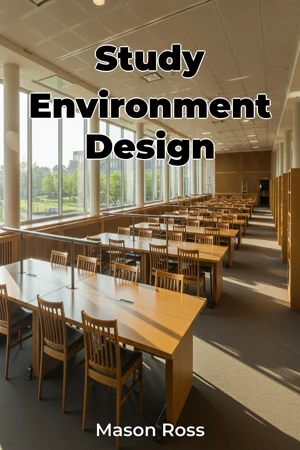
Have you ever wondered how much your surroundings affect your ability to learn and retain information? "Study Environment Design" delves into the profound impact of our physical learning spaces, drawing from environmental psychology and practical educational settings to reveal how thoughtful design can significantly enhance the learning experience. This book addresses two key questions: How do specific environmental factors influence cognitive processes like attention, memory, and motivation? And how can we strategically design learning environments to optimize these factors for improved educational outcomes? These questions are vital because, despite advancements in educational technology and pedagogy, the physical learning environment is often overlooked, leading to suboptimal learning outcomes. This book argues that learning environments are not merely passive backdrops but active agents that shape cognitive performance and emotional well-being. This argument is critical because it challenges traditional, often standardized, approaches to classroom design, advocating for evidence-based strategies that prioritize the learner's needs and the specific demands of different subjects. "Study Environment Design" begins by establishing a foundational understanding of environmental psychology, exploring key concepts such as sensory stimulation, spatial cognition, and the impact of environmental stressors on learning. It then transitions into an examination of diverse learning environments, ranging from traditional classrooms and libraries to modern co-working spaces and home study areas. The book's structure unfolds as follows: First, it introduces the core principles of environmental psychology and their relevance to education, providing a historical overview of research in this area. Second, it examines specific design elements – including lighting, acoustics, color, layout, and furniture – and analyzes their effects on various cognitive functions. Two major points will be explored in depth: The impact of natural light and ventilation on alertness and cognitive performance, and the role of flexible and adaptable spaces in promoting engagement and collaboration. These chapters will present empirical data from field studies and controlled experiments conducted in real-world educational settings. Third, the book explores the application of these principles across different educational contexts, considering the unique needs of various age groups and learning styles, showing examples of how these findings might be applied in practice. Finally, it addresses emerging trends in learning environment design, such as the integration of biophilic design (incorporating natural elements) and the use of technology to create adaptive and personalized learning spaces. The evidence presented in "Study Environment Design" relies on a combination of quantitative and qualitative data. It includes statistical analyses of student performance in different learning environments, observational studies of student behavior, and interviews with educators and students. Unique data sources include longitudinal studies tracking the impact of redesigned classrooms on student achievement and wellbeing, as well as meta-analyses of existing research on the effects of specific environmental factors. The book also incorporates interdisciplinary perspectives, drawing connections to architecture, neuroscience, and educational psychology. Architecture provides insights into spatial design and building materials; neuroscience offers a deeper understanding of the brain's response to environmental stimuli; and educational psychology provides theoretical frameworks for understanding learning processes. These connections enrich the book's argument by providing a more holistic and nuanced understanding of the relationship between learning environments and educational outcomes. One innovative aspect of "Study Environment Design" is its emphasis on participatory design, involving students and educators in the design process to create spaces that truly meet their needs. This approach recognizes that learning environments should be co-created, not imposed, and that the insights of those who use these spaces are invaluable. Written in an academic yet accessible style, "Study Environment Design" is targeted toward educators, architects, designers, and anyone interested in creating more effective and engaging learning environments. It offers practical guidance and evidence-based strategies for optimizing learning spaces to support student success and well-being. While the book aims to provide a comprehensive overview of the field, it primarily focuses on formal learning environments (schools, universities) and acknowledges that the principles may need to be adapted for informal learning settings (museums, community centers). The information contained within this book has real-world application. From redesigning a single classroom, to informing the construction of an entirely new campus, the principles outlined can be employed to improve student performance and overall well-being. "Study Environment Design" addresses ongoing debates in the field, such as the optimal level of sensory stimulation in learning environments and the role of technology in creating personalized learning spaces. By presenting diverse perspectives and evidence-based recommendations, this book contributes to a more informed and nuanced understanding of the complex relationship between learning environments and educational outcomes.
Have you ever wondered how much your surroundings affect your ability to learn and retain information? "Study Environment Design" delves into the profound impact of our physical learning spaces, drawing from environmental psychology and practical educational settings to reveal how thoughtful design can significantly enhance the learning experience. This book addresses two key questions: How do specific environmental factors influence cognitive processes like attention, memory, and motivation? And how can we strategically design learning environments to optimize these factors for improved educational outcomes? These questions are vital because, despite advancements in educational technology and pedagogy, the physical learning environment is often overlooked, leading to suboptimal learning outcomes. This book argues that learning environments are not merely passive backdrops but active agents that shape cognitive performance and emotional well-being. This argument is critical because it challenges traditional, often standardized, approaches to classroom design, advocating for evidence-based strategies that prioritize the learner's needs and the specific demands of different subjects. "Study Environment Design" begins by establishing a foundational understanding of environmental psychology, exploring key concepts such as sensory stimulation, spatial cognition, and the impact of environmental stressors on learning. It then transitions into an examination of diverse learning environments, ranging from traditional classrooms and libraries to modern co-working spaces and home study areas. The book's structure unfolds as follows: First, it introduces the core principles of environmental psychology and their relevance to education, providing a historical overview of research in this area. Second, it examines specific design elements – including lighting, acoustics, color, layout, and furniture – and analyzes their effects on various cognitive functions. Two major points will be explored in depth: The impact of natural light and ventilation on alertness and cognitive performance, and the role of flexible and adaptable spaces in promoting engagement and collaboration. These chapters will present empirical data from field studies and controlled experiments conducted in real-world educational settings. Third, the book explores the application of these principles across different educational contexts, considering the unique needs of various age groups and learning styles, showing examples of how these findings might be applied in practice. Finally, it addresses emerging trends in learning environment design, such as the integration of biophilic design (incorporating natural elements) and the use of technology to create adaptive and personalized learning spaces. The evidence presented in "Study Environment Design" relies on a combination of quantitative and qualitative data. It includes statistical analyses of student performance in different learning environments, observational studies of student behavior, and interviews with educators and students. Unique data sources include longitudinal studies tracking the impact of redesigned classrooms on student achievement and wellbeing, as well as meta-analyses of existing research on the effects of specific environmental factors. The book also incorporates interdisciplinary perspectives, drawing connections to architecture, neuroscience, and educational psychology. Architecture provides insights into spatial design and building materials; neuroscience offers a deeper understanding of the brain's response to environmental stimuli; and educational psychology provides theoretical frameworks for understanding learning processes. These connections enrich the book's argument by providing a more holistic and nuanced understanding of the relationship between learning environments and educational outcomes. One innovative aspect of "Study Environment Design" is its emphasis on participatory design, involving students and educators in the design process to create spaces that truly meet their needs. This approach recognizes that learning environments should be co-created, not imposed, and that the insights of those who use these spaces are invaluable. Written in an academic yet accessible style, "Study Environment Design" is targeted toward educators, architects, designers, and anyone interested in creating more effective and engaging learning environments. It offers practical guidance and evidence-based strategies for optimizing learning spaces to support student success and well-being. While the book aims to provide a comprehensive overview of the field, it primarily focuses on formal learning environments (schools, universities) and acknowledges that the principles may need to be adapted for informal learning settings (museums, community centers). The information contained within this book has real-world application. From redesigning a single classroom, to informing the construction of an entirely new campus, the principles outlined can be employed to improve student performance and overall well-being. "Study Environment Design" addresses ongoing debates in the field, such as the optimal level of sensory stimulation in learning environments and the role of technology in creating personalized learning spaces. By presenting diverse perspectives and evidence-based recommendations, this book contributes to a more informed and nuanced understanding of the complex relationship between learning environments and educational outcomes.
"Study Environment Design" explores how our physical surroundings profoundly impact learning and memory, arguing that learning environments actively shape cognitive performance and emotional well-being. It examines how specific environmental factors, such as sensory stimulation and spatial cognition, influence attention, memory, and motivation. The book highlights the impact of natural light and ventilation on alertness, as well as the importance of flexible spaces in promoting engagement. The book uniquely combines environmental psychology with educational settings, advocating for evidence-based strategies in classroom design. Presenting both quantitative and qualitative data, including statistical analyses and observational studies, the book emphasizes participatory design, involving students and educators in creating optimal learning spaces. By drawing connections to architecture, neuroscience, and educational psychology, it offers a holistic understanding of learning environments. Beginning with the principles of environmental psychology, the book progresses to examining specific design elements like lighting, acoustics, and layout. It then explores the application of these principles across diverse educational contexts and concludes by addressing emerging trends like biophilic design and personalized learning spaces. This approach offers practical guidance for educators, architects, and designers seeking to create more effective and engaging environments to improve educational outcomes and student well-being.
Book Details
ISBN
9788233999964
Publisher
Publifye AS
Your Licenses
You don't own any licenses for this book
Purchase a license below to unlock this book and download the EPUB.
Purchase License
Select a tier to unlock this book
Need bulk licensing?
Contact us for enterprise agreements.