
About This Book
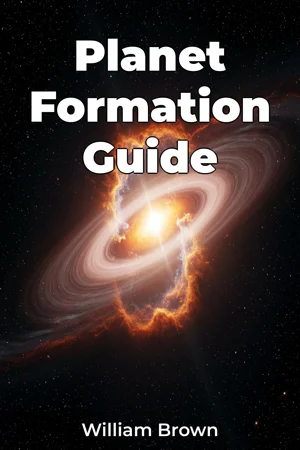
How did our solar system, with its diverse array of planets, moons, asteroids, and comets, come to be? "Planet Formation Guide" offers a comprehensive exploration of our current understanding of planetary formation, synthesizing the latest astronomical observations with cutting-edge theoretical models. This book delves into the complex processes that transform microscopic dust grains into fully formed planets, illuminating the key stages and underlying physics that govern this cosmic evolution. Two central themes are the accretion of planetesimals and the role of protoplanetary disks. Understanding how tiny dust particles coalesce into larger bodies, eventually forming planetesimals, is crucial. These planetesimals then gravitationally attract each other, growing into protoplanets and ultimately planets. The protoplanetary disk, the swirling disk of gas and dust surrounding a young star, provides the raw materials and the environment where these processes unfold. These topics matter because they explain the very existence of planets and, by extension, the potential for life beyond Earth. The book builds upon decades of astronomical observations of star-forming regions and exoplanetary systems, coupled with sophisticated computer simulations. A basic understanding of physics, particularly mechanics and thermodynamics, will be helpful for readers, but the book is designed to be accessible to anyone with a strong interest in science and astronomy. The core argument is that planet formation is a complex, multi-faceted process influenced by a delicate interplay of physical forces, chemical reactions, and environmental conditions. Understanding this interplay is essential to interpreting the diversity of planetary systems observed throughout the galaxy and to assessing the potential for habitability on other planets. The book is structured in a logical progression. It begins with an introduction to the fundamental properties of protoplanetary disks, including their composition, temperature profiles, and dynamical evolution. It then explores the processes of dust coagulation and planetesimal formation, examining different theoretical models and observational constraints. Major sections are dedicated to the growth of protoplanets, the role of gas giants in shaping planetary architectures, and the dynamics of planetary systems. The book culminates in a discussion of the implications for the search for habitable exoplanets and the origins of life. The evidence presented relies heavily on data from ground-based telescopes, space-based observatories like the Hubble Space Telescope and the James Webb Space Telescope, and sophisticated numerical simulations. The book also draws upon meteorite analyses and studies of our own solar system to provide insights into the composition and history of planetary building blocks. The book bridges astronomy and astrophysics, planetary science, and chemistry. The physics of accretion is inseparable from the chemical composition of the protoplanetary disk. The orbital dynamics of planets influence the potential for habitability, creating a rich interdisciplinary tapestry. A unique aspect is its emphasis on the interplay between theory and observation. It not only presents the latest theoretical models but also critically evaluates them in light of observational data. The simulations are balanced with real-world observational evidence. The writing style is designed to be both informative and engaging, presenting complex concepts in a clear and accessible manner. The book is targeted towards advanced undergraduate and graduate students in astronomy, astrophysics, and planetary science, as well as researchers and anyone with a passion for understanding the cosmos. As a non-fiction science book, it maintains a strong emphasis on evidence-based reasoning and rigorous scientific methodology. The scope is limited to the physical processes of planet formation, with a focus on the early stages of planetary system evolution. While touching on the search for habitable exoplanets, it does not delve deeply into the biological aspects of habitability. The information presented has real-world applications in the design and interpretation of exoplanet surveys, the development of new models of planetary system formation, and the search for extraterrestrial life. The book also addresses some of the ongoing debates in the field, such as the relative importance of different planetesimal formation mechanisms and the role of giant planet migration in shaping planetary system architectures. By presenting different perspectives and outlining the key areas of uncertainty, the book aims to stimulate further research and discussion.
How did our solar system, with its diverse array of planets, moons, asteroids, and comets, come to be? "Planet Formation Guide" offers a comprehensive exploration of our current understanding of planetary formation, synthesizing the latest astronomical observations with cutting-edge theoretical models. This book delves into the complex processes that transform microscopic dust grains into fully formed planets, illuminating the key stages and underlying physics that govern this cosmic evolution. Two central themes are the accretion of planetesimals and the role of protoplanetary disks. Understanding how tiny dust particles coalesce into larger bodies, eventually forming planetesimals, is crucial. These planetesimals then gravitationally attract each other, growing into protoplanets and ultimately planets. The protoplanetary disk, the swirling disk of gas and dust surrounding a young star, provides the raw materials and the environment where these processes unfold. These topics matter because they explain the very existence of planets and, by extension, the potential for life beyond Earth. The book builds upon decades of astronomical observations of star-forming regions and exoplanetary systems, coupled with sophisticated computer simulations. A basic understanding of physics, particularly mechanics and thermodynamics, will be helpful for readers, but the book is designed to be accessible to anyone with a strong interest in science and astronomy. The core argument is that planet formation is a complex, multi-faceted process influenced by a delicate interplay of physical forces, chemical reactions, and environmental conditions. Understanding this interplay is essential to interpreting the diversity of planetary systems observed throughout the galaxy and to assessing the potential for habitability on other planets. The book is structured in a logical progression. It begins with an introduction to the fundamental properties of protoplanetary disks, including their composition, temperature profiles, and dynamical evolution. It then explores the processes of dust coagulation and planetesimal formation, examining different theoretical models and observational constraints. Major sections are dedicated to the growth of protoplanets, the role of gas giants in shaping planetary architectures, and the dynamics of planetary systems. The book culminates in a discussion of the implications for the search for habitable exoplanets and the origins of life. The evidence presented relies heavily on data from ground-based telescopes, space-based observatories like the Hubble Space Telescope and the James Webb Space Telescope, and sophisticated numerical simulations. The book also draws upon meteorite analyses and studies of our own solar system to provide insights into the composition and history of planetary building blocks. The book bridges astronomy and astrophysics, planetary science, and chemistry. The physics of accretion is inseparable from the chemical composition of the protoplanetary disk. The orbital dynamics of planets influence the potential for habitability, creating a rich interdisciplinary tapestry. A unique aspect is its emphasis on the interplay between theory and observation. It not only presents the latest theoretical models but also critically evaluates them in light of observational data. The simulations are balanced with real-world observational evidence. The writing style is designed to be both informative and engaging, presenting complex concepts in a clear and accessible manner. The book is targeted towards advanced undergraduate and graduate students in astronomy, astrophysics, and planetary science, as well as researchers and anyone with a passion for understanding the cosmos. As a non-fiction science book, it maintains a strong emphasis on evidence-based reasoning and rigorous scientific methodology. The scope is limited to the physical processes of planet formation, with a focus on the early stages of planetary system evolution. While touching on the search for habitable exoplanets, it does not delve deeply into the biological aspects of habitability. The information presented has real-world applications in the design and interpretation of exoplanet surveys, the development of new models of planetary system formation, and the search for extraterrestrial life. The book also addresses some of the ongoing debates in the field, such as the relative importance of different planetesimal formation mechanisms and the role of giant planet migration in shaping planetary system architectures. By presenting different perspectives and outlining the key areas of uncertainty, the book aims to stimulate further research and discussion.
"Planet Formation Guide" explores the fascinating journey from microscopic dust to fully formed planets. Delving into the heart of star-forming regions, the book illuminates the crucial role of protoplanetary disks, the swirling nurseries where planets are born. One intriguing fact is how planetesimals, small bodies formed from dust accretion, gravitationally attract each other, growing into protoplanets. Understanding planet formation is key to potentially discovering habitable exoplanets and grasping the potential for life beyond Earth. The book progresses logically, beginning with protoplanetary disk properties and moving through dust coagulation, planetesimal formation, and protoplanet growth. A unique strength lies in its balanced approach, intertwining the latest theoretical models with observational data from telescopes like Hubble and James Webb. The book also addresses ongoing debates, presenting multiple perspectives to stimulate further research.
Book Details
ISBN
9788233999827
Publisher
Publifye AS
Your Licenses
You don't own any licenses for this book
Purchase a license below to unlock this book and download the EPUB.
Purchase License
Select a tier to unlock this book
Need bulk licensing?
Contact us for enterprise agreements.