
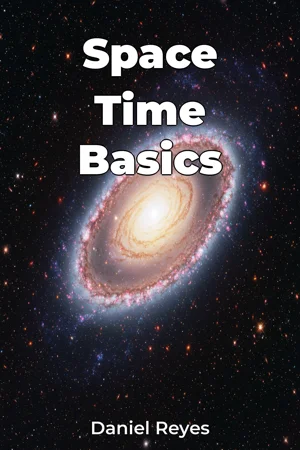
About This Book
How does our universe truly operate at its most fundamental level? "Space Time Basics" delves into the essential concepts of relativity, offering a robust exploration of the physics research and observational evidence that have shaped our understanding of space, time, gravity, and the cosmos. This book matters because relativity, at its core, reshaped our understanding of the universe, and influences technologies from GPS to medical imaging. This exploration unfolds against the backdrop of centuries of scientific inquiry, moving from Newtonian physics to the groundbreaking theories of Albert Einstein. A basic understanding of high-school level physics will enhance the reader's engagement, though all concepts are meticulously explained. The central argument of "Space Time Basics" is that space and time are not absolute and independent entities, but rather are intertwined into a single, flexible fabric known as spacetime, profoundly influenced by gravity and motion. Understanding this interwoven relationship is crucial for comprehending the behavior of objects within the universe, from photons to galaxies. The book begins by introducing the foundational principles of special relativity, elucidating concepts such as time dilation, length contraction, and the constancy of the speed of light. It will then progress into the complexities of general relativity, where gravity is redefined not as a force, but as a curvature of spacetime caused by mass and energy. Further chapters will explore the experimental evidence supporting these theories, ranging from the famous Eddington experiment confirming the bending of starlight during a solar eclipse, to modern-day observations of gravitational lensing and the detection of gravitational waves. The culmination of the book presents the implications of relativity for cosmology, including the expansion of the universe, black holes, with connections to quantum mechanics and attempts at quantum gravity. Supporting these arguments, the book relies heavily on documented physics research, providing a comprehensive review of key experiments and observational data. The methodologies range from classical mechanics analyses to advanced mathematical frameworks, ensuring a rich and nuanced perspective. "Space Time Basics" intersects with other scientific disciplines. Astrophysics uses relativity when studying black holes. Navigation systems rely on relativistic corrections for precise positioning. Philosophy contemplates the implications of relativity on causality and the nature of reality. The approach taken in "Space Time Basics" is to ground complex theoretical concepts in tangible examples and empirical observations. The book aims to explain the core equations of relativity in a clear and accessible manner, avoiding overly technical jargon where possible, while preserving the mathematical essence. The target audience includes physics students, science enthusiasts, and anyone curious about the fundamental nature of the universe. This book demystifies relativity, making it accessible without sacrificing scientific rigor. As a work in physics and science, "Space Time Basics" adheres to the standards of presenting verified information, logical reasoning, and comprehensive referencing. The book's scope is specifically focused on the core principles and evidence of special and general relativity. It stops short of detailed explorations into quantum field theory or other more speculative areas of theoretical physics. Relativity plays a crucial role in various technologies. MRI machines, for example, rely on the precise control of magnetic fields, which are described by relativistic electromagnetism. Particle accelerators depend on relativistic dynamics for the manipulation of high-energy particles. Throughout the book, the scientific disputes that shaped the acceptance of relativity are considered. The debates surrounding the interpretation of quantum mechanics are also discussed, highlighting the contrasts and possible compatibilities with relativistic concepts.
How does our universe truly operate at its most fundamental level? "Space Time Basics" delves into the essential concepts of relativity, offering a robust exploration of the physics research and observational evidence that have shaped our understanding of space, time, gravity, and the cosmos. This book matters because relativity, at its core, reshaped our understanding of the universe, and influences technologies from GPS to medical imaging. This exploration unfolds against the backdrop of centuries of scientific inquiry, moving from Newtonian physics to the groundbreaking theories of Albert Einstein. A basic understanding of high-school level physics will enhance the reader's engagement, though all concepts are meticulously explained. The central argument of "Space Time Basics" is that space and time are not absolute and independent entities, but rather are intertwined into a single, flexible fabric known as spacetime, profoundly influenced by gravity and motion. Understanding this interwoven relationship is crucial for comprehending the behavior of objects within the universe, from photons to galaxies. The book begins by introducing the foundational principles of special relativity, elucidating concepts such as time dilation, length contraction, and the constancy of the speed of light. It will then progress into the complexities of general relativity, where gravity is redefined not as a force, but as a curvature of spacetime caused by mass and energy. Further chapters will explore the experimental evidence supporting these theories, ranging from the famous Eddington experiment confirming the bending of starlight during a solar eclipse, to modern-day observations of gravitational lensing and the detection of gravitational waves. The culmination of the book presents the implications of relativity for cosmology, including the expansion of the universe, black holes, with connections to quantum mechanics and attempts at quantum gravity. Supporting these arguments, the book relies heavily on documented physics research, providing a comprehensive review of key experiments and observational data. The methodologies range from classical mechanics analyses to advanced mathematical frameworks, ensuring a rich and nuanced perspective. "Space Time Basics" intersects with other scientific disciplines. Astrophysics uses relativity when studying black holes. Navigation systems rely on relativistic corrections for precise positioning. Philosophy contemplates the implications of relativity on causality and the nature of reality. The approach taken in "Space Time Basics" is to ground complex theoretical concepts in tangible examples and empirical observations. The book aims to explain the core equations of relativity in a clear and accessible manner, avoiding overly technical jargon where possible, while preserving the mathematical essence. The target audience includes physics students, science enthusiasts, and anyone curious about the fundamental nature of the universe. This book demystifies relativity, making it accessible without sacrificing scientific rigor. As a work in physics and science, "Space Time Basics" adheres to the standards of presenting verified information, logical reasoning, and comprehensive referencing. The book's scope is specifically focused on the core principles and evidence of special and general relativity. It stops short of detailed explorations into quantum field theory or other more speculative areas of theoretical physics. Relativity plays a crucial role in various technologies. MRI machines, for example, rely on the precise control of magnetic fields, which are described by relativistic electromagnetism. Particle accelerators depend on relativistic dynamics for the manipulation of high-energy particles. Throughout the book, the scientific disputes that shaped the acceptance of relativity are considered. The debates surrounding the interpretation of quantum mechanics are also discussed, highlighting the contrasts and possible compatibilities with relativistic concepts.
"Space Time Basics" explores the revolutionary concepts of relativity, examining how our understanding of space, time, and gravity has evolved. It highlights how space and time are not independent but are woven together into spacetime, a flexible fabric influenced by mass and energy, impacting everything from light to galaxies. This book explains complex ideas like time dilation and length contraction, showing how they challenge classical physics and underpin modern cosmology. The book begins with special relativity, explaining how the speed of light is constant for all observers, leading to mind-bending effects on time and space. It then moves into general relativity, where gravity isn't a force but a curvature of spacetime. Real-world evidence, such as the bending of starlight and the detection of gravitational waves, supports these theories. Understanding these concepts is crucial, as relativity influences technologies like GPS and provides insight into astrophysical phenomena like black holes. "Space Time Basics" aims to make these complex physics concepts accessible by grounding them in tangible examples and observational data. It seeks to demystify relativity for students and enthusiasts alike, presenting verified information and logical reasoning. The book progresses systematically, building from foundational principles to the implications of relativity for understanding the universe and its expansion.
Book Details
ISBN
9788233999674
Publisher
Publifye AS
Your Licenses
You don't own any licenses for this book
Purchase a license below to unlock this book and download the EPUB.
Purchase License
Select a tier to unlock this book
Need bulk licensing?
Contact us for enterprise agreements.