
About This Book
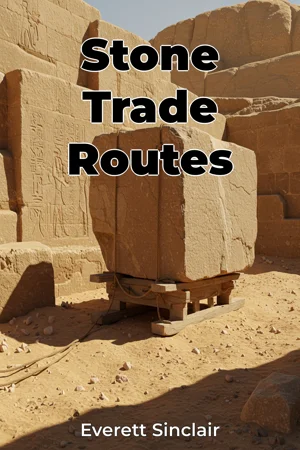
How did ancient civilizations move tons of stone across vast distances to create enduring monuments? "Stone Trade Routes" explores the intricate networks that facilitated the transportation of stone throughout history, relying on both archaeological discoveries and historical records to illuminate these long-lost logistical feats. Two key areas of focus include the engineering solutions developed to move massive stones, and the economic and social impacts of stone procurement and transport on ancient societies. Understanding these networks offers insight into technological innovation and the complex interplay of labor, resources, and power in bygone eras. This book provides a comprehensive examination of stone transportation networks within the broader context of ancient technology, trade, and social structures. It requires a general familiarity with ancient history, geography, and basic elements of architecture, but avoids specialist jargon to remain accessible. The central argument posits that the ability to transport large quantities of stone was a critical factor in the development and expression of power of numerous ancient civilizations, influencing architectural styles, settlement patterns, and trade relationships. Effective stone transport was not merely a practical concern, but a key element shaping ancient social and economic organization. The book is structured to first introduce the fundamental challenges of stone transport, considering factors like weight, distance, terrain, and available resources. It then examines specific case studies like ancient Egypt, the Roman Empire, and pre-Columbian Mesoamerica. These case studies detail quarrying techniques, methods of transport (including land and water routes), and the organization of labor involved. The book then analyzes the economic impact of the stone trade, including its influence on trade routes. The economic and social ramifications of monumental construction are considered. Finally, the book synthesizes these findings to present a broader understanding of the role of stone transport in shaping ancient societies. The evidence presented draws from a range of sources. Archaeological excavations provide direct evidence of quarry locations, tools, transport infrastructure (roads, ramps, canals), and unfinished or abandoned stone blocks. Historical texts, including inscriptions, administrative records, and accounts by ancient writers, offer insights into the organization of labor, the costs involved, and the political motivations behind large-scale building projects. Furthermore, the book connects to several interdisciplinary fields, including archaeology, economic history, and engineering history. Collaboration between these disciplines enriches our understanding of the topic. This book stands out by integrating archaeological data with historical texts to create a holistic picture. The approach is academic, but strives for clarity and accessibility, avoiding technical jargon. The target audience includes students and scholars of archaeology, history, and architecture, as well as general readers interested in ancient technology, trade, and the construction of monuments. The book is especially valuable to anyone seeking a comprehensive overview of the subject, from a wide range of historical and geographical contexts. As a work of non-fiction history and architecture, this book adheres to standards of evidence-based analysis and scholarly rigor. While the book covers a broad geographical range, it concentrates on civilizations with well-documented examples of monumental construction, such as those mentioned above. This is a deliberate limitation to allow for in-depth analysis within a reasonable scope. The information in this book has practical applications for modern architects, engineers, and preservationists, offering valuable lessons in construction techniques, project management, and the sustainable use of resources. The book addresses debates surrounding the engineering feats of ancient civilizations, offering balanced assessments.
How did ancient civilizations move tons of stone across vast distances to create enduring monuments? "Stone Trade Routes" explores the intricate networks that facilitated the transportation of stone throughout history, relying on both archaeological discoveries and historical records to illuminate these long-lost logistical feats. Two key areas of focus include the engineering solutions developed to move massive stones, and the economic and social impacts of stone procurement and transport on ancient societies. Understanding these networks offers insight into technological innovation and the complex interplay of labor, resources, and power in bygone eras. This book provides a comprehensive examination of stone transportation networks within the broader context of ancient technology, trade, and social structures. It requires a general familiarity with ancient history, geography, and basic elements of architecture, but avoids specialist jargon to remain accessible. The central argument posits that the ability to transport large quantities of stone was a critical factor in the development and expression of power of numerous ancient civilizations, influencing architectural styles, settlement patterns, and trade relationships. Effective stone transport was not merely a practical concern, but a key element shaping ancient social and economic organization. The book is structured to first introduce the fundamental challenges of stone transport, considering factors like weight, distance, terrain, and available resources. It then examines specific case studies like ancient Egypt, the Roman Empire, and pre-Columbian Mesoamerica. These case studies detail quarrying techniques, methods of transport (including land and water routes), and the organization of labor involved. The book then analyzes the economic impact of the stone trade, including its influence on trade routes. The economic and social ramifications of monumental construction are considered. Finally, the book synthesizes these findings to present a broader understanding of the role of stone transport in shaping ancient societies. The evidence presented draws from a range of sources. Archaeological excavations provide direct evidence of quarry locations, tools, transport infrastructure (roads, ramps, canals), and unfinished or abandoned stone blocks. Historical texts, including inscriptions, administrative records, and accounts by ancient writers, offer insights into the organization of labor, the costs involved, and the political motivations behind large-scale building projects. Furthermore, the book connects to several interdisciplinary fields, including archaeology, economic history, and engineering history. Collaboration between these disciplines enriches our understanding of the topic. This book stands out by integrating archaeological data with historical texts to create a holistic picture. The approach is academic, but strives for clarity and accessibility, avoiding technical jargon. The target audience includes students and scholars of archaeology, history, and architecture, as well as general readers interested in ancient technology, trade, and the construction of monuments. The book is especially valuable to anyone seeking a comprehensive overview of the subject, from a wide range of historical and geographical contexts. As a work of non-fiction history and architecture, this book adheres to standards of evidence-based analysis and scholarly rigor. While the book covers a broad geographical range, it concentrates on civilizations with well-documented examples of monumental construction, such as those mentioned above. This is a deliberate limitation to allow for in-depth analysis within a reasonable scope. The information in this book has practical applications for modern architects, engineers, and preservationists, offering valuable lessons in construction techniques, project management, and the sustainable use of resources. The book addresses debates surrounding the engineering feats of ancient civilizations, offering balanced assessments.
"Stone Trade Routes" unveils the complex logistical networks that enabled ancient civilizations to transport massive stones for monumental construction. Exploring both archaeological discoveries and historical records, the book highlights the ingenuity of ancient engineers who devised solutions to move colossal weights across vast distances. The economic and social ramifications of stone procurement are also examined, revealing how the demand for building materials shaped ancient societies and influenced trade relationships. The book progresses from the fundamental challenges of stone transport to specific case studies, such as ancient Egypt and the Roman Empire, detailing quarrying techniques and methods of transport. By integrating archaeological data with historical texts, "Stone Trade Routes" offers a holistic view of how the ability to transport large quantities of stone was critical to demonstrating power, influencing architectural styles, and shaping economic organization in the ancient world.
Book Details
ISBN
9788233998578
Publisher
Publifye AS
Your Licenses
You don't own any licenses for this book
Purchase a license below to unlock this book and download the EPUB.
Purchase License
Select a tier to unlock this book
Need bulk licensing?
Contact us for enterprise agreements.