
About This Book
Can skyscrapers truly be sustainable, or is it a paradox to build ever higher while striving for environmental responsibility? "Sustainable Skyscrapers" delves into the rapidly evolving world of green technology and energy-efficient design within the context of vertical urban development. This book explores how architects, engineers, and urban planners are working to mitigate the environmental impact of skyscrapers, transforming them from symbols of excess into models of sustainability. Two key topics form the foundation of this exploration: firstly, the integration of passive and active energy systems, and secondly, the adoption of sustainable materials and construction practices. The importance of these topics lies in the urgent need to reduce the carbon footprint of cities, where skyscrapers contribute significantly to energy consumption and waste generation. Understanding how these buildings can be designed and operated more efficiently is crucial for creating truly sustainable urban environments. The book provides the historical context of skyscraper design, tracing its evolution from purely aesthetic and economic considerations to a growing awareness of environmental impact. It examines the social pressures and the increasing regulatory demands that are now driving the adoption of green building practices. Readers will gain foundational knowledge of building science principles, including thermodynamics, material science, and renewable energy technologies. The central argument of "Sustainable Skyscrapers" is that achieving true sustainability in skyscraper design requires a holistic approach, integrating innovative technologies with mindful material selection and a deep understanding of the building's lifecycle. This argument is crucial because it challenges the conventional view of skyscrapers as inherently unsustainable and presents a pathway towards a more ecologically responsible future for vertical urban development. The book unfolds in a structured manner. It begins by introducing the core concepts of sustainable design, including energy efficiency, water conservation, and waste reduction. The following sections delve into specific strategies, examining case studies of skyscrapers around the world that exemplify best practices in green building. These sections address key areas such as high-performance facades, renewable energy integration (solar, wind, geothermal), advanced HVAC systems, and water management strategies. A dedicated chapter focuses on the selection and sourcing of sustainable materials, considering factors such as embodied energy, recyclability, and life-cycle assessment. The book culminates with a discussion of the social and economic implications of sustainable skyscraper design, exploring how these buildings can contribute to community well-being and economic prosperity. The evidence presented in "Sustainable Skyscrapers" draws from a variety of sources, including peer-reviewed research, industry reports, case studies, and interviews with leading architects and engineers. Performance data from real-world projects is analyzed to demonstrate the effectiveness of different green building strategies. The book connects to several other fields of study, including urban planning, environmental science, and economics. By considering the broader urban context and the environmental impact of skyscrapers, it offers a more comprehensive understanding of sustainability. It also touches upon economic considerations, examining the costs and benefits of investing in green building technologies. "Sustainable Skyscrapers" takes a systems-thinking approach, emphasizing the interconnectedness of different design elements and their impact on the overall performance of the building. This perspective encourages readers to move beyond isolated solutions and consider the holistic impact. The book adopts a professional yet accessible tone, making complex technical information understandable to a broad audience. While grounded in scientific principles, the writing style avoids excessive jargon and focuses on clear, concise explanations. The target audience includes architects, engineers, urban planners, developers, and students in related fields. It is also relevant to policymakers and anyone interested in sustainable urban development. The book provides valuable insights and practical guidance for designing, constructing, and operating high-performance skyscrapers. As a work of non-fiction in the fields of architecture and environmental studies, "Sustainable Skyscrapers" adheres to principles of accuracy, objectivity, and evidence-based analysis. It aims to provide a balanced and comprehensive overview of the topic, avoiding unsubstantiated claims and presenting diverse perspectives. The book's scope encompasses a wide range of green building technologies and design strategies applicable to skyscrapers. However, it does not delve into highly specialized engineering topics, such as structural analysis or advanced material science. The focus remains on the practical application of sustainable design principles. The information presented in "Sustainable Skyscrapers" can be applied directly to real-world projects. Architects and engineers can use the book to inform their design decisions, while developers can use it to assess the feasibility and benefits of green building investments. Urban planners can use it to develop policies and regulations that promote sustainable urban development. One ongoing debate in the field concerns the relative importance of different sustainability metrics. Some argue that energy efficiency should be the primary focus, while others emphasize the importance of embodied energy and life-cycle assessment. "Sustainable Skyscrapers" addresses these debates by presenting a balanced perspective and encouraging readers to consider a range of factors when evaluating the sustainability of a building.
Can skyscrapers truly be sustainable, or is it a paradox to build ever higher while striving for environmental responsibility? "Sustainable Skyscrapers" delves into the rapidly evolving world of green technology and energy-efficient design within the context of vertical urban development. This book explores how architects, engineers, and urban planners are working to mitigate the environmental impact of skyscrapers, transforming them from symbols of excess into models of sustainability. Two key topics form the foundation of this exploration: firstly, the integration of passive and active energy systems, and secondly, the adoption of sustainable materials and construction practices. The importance of these topics lies in the urgent need to reduce the carbon footprint of cities, where skyscrapers contribute significantly to energy consumption and waste generation. Understanding how these buildings can be designed and operated more efficiently is crucial for creating truly sustainable urban environments. The book provides the historical context of skyscraper design, tracing its evolution from purely aesthetic and economic considerations to a growing awareness of environmental impact. It examines the social pressures and the increasing regulatory demands that are now driving the adoption of green building practices. Readers will gain foundational knowledge of building science principles, including thermodynamics, material science, and renewable energy technologies. The central argument of "Sustainable Skyscrapers" is that achieving true sustainability in skyscraper design requires a holistic approach, integrating innovative technologies with mindful material selection and a deep understanding of the building's lifecycle. This argument is crucial because it challenges the conventional view of skyscrapers as inherently unsustainable and presents a pathway towards a more ecologically responsible future for vertical urban development. The book unfolds in a structured manner. It begins by introducing the core concepts of sustainable design, including energy efficiency, water conservation, and waste reduction. The following sections delve into specific strategies, examining case studies of skyscrapers around the world that exemplify best practices in green building. These sections address key areas such as high-performance facades, renewable energy integration (solar, wind, geothermal), advanced HVAC systems, and water management strategies. A dedicated chapter focuses on the selection and sourcing of sustainable materials, considering factors such as embodied energy, recyclability, and life-cycle assessment. The book culminates with a discussion of the social and economic implications of sustainable skyscraper design, exploring how these buildings can contribute to community well-being and economic prosperity. The evidence presented in "Sustainable Skyscrapers" draws from a variety of sources, including peer-reviewed research, industry reports, case studies, and interviews with leading architects and engineers. Performance data from real-world projects is analyzed to demonstrate the effectiveness of different green building strategies. The book connects to several other fields of study, including urban planning, environmental science, and economics. By considering the broader urban context and the environmental impact of skyscrapers, it offers a more comprehensive understanding of sustainability. It also touches upon economic considerations, examining the costs and benefits of investing in green building technologies. "Sustainable Skyscrapers" takes a systems-thinking approach, emphasizing the interconnectedness of different design elements and their impact on the overall performance of the building. This perspective encourages readers to move beyond isolated solutions and consider the holistic impact. The book adopts a professional yet accessible tone, making complex technical information understandable to a broad audience. While grounded in scientific principles, the writing style avoids excessive jargon and focuses on clear, concise explanations. The target audience includes architects, engineers, urban planners, developers, and students in related fields. It is also relevant to policymakers and anyone interested in sustainable urban development. The book provides valuable insights and practical guidance for designing, constructing, and operating high-performance skyscrapers. As a work of non-fiction in the fields of architecture and environmental studies, "Sustainable Skyscrapers" adheres to principles of accuracy, objectivity, and evidence-based analysis. It aims to provide a balanced and comprehensive overview of the topic, avoiding unsubstantiated claims and presenting diverse perspectives. The book's scope encompasses a wide range of green building technologies and design strategies applicable to skyscrapers. However, it does not delve into highly specialized engineering topics, such as structural analysis or advanced material science. The focus remains on the practical application of sustainable design principles. The information presented in "Sustainable Skyscrapers" can be applied directly to real-world projects. Architects and engineers can use the book to inform their design decisions, while developers can use it to assess the feasibility and benefits of green building investments. Urban planners can use it to develop policies and regulations that promote sustainable urban development. One ongoing debate in the field concerns the relative importance of different sustainability metrics. Some argue that energy efficiency should be the primary focus, while others emphasize the importance of embodied energy and life-cycle assessment. "Sustainable Skyscrapers" addresses these debates by presenting a balanced perspective and encouraging readers to consider a range of factors when evaluating the sustainability of a building.
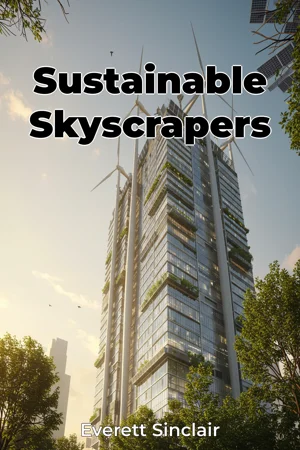
"Sustainable Skyscrapers" explores the possibility of eco-friendly vertical urban development. It examines how architects and engineers are integrating green building practices to transform skyscrapers from symbols of environmental excess into models of sustainability. A key focus is on combining passive and active energy systems alongside the use of sustainable materials to reduce urban carbon footprints. The book highlights how social pressures and regulations are driving the adoption of energy-efficient designs and renewable energy sources. The book traces the historical evolution of skyscraper design, from prioritizing aesthetics to acknowledging environmental impact. It uses case studies to exemplify best practices in areas like high-performance facades and advanced HVAC systems. By adopting a systems-thinking approach, "Sustainable Skyscrapers" emphasizes the interconnectedness of design elements. The book progresses through core concepts of sustainable design, then delves into specific strategies and real-world examples. It culminates in a discussion of the social and economic implications, advocating for a holistic approach that integrates innovative technologies with mindful material selection. This approach challenges the conventional view of skyscrapers as inherently unsustainable.
Book Details
ISBN
9788233997489
Publisher
Publifye AS
Your Licenses
You don't own any licenses for this book
Purchase a license below to unlock this book and download the EPUB.
Purchase License
Select a tier to unlock this book
Need bulk licensing?
Contact us for enterprise agreements.