
About This Book
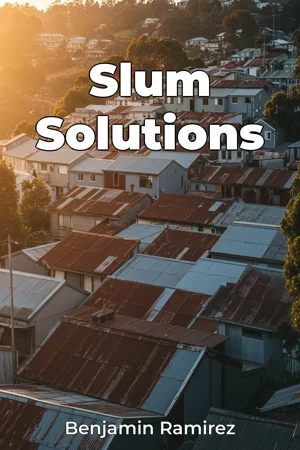
How can we transform slums from symbols of urban decay into thriving, sustainable communities? "Slum Solutions" addresses this critical question by exploring the multifaceted challenges of informal settlements and presenting innovative strategies for urban planners, policymakers, and community stakeholders. This book delves into the core issues of slum development and sustainable housing, providing a comprehensive framework for understanding and tackling these complex urban problems. These topics are vital because the rapid growth of slums worldwide demands immediate and effective solutions to improve the lives of billions and foster equitable urban environments. This book examines the historical context of slum formation, tracing its roots to rapid urbanization, economic disparities, and inadequate housing policies. It provides an overview of the social, economic, and environmental factors that contribute to the persistence of slums, setting the stage for a deeper exploration of potential solutions. Readers should have a basic understanding of urban planning principles and socio-economic concepts to fully appreciate the book's arguments. The central argument of "Slum Solutions" is that effective slum upgrading requires a holistic, participatory approach that integrates physical improvements with social and economic development. This argument is crucial because traditional, top-down approaches often fail to address the underlying causes of slum formation and can even exacerbate existing inequalities. The book is structured in three main parts. First, it introduces the key concepts and challenges related to slum development, including definitions, typologies, and the impacts of slums on public health, safety, and economic opportunity. Second, it examines various slum upgrading strategies, focusing on participatory planning, land tenure regularization, infrastructure provision, and livelihood support. Case studies from different regions illustrate successes and failures, providing valuable lessons for practitioners. Third, it explores innovative housing solutions, such as affordable housing finance, community-led construction, and sustainable building materials, analyzing their potential to transform slums into sustainable neighborhoods. The book culminates by offering a framework for integrated urban planning that prioritizes inclusive growth and resilience. The evidence presented in "Slum Solutions" draws on empirical research, case studies, and policy analysis. Data from international organizations, government reports, and academic studies are utilized to support the arguments. Unique data sources, such as community surveys and participatory mapping exercises, are presented to provide a ground-level perspective on the challenges and opportunities of slum upgrading. "Slum Solutions" also connects to other fields, such as economics (examining the economic impacts of slums and the role of microfinance), sociology (analyzing social exclusion and community empowerment), and environmental science (assessing the environmental impacts of slums and promoting sustainable solutions). These interdisciplinary connections strengthen the book's argument by providing a more comprehensive understanding of the complexities of slum development. A unique aspect of this book is its emphasis on community participation and empowerment. It highlights the importance of involving slum dwellers in the planning and implementation of upgrading projects, recognizing their knowledge and agency as key drivers of successful outcomes. The book provides practical guidance on how to facilitate participatory processes and build strong partnerships between governments, NGOs, and community organizations. The tone and writing style are professional yet accessible, aiming to bridge the gap between academic research and practical application. The book is written for urban planners, policymakers, architects, social workers, and students interested in urban development and social justice. It would also be useful to NGOs and community organizations working on slum upgrading projects. Readers will find value in the book's comprehensive overview of the issues, its practical guidance on how to tackle them, and its emphasis on community participation and empowerment. As a work of social science and architecture, "Slum Solutions" adheres to the conventions of rigorous research, evidence-based analysis, and clear communication. The scope of the book is global, drawing on case studies from different regions to illustrate the diversity of slum contexts and upgrading approaches. However, it acknowledges the limitations of generalizing from specific cases and emphasizes the need for context-specific solutions. The information in "Slum Solutions" can be applied practically by readers to inform policy decisions, design effective upgrading programs, and advocate for more equitable urban development. It offers a toolkit of strategies and best practices that can be adapted to different contexts and challenges. The book addresses ongoing debates in the field, such as the role of resettlement versus in-situ upgrading, the balance between affordability and quality in housing solutions, and the challenges of scaling up successful pilot projects. By presenting different perspectives and analyzing the tradeoffs, the book aims to foster informed dialogue and promote more effective approaches to slum upgrading.
How can we transform slums from symbols of urban decay into thriving, sustainable communities? "Slum Solutions" addresses this critical question by exploring the multifaceted challenges of informal settlements and presenting innovative strategies for urban planners, policymakers, and community stakeholders. This book delves into the core issues of slum development and sustainable housing, providing a comprehensive framework for understanding and tackling these complex urban problems. These topics are vital because the rapid growth of slums worldwide demands immediate and effective solutions to improve the lives of billions and foster equitable urban environments. This book examines the historical context of slum formation, tracing its roots to rapid urbanization, economic disparities, and inadequate housing policies. It provides an overview of the social, economic, and environmental factors that contribute to the persistence of slums, setting the stage for a deeper exploration of potential solutions. Readers should have a basic understanding of urban planning principles and socio-economic concepts to fully appreciate the book's arguments. The central argument of "Slum Solutions" is that effective slum upgrading requires a holistic, participatory approach that integrates physical improvements with social and economic development. This argument is crucial because traditional, top-down approaches often fail to address the underlying causes of slum formation and can even exacerbate existing inequalities. The book is structured in three main parts. First, it introduces the key concepts and challenges related to slum development, including definitions, typologies, and the impacts of slums on public health, safety, and economic opportunity. Second, it examines various slum upgrading strategies, focusing on participatory planning, land tenure regularization, infrastructure provision, and livelihood support. Case studies from different regions illustrate successes and failures, providing valuable lessons for practitioners. Third, it explores innovative housing solutions, such as affordable housing finance, community-led construction, and sustainable building materials, analyzing their potential to transform slums into sustainable neighborhoods. The book culminates by offering a framework for integrated urban planning that prioritizes inclusive growth and resilience. The evidence presented in "Slum Solutions" draws on empirical research, case studies, and policy analysis. Data from international organizations, government reports, and academic studies are utilized to support the arguments. Unique data sources, such as community surveys and participatory mapping exercises, are presented to provide a ground-level perspective on the challenges and opportunities of slum upgrading. "Slum Solutions" also connects to other fields, such as economics (examining the economic impacts of slums and the role of microfinance), sociology (analyzing social exclusion and community empowerment), and environmental science (assessing the environmental impacts of slums and promoting sustainable solutions). These interdisciplinary connections strengthen the book's argument by providing a more comprehensive understanding of the complexities of slum development. A unique aspect of this book is its emphasis on community participation and empowerment. It highlights the importance of involving slum dwellers in the planning and implementation of upgrading projects, recognizing their knowledge and agency as key drivers of successful outcomes. The book provides practical guidance on how to facilitate participatory processes and build strong partnerships between governments, NGOs, and community organizations. The tone and writing style are professional yet accessible, aiming to bridge the gap between academic research and practical application. The book is written for urban planners, policymakers, architects, social workers, and students interested in urban development and social justice. It would also be useful to NGOs and community organizations working on slum upgrading projects. Readers will find value in the book's comprehensive overview of the issues, its practical guidance on how to tackle them, and its emphasis on community participation and empowerment. As a work of social science and architecture, "Slum Solutions" adheres to the conventions of rigorous research, evidence-based analysis, and clear communication. The scope of the book is global, drawing on case studies from different regions to illustrate the diversity of slum contexts and upgrading approaches. However, it acknowledges the limitations of generalizing from specific cases and emphasizes the need for context-specific solutions. The information in "Slum Solutions" can be applied practically by readers to inform policy decisions, design effective upgrading programs, and advocate for more equitable urban development. It offers a toolkit of strategies and best practices that can be adapted to different contexts and challenges. The book addresses ongoing debates in the field, such as the role of resettlement versus in-situ upgrading, the balance between affordability and quality in housing solutions, and the challenges of scaling up successful pilot projects. By presenting different perspectives and analyzing the tradeoffs, the book aims to foster informed dialogue and promote more effective approaches to slum upgrading.
"Slum Solutions" tackles the pressing global issue of informal settlements, offering a comprehensive exploration of challenges and innovative strategies for urban development. It emphasizes the need to transform slums into sustainable communities through holistic, participatory approaches. The book highlights that traditional top-down methods often fail, advocating instead for integrating physical improvements with social and economic development, vital for equitable urban environments. The content underscores community empowerment as a key driver, demonstrating how involving residents in planning and implementation leads to more successful and sustainable outcomes. The book progresses systematically, first introducing key concepts and challenges related to slum development, including impacts on public health and economic opportunity. It then examines various slum upgrading strategies, such as land tenure regularization and infrastructure provision, using case studies to illustrate successes and failures. Finally, it explores innovative housing solutions, like affordable housing finance and community-led construction. This approach ensures readers gain a thorough understanding of the complexities involved and the potential for creating inclusive and resilient urban spaces.
Book Details
ISBN
9788233997243
Publisher
Publifye AS
Your Licenses
You don't own any licenses for this book
Purchase a license below to unlock this book and download the EPUB.
Purchase License
Select a tier to unlock this book
Need bulk licensing?
Contact us for enterprise agreements.