
About This Book
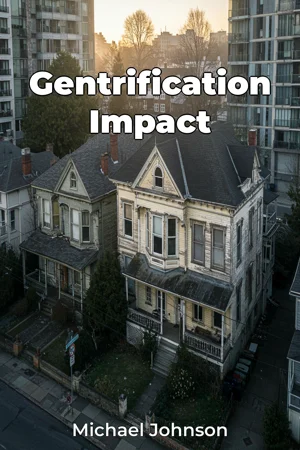
How does progress become displacement? "Gentrification Impact" delves into the complex transformations reshaping urban landscapes, exploring both the benefits and the profound social costs associated with neighborhood revitalization. This book examines gentrification not merely as an economic phenomenon but as a multifaceted process with far-reaching consequences for housing markets, social equity, and community identity. We will explore three core themes: the economic drivers of gentrification, the resulting displacement of long-term residents, and the reshaping of neighborhood character. Understanding these elements is crucial for policymakers, community organizers, and engaged citizens who seek to address the challenges of urban change in a just and equitable manner. The book provides a crucial framework for understanding the forces at play in reshaping our cities. The book begins by establishing a historical context, tracing the evolution of gentrification from its mid-20th-century roots to its current global manifestation. We examine factors such as deindustrialization, urban renewal policies, and shifts in demographics that have paved the way for gentrification. We define key terms – gentrification, displacement, affordable housing – to ensure a shared understanding of the issues. The central argument is that while gentrification can bring positive changes like reduced crime rates, improved infrastructure, and increased property values, these benefits often come at the expense of vulnerable populations. Specifically, lower-income residents and minority communities frequently face displacement pressures, leading to the erosion of social networks and a loss of cultural heritage. "Gentrification Impact" is structured to provide a comprehensive analysis of this issue. First, we explore the economic forces driving gentrification: real estate speculation, the influx of high-income residents, and the role of government policies. Second, we analyze the direct and indirect displacement mechanisms, including rent increases, evictions, and the loss of affordable housing options. Third, we examine the qualitative impact of gentrification on community identity, social cohesion, and cultural diversity. The book culminates by offering policy recommendations and community-based strategies to mitigate the negative consequences of gentrification while harnessing its potential benefits. The analysis is grounded in a wide range of evidence: statistical data on housing prices and demographic shifts, case studies of gentrifying neighborhoods across the United States, and qualitative interviews with residents, developers, and policymakers. We draw upon data from the U.S. Census Bureau, local housing authorities, and academic research institutions to provide a rigorous and nuanced understanding of gentrification's impacts. Original interviews offer firsthand accounts of lived experiences in rapidly changing urban environments. This study also connects to other fields, such as urban planning, sociology, and economics. The link to urban planning highlights how zoning regulations and development policies can either exacerbate or alleviate displacement pressures. The connection to sociology reveals the social dynamics of gentrification, including the formation of new social hierarchies and the disruption of existing communities. The insights from economics clarify how market forces shape the location decisions of residents and businesses. This book offers a balanced assessment of gentrification, recognizing its complexities and avoiding simplistic narratives. The approach blends quantitative data with qualitative insights to provide a nuanced and multifaceted understanding of the phenomenon. Written in an accessible yet rigorous style, "Gentrification Impact" is aimed at a broad audience including students, academics, policymakers, community organizers, and anyone interested in understanding the dynamics of urban change. This book offers valuable insights and tools for analyzing and addressing the challenges of gentrification in a variety of contexts. While the book focuses primarily on gentrification in the United States, it also acknowledges the global dimensions of this phenomenon and draws upon international examples to illustrate broader trends. "Gentrification Impact" focuses on the socio-economic impacts, and does not delve into architectural or design aspects of this issue. The information presented throughout our study can be applied to practical, real-world applications. For example, community organizers can use the insights to advocate for policies that protect vulnerable residents, while policymakers can draw upon the research to design more equitable development strategies. Finally, the book engages with ongoing debates about the role of gentrification in addressing urban decay versus contributing to social inequality, offering a perspective rooted in evidence and a commitment to social justice.
How does progress become displacement? "Gentrification Impact" delves into the complex transformations reshaping urban landscapes, exploring both the benefits and the profound social costs associated with neighborhood revitalization. This book examines gentrification not merely as an economic phenomenon but as a multifaceted process with far-reaching consequences for housing markets, social equity, and community identity. We will explore three core themes: the economic drivers of gentrification, the resulting displacement of long-term residents, and the reshaping of neighborhood character. Understanding these elements is crucial for policymakers, community organizers, and engaged citizens who seek to address the challenges of urban change in a just and equitable manner. The book provides a crucial framework for understanding the forces at play in reshaping our cities. The book begins by establishing a historical context, tracing the evolution of gentrification from its mid-20th-century roots to its current global manifestation. We examine factors such as deindustrialization, urban renewal policies, and shifts in demographics that have paved the way for gentrification. We define key terms – gentrification, displacement, affordable housing – to ensure a shared understanding of the issues. The central argument is that while gentrification can bring positive changes like reduced crime rates, improved infrastructure, and increased property values, these benefits often come at the expense of vulnerable populations. Specifically, lower-income residents and minority communities frequently face displacement pressures, leading to the erosion of social networks and a loss of cultural heritage. "Gentrification Impact" is structured to provide a comprehensive analysis of this issue. First, we explore the economic forces driving gentrification: real estate speculation, the influx of high-income residents, and the role of government policies. Second, we analyze the direct and indirect displacement mechanisms, including rent increases, evictions, and the loss of affordable housing options. Third, we examine the qualitative impact of gentrification on community identity, social cohesion, and cultural diversity. The book culminates by offering policy recommendations and community-based strategies to mitigate the negative consequences of gentrification while harnessing its potential benefits. The analysis is grounded in a wide range of evidence: statistical data on housing prices and demographic shifts, case studies of gentrifying neighborhoods across the United States, and qualitative interviews with residents, developers, and policymakers. We draw upon data from the U.S. Census Bureau, local housing authorities, and academic research institutions to provide a rigorous and nuanced understanding of gentrification's impacts. Original interviews offer firsthand accounts of lived experiences in rapidly changing urban environments. This study also connects to other fields, such as urban planning, sociology, and economics. The link to urban planning highlights how zoning regulations and development policies can either exacerbate or alleviate displacement pressures. The connection to sociology reveals the social dynamics of gentrification, including the formation of new social hierarchies and the disruption of existing communities. The insights from economics clarify how market forces shape the location decisions of residents and businesses. This book offers a balanced assessment of gentrification, recognizing its complexities and avoiding simplistic narratives. The approach blends quantitative data with qualitative insights to provide a nuanced and multifaceted understanding of the phenomenon. Written in an accessible yet rigorous style, "Gentrification Impact" is aimed at a broad audience including students, academics, policymakers, community organizers, and anyone interested in understanding the dynamics of urban change. This book offers valuable insights and tools for analyzing and addressing the challenges of gentrification in a variety of contexts. While the book focuses primarily on gentrification in the United States, it also acknowledges the global dimensions of this phenomenon and draws upon international examples to illustrate broader trends. "Gentrification Impact" focuses on the socio-economic impacts, and does not delve into architectural or design aspects of this issue. The information presented throughout our study can be applied to practical, real-world applications. For example, community organizers can use the insights to advocate for policies that protect vulnerable residents, while policymakers can draw upon the research to design more equitable development strategies. Finally, the book engages with ongoing debates about the role of gentrification in addressing urban decay versus contributing to social inequality, offering a perspective rooted in evidence and a commitment to social justice.
"Gentrification Impact" explores the multifaceted phenomenon of gentrification, examining its economic drivers, displacement effects, and impact on community identity. It highlights how urban change, while often bringing benefits like improved infrastructure, can lead to the displacement of long-term residents, particularly in minority communities facing social inequality. For example, increased property values, while seemingly positive, can drive up housing costs, making it unaffordable for vulnerable populations. The book progresses from a historical overview of gentrification's evolution to an analysis of its economic forces, such as real estate speculation and the influx of high-income residents. It then delves into displacement mechanisms, including rent increases and evictions, before examining the qualitative impact on community cohesion and cultural diversity. The book emphasizes that urban development requires careful consideration to avoid exacerbating social inequality and to promote affordable housing. Ultimately, this study provides a balanced perspective, blending quantitative data with qualitative insights to offer a nuanced understanding of gentrification. It aims to equip policymakers, community organizers, and engaged citizens with the knowledge and tools to address the challenges of gentrification, fostering social equity and sustainable community development.
Book Details
ISBN
9788233997083
Publisher
Publifye AS
Your Licenses
You don't own any licenses for this book
Purchase a license below to unlock this book and download the EPUB.
Purchase License
Select a tier to unlock this book
Need bulk licensing?
Contact us for enterprise agreements.