
About This Book
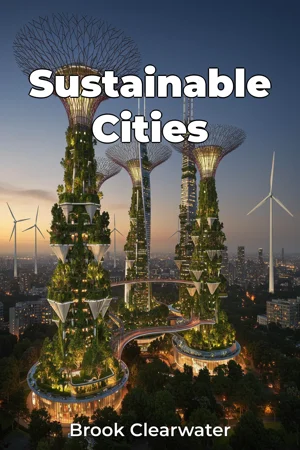
Can cities be both engines of economic growth and bastions of environmental sustainability? *Sustainable Cities* delves into the multifaceted strategies urban areas are employing to mitigate pollution and reduce their carbon footprint, exploring the transition towards environmentally responsible urban development. The book focuses on two principal areas: innovative technological solutions and progressive policy implementations, examining how these elements converge to shape more sustainable urban environments. This is crucial as cities, major contributors to global greenhouse gas emissions, are simultaneously uniquely positioned to spearhead meaningful change. This book contextualizes the current sustainability movement within the historical backdrop of industrial urbanization and its environmental impact. It presumes a basic understanding of ecological principles and urban planning concepts, building upon this foundation to explore advanced strategies. The central argument posits that a holistic approach – integrating technological advancements with robust policy frameworks – is essential for achieving genuine urban sustainability. This is not merely about adopting isolated green initiatives; rather, it requires a systemic transformation of urban infrastructure and governance. *Sustainable Cities* unfolds in three major sections. Section 1 introduces the core concepts of urban sustainability, defining key terms and outlining the environmental challenges confronting modern cities. Section 2 delves into the technological innovations driving the sustainability movement, with chapters dedicated to renewable energy integration, smart transportation systems, and waste management technologies. Section 3 examines the policy and planning frameworks that facilitate sustainable development, analyzing case studies of cities that have successfully implemented green initiatives and evaluating the effectiveness of various policy instruments. The book culminates by exploring the scalability and adaptability of these strategies in diverse urban contexts and discussing the future trajectory of sustainable urban development. The evidence presented in *Sustainable Cities* draws from a wide array of sources, including empirical data on urban environmental performance, case studies of successful sustainability initiatives, and analyses of policy effectiveness. It incorporates data from governmental organizations, academic research institutions, and private sector reports. The book bridges several disciplines: environmental science, urban planning, and public policy. The environmental science perspective informs the analysis of urban ecosystems and the impact of human activities. Urban planning principles guide the evaluation of spatial strategies for sustainability. Public policy analysis helps assess the effectiveness of different regulatory and incentive-based approaches. *Sustainable Cities* critically analyzes the current state of urban sustainability, offering actionable insights for policymakers, urban planners, and engaged citizens. The book presents a balanced assessment of both the opportunities and challenges associated with creating sustainable cities. Written in a clear and accessible style, *Sustainable Cities* targets a broad audience, including students, researchers, policymakers, urban planners, and anyone interested in learning more about sustainable urban development. It provides a comprehensive overview of the field, making it a valuable resource for those seeking to understand the complexities of urban sustainability. As a work of non-fiction in the fields of Earth Sciences, Geography, and Environment, *Sustainable Cities* adheres to rigorous standards of accuracy and objectivity. The book addresses the scope by focusing on practical, implementable strategies for urban sustainability. Limitations include the rapid evolution of technology and policy, and also geographic constraints due to the varying success of certain tactics in different locations. The information presented in *Sustainable Cities* has numerous real-world applications. Policymakers can use the book's findings to inform the development of effective sustainability policies. Urban planners can apply the book's insights to design more sustainable urban environments. Citizens can use the book's knowledge to advocate for sustainable practices in their communities. *Sustainable Cities* also touches upon debates surrounding the economic implications of sustainable development and the potential trade-offs between environmental protection and economic growth showing that well-planned strategies are economically beneficial.
Can cities be both engines of economic growth and bastions of environmental sustainability? *Sustainable Cities* delves into the multifaceted strategies urban areas are employing to mitigate pollution and reduce their carbon footprint, exploring the transition towards environmentally responsible urban development. The book focuses on two principal areas: innovative technological solutions and progressive policy implementations, examining how these elements converge to shape more sustainable urban environments. This is crucial as cities, major contributors to global greenhouse gas emissions, are simultaneously uniquely positioned to spearhead meaningful change. This book contextualizes the current sustainability movement within the historical backdrop of industrial urbanization and its environmental impact. It presumes a basic understanding of ecological principles and urban planning concepts, building upon this foundation to explore advanced strategies. The central argument posits that a holistic approach – integrating technological advancements with robust policy frameworks – is essential for achieving genuine urban sustainability. This is not merely about adopting isolated green initiatives; rather, it requires a systemic transformation of urban infrastructure and governance. *Sustainable Cities* unfolds in three major sections. Section 1 introduces the core concepts of urban sustainability, defining key terms and outlining the environmental challenges confronting modern cities. Section 2 delves into the technological innovations driving the sustainability movement, with chapters dedicated to renewable energy integration, smart transportation systems, and waste management technologies. Section 3 examines the policy and planning frameworks that facilitate sustainable development, analyzing case studies of cities that have successfully implemented green initiatives and evaluating the effectiveness of various policy instruments. The book culminates by exploring the scalability and adaptability of these strategies in diverse urban contexts and discussing the future trajectory of sustainable urban development. The evidence presented in *Sustainable Cities* draws from a wide array of sources, including empirical data on urban environmental performance, case studies of successful sustainability initiatives, and analyses of policy effectiveness. It incorporates data from governmental organizations, academic research institutions, and private sector reports. The book bridges several disciplines: environmental science, urban planning, and public policy. The environmental science perspective informs the analysis of urban ecosystems and the impact of human activities. Urban planning principles guide the evaluation of spatial strategies for sustainability. Public policy analysis helps assess the effectiveness of different regulatory and incentive-based approaches. *Sustainable Cities* critically analyzes the current state of urban sustainability, offering actionable insights for policymakers, urban planners, and engaged citizens. The book presents a balanced assessment of both the opportunities and challenges associated with creating sustainable cities. Written in a clear and accessible style, *Sustainable Cities* targets a broad audience, including students, researchers, policymakers, urban planners, and anyone interested in learning more about sustainable urban development. It provides a comprehensive overview of the field, making it a valuable resource for those seeking to understand the complexities of urban sustainability. As a work of non-fiction in the fields of Earth Sciences, Geography, and Environment, *Sustainable Cities* adheres to rigorous standards of accuracy and objectivity. The book addresses the scope by focusing on practical, implementable strategies for urban sustainability. Limitations include the rapid evolution of technology and policy, and also geographic constraints due to the varying success of certain tactics in different locations. The information presented in *Sustainable Cities* has numerous real-world applications. Policymakers can use the book's findings to inform the development of effective sustainability policies. Urban planners can apply the book's insights to design more sustainable urban environments. Citizens can use the book's knowledge to advocate for sustainable practices in their communities. *Sustainable Cities* also touches upon debates surrounding the economic implications of sustainable development and the potential trade-offs between environmental protection and economic growth showing that well-planned strategies are economically beneficial.
*Sustainable Cities* explores how urban areas are becoming more environmentally responsible through technological innovations and policy implementations. Cities, while major contributors to greenhouse gas emissions, are uniquely positioned to drive sustainability. The book highlights that achieving genuine urban sustainability requires a holistic approach, integrating advancements like smart transportation systems and renewable energy with robust policy frameworks, moving beyond isolated green initiatives. For example, efficient waste management can transform urban refuse into a valuable resource, reducing landfill waste and generating energy. The book examines the history of urbanization and its environmental impact, then unfolds across three sections. It introduces core concepts, delves into technological innovations such as smart transportation systems, and analyzes policy frameworks. Case studies of successful green initiatives provide practical examples. The comprehensive approach makes it a valuable resource for policymakers, urban planners, and anyone interested in urban sustainability, offering actionable insights into creating sustainable cities.
Book Details
ISBN
9788233997052
Publisher
Publifye AS
Your Licenses
You don't own any licenses for this book
Purchase a license below to unlock this book and download the EPUB.
Purchase License
Select a tier to unlock this book
Need bulk licensing?
Contact us for enterprise agreements.