
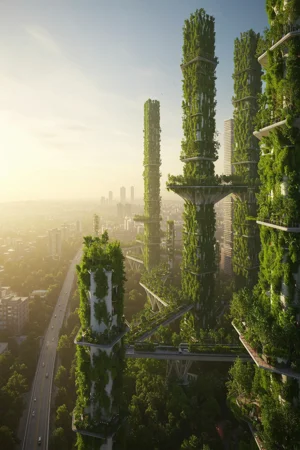
About This Book
Can our cities grow up, not just out? *Future Skylines* addresses this critical question, exploring the multifaceted evolution of urban environments through the lenses of high-rise construction, vertical farming, and green architecture. These elements represent crucial strategies for creating sustainable, resilient, and livable cities in the face of increasing populations and environmental challenges. This book examines how these three seemingly distinct elements—high-rise buildings, vertical farms, and green architecture—intersect to offer innovative solutions for urban sustainability. We delve into the architectural and engineering advancements that make taller structures feasible, alongside the agricultural technologies transforming food production within city limits. Furthermore, *Future Skylines* investigates how green architectural principles integrate nature into the built environment, improving air quality, reducing energy consumption, and enhancing the overall quality of life for urban dwellers. Understanding the historical context of urban development is essential. The book traces the evolution of cities from sprawling horizontal landscapes to increasingly dense vertical environments, considering the social, economic, and technological factors driving this transformation. It analyzes past successes and failures in urban planning, drawing lessons to inform future strategies. Our central argument is that the successful integration of high-rise buildings, vertical farms, and green architecture is not merely a technological challenge but a holistic design imperative. We contend that only through careful planning, interdisciplinary collaboration, and a commitment to sustainability can we create urban environments that are both efficient and equitable. *Future Skylines* begins by introducing the core concepts of sustainable urbanization and their historical roots. Subsequent chapters are divided into three main sections, each focusing on one of the key elements: high-rise buildings, vertical farming, and green architecture. These sections explore their respective technologies, design principles, and potential benefits. The book culminates in a synthesis of these elements, outlining integrated urban design strategies and providing case studies of cities that are successfully implementing these approaches. The arguments presented are supported by a wide range of evidence, including architectural plans, engineering reports, scientific studies on urban agriculture, and environmental impact assessments. Unique data sources include comparative analyses of energy consumption in different types of buildings, assessments of crop yields in vertical farms compared to traditional agriculture, and surveys of residents' perceptions of green spaces in urban environments. *Future Skylines* connects to various fields, including environmental science, urban planning, and economics. It examines the environmental impact of urban development, the economic viability of vertical farming, and the social equity implications of urban design decisions. These interdisciplinary connections strengthen the book's argument by providing a comprehensive perspective on urban sustainability. This book offers a fresh perspective by examining the synergistic potential of high-rise buildings, vertical farms, and green architecture. It moves beyond viewing these elements in isolation, instead advocating for their integrated design and implementation. The tone is informative and analytical. The writing style is accessible to a broad audience while maintaining scholarly rigor. The intended audience includes architects, urban planners, engineers, policymakers, environmental scientists, and anyone interested in the future of cities. It will also appeal to students in architecture, urban studies, and sustainability programs. As a work of non-fiction architecture, *Future Skylines* emphasizes factual accuracy, evidence-based arguments, and clear communication of complex ideas. It adheres to the conventions of academic writing while striving to engage a wider readership. The book's scope is limited to exploring the integration of high-rise buildings, vertical farms, and green architecture within existing urban environments. It does not delve extensively into broader issues of social inequality or political governance, although these factors are acknowledged as important considerations in urban planning. The information presented can be applied practically by urban planners, architects, and policymakers seeking to create more sustainable and resilient cities. It provides a framework for evaluating different urban design options and making informed decisions about infrastructure investments. The book addresses ongoing debates about the environmental impacts of high-rise buildings, the economic viability of vertical farming, and the effectiveness of different green building technologies. It also acknowledges the challenges of implementing these approaches in existing urban environments, such as the high cost of land and the need for public support.
Can our cities grow up, not just out? *Future Skylines* addresses this critical question, exploring the multifaceted evolution of urban environments through the lenses of high-rise construction, vertical farming, and green architecture. These elements represent crucial strategies for creating sustainable, resilient, and livable cities in the face of increasing populations and environmental challenges. This book examines how these three seemingly distinct elements—high-rise buildings, vertical farms, and green architecture—intersect to offer innovative solutions for urban sustainability. We delve into the architectural and engineering advancements that make taller structures feasible, alongside the agricultural technologies transforming food production within city limits. Furthermore, *Future Skylines* investigates how green architectural principles integrate nature into the built environment, improving air quality, reducing energy consumption, and enhancing the overall quality of life for urban dwellers. Understanding the historical context of urban development is essential. The book traces the evolution of cities from sprawling horizontal landscapes to increasingly dense vertical environments, considering the social, economic, and technological factors driving this transformation. It analyzes past successes and failures in urban planning, drawing lessons to inform future strategies. Our central argument is that the successful integration of high-rise buildings, vertical farms, and green architecture is not merely a technological challenge but a holistic design imperative. We contend that only through careful planning, interdisciplinary collaboration, and a commitment to sustainability can we create urban environments that are both efficient and equitable. *Future Skylines* begins by introducing the core concepts of sustainable urbanization and their historical roots. Subsequent chapters are divided into three main sections, each focusing on one of the key elements: high-rise buildings, vertical farming, and green architecture. These sections explore their respective technologies, design principles, and potential benefits. The book culminates in a synthesis of these elements, outlining integrated urban design strategies and providing case studies of cities that are successfully implementing these approaches. The arguments presented are supported by a wide range of evidence, including architectural plans, engineering reports, scientific studies on urban agriculture, and environmental impact assessments. Unique data sources include comparative analyses of energy consumption in different types of buildings, assessments of crop yields in vertical farms compared to traditional agriculture, and surveys of residents' perceptions of green spaces in urban environments. *Future Skylines* connects to various fields, including environmental science, urban planning, and economics. It examines the environmental impact of urban development, the economic viability of vertical farming, and the social equity implications of urban design decisions. These interdisciplinary connections strengthen the book's argument by providing a comprehensive perspective on urban sustainability. This book offers a fresh perspective by examining the synergistic potential of high-rise buildings, vertical farms, and green architecture. It moves beyond viewing these elements in isolation, instead advocating for their integrated design and implementation. The tone is informative and analytical. The writing style is accessible to a broad audience while maintaining scholarly rigor. The intended audience includes architects, urban planners, engineers, policymakers, environmental scientists, and anyone interested in the future of cities. It will also appeal to students in architecture, urban studies, and sustainability programs. As a work of non-fiction architecture, *Future Skylines* emphasizes factual accuracy, evidence-based arguments, and clear communication of complex ideas. It adheres to the conventions of academic writing while striving to engage a wider readership. The book's scope is limited to exploring the integration of high-rise buildings, vertical farms, and green architecture within existing urban environments. It does not delve extensively into broader issues of social inequality or political governance, although these factors are acknowledged as important considerations in urban planning. The information presented can be applied practically by urban planners, architects, and policymakers seeking to create more sustainable and resilient cities. It provides a framework for evaluating different urban design options and making informed decisions about infrastructure investments. The book addresses ongoing debates about the environmental impacts of high-rise buildings, the economic viability of vertical farming, and the effectiveness of different green building technologies. It also acknowledges the challenges of implementing these approaches in existing urban environments, such as the high cost of land and the need for public support.
*Future Skylines* explores a future where cities grow upwards, not just outwards, by integrating high-rise buildings, vertical farming, and green architecture. These elements can create urban environments that are both sustainable and livable. The book highlights how advancements in architectural engineering now allow for taller, more efficient structures. It also delves into how green architectural principles, such as integrating parks into building design, can improve air quality and reduce energy consumption. The book examines the historical context of urban development, tracing how cities evolved into dense, vertical environments. It argues that integrating high-rise buildings, vertical farms, and green architecture requires careful planning and interdisciplinary collaboration. The book presents this information through architectural plans, engineering reports, and scientific studies. The book progresses by first introducing sustainable urbanization concepts. It then dedicates sections to high-rise buildings, vertical farming, and green architecture, exploring their technologies and design principles. Finally, it synthesizes these elements, showcasing integrated urban design strategies and case studies of successful implementations.
Book Details
ISBN
9788233997045
Publisher
Publifye AS
Your Licenses
You don't own any licenses for this book
Purchase a license below to unlock this book and download the EPUB.
Purchase License
Select a tier to unlock this book
Need bulk licensing?
Contact us for enterprise agreements.