
About This Book
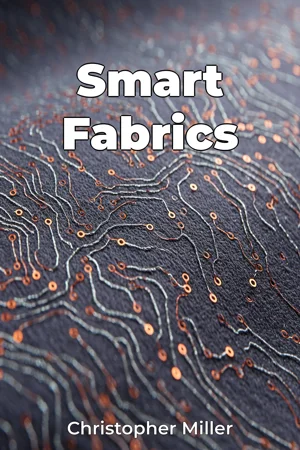
Imagine a world where your clothes actively monitor your health, regulate your body temperature, or even communicate with other devices. This is the reality that "Smart Fabrics" explores, delving into the burgeoning field of wearable technology seamlessly integrated into the textiles we wear every day. This book examines not just the technological advancements, but also the profound implications of these innovations for healthcare, fashion, and beyond. We will examine the core concepts underpinning smart fabrics, focusing primarily on three key areas: conductive textiles, sensor integration, and energy harvesting. Conductive textiles, woven with metallic fibers or coated with conductive polymers, form the electronic pathways within smart garments. Sensor integration explores how miniature sensors can track vital signs such as heart rate, body temperature, and even muscle activity. Energy harvesting investigates methods for powering these devices directly from the wearer's movement or the surrounding environment, making smart fabrics truly self-sufficient. These topics are crucial because they represent the building blocks of a future where clothing is not just a covering, but an intelligent interface with our bodies and the world around us. Understanding the development of microelectronics and materials science is essential to grasp the significance of smart fabrics. We'll trace the evolution from bulky, external wearable devices to the elegant, integrated systems we see today. No specialized background is required; the book will provide clear explanations of the underlying scientific principles. The central argument of "Smart Fabrics" is that the convergence of textile engineering, materials science, and microelectronics is creating a paradigm shift, transforming passive clothing into active, responsive systems with the potential to enhance human health and performance. This transformation is vital because it offers personalized healthcare solutions, improves athletic performance, and creates new forms of human-computer interaction. The book proceeds systematically. First, it introduces the fundamental concepts of conductive materials, sensors, and power sources relevant to smart fabrics. Second, it dedicates chapters to the development of sensing capabilities focusing on physiological monitoring. Third, it explores energy harvesting from body movement, heat, and light. Finally, it culminates with a discussion of the practical challenges and future potential of smart fabrics, highlighting applications across healthcare, sportswear, and military apparel. Supporting these arguments will be a robust compilation of research findings, including data from peer-reviewed scientific articles, case studies of existing smart fabric applications, and interviews with leading researchers and developers in the field. Patent filings and industry reports will also provide insights into the commercial landscape. "Smart Fabrics" connects to several other disciplines. Biomedical engineering is crucial for understanding the physiological data collected by smart garments. Computer science plays a role in data processing and communication. Fashion design is vital for ensuring that smart fabrics are both functional and aesthetically pleasing. These interdisciplinary connections enrich the book's perspective, demonstrating that smart fabrics require a collaborative approach. This book adopts a comprehensive approach, offering a balanced view of technological advancements, potential applications, and remaining challenges. It distinguishes itself by focusing on the practical feasibility of smart fabrics in real-world settings, moving beyond theoretical possibilities to address issues such as durability, washability, and user comfort. The tone is informative and accessible, balancing technical detail with clear explanations suitable for a broad audience. Complex scientific concepts are presented in a straightforward manner. The primary audience includes students and researchers in materials science, textile engineering, and biomedical engineering, as well as designers, entrepreneurs, and anyone interested in the future of wearable technology. This book will be valuable to them for its in-depth analysis, real-world examples, and forward-looking perspective. As a work of non-fiction in the technology and science genres, "Smart Fabrics" adheres to the conventions of presenting factual information, citing credible sources, and maintaining objectivity. It avoids speculative claims and focuses on evidence-based analysis. The scope of “Smart Fabrics” is limited to technologies directly embedded within or integrated onto fabrics. It does not cover external wearable devices with minimal fabric integration, such as smartwatches. The information in this book can be applied by readers in several ways. Engineers and designers can use it to develop new smart fabric products. Healthcare professionals can learn about the potential of smart fabrics for remote patient monitoring. Consumers can make informed decisions about purchasing smart clothing. The responsible and ethical use of personal data collected by smart fabrics is an ongoing debate. This book acknowledges and addresses these concerns, exploring issues such as data privacy, security, and the potential for misuse.
Imagine a world where your clothes actively monitor your health, regulate your body temperature, or even communicate with other devices. This is the reality that "Smart Fabrics" explores, delving into the burgeoning field of wearable technology seamlessly integrated into the textiles we wear every day. This book examines not just the technological advancements, but also the profound implications of these innovations for healthcare, fashion, and beyond. We will examine the core concepts underpinning smart fabrics, focusing primarily on three key areas: conductive textiles, sensor integration, and energy harvesting. Conductive textiles, woven with metallic fibers or coated with conductive polymers, form the electronic pathways within smart garments. Sensor integration explores how miniature sensors can track vital signs such as heart rate, body temperature, and even muscle activity. Energy harvesting investigates methods for powering these devices directly from the wearer's movement or the surrounding environment, making smart fabrics truly self-sufficient. These topics are crucial because they represent the building blocks of a future where clothing is not just a covering, but an intelligent interface with our bodies and the world around us. Understanding the development of microelectronics and materials science is essential to grasp the significance of smart fabrics. We'll trace the evolution from bulky, external wearable devices to the elegant, integrated systems we see today. No specialized background is required; the book will provide clear explanations of the underlying scientific principles. The central argument of "Smart Fabrics" is that the convergence of textile engineering, materials science, and microelectronics is creating a paradigm shift, transforming passive clothing into active, responsive systems with the potential to enhance human health and performance. This transformation is vital because it offers personalized healthcare solutions, improves athletic performance, and creates new forms of human-computer interaction. The book proceeds systematically. First, it introduces the fundamental concepts of conductive materials, sensors, and power sources relevant to smart fabrics. Second, it dedicates chapters to the development of sensing capabilities focusing on physiological monitoring. Third, it explores energy harvesting from body movement, heat, and light. Finally, it culminates with a discussion of the practical challenges and future potential of smart fabrics, highlighting applications across healthcare, sportswear, and military apparel. Supporting these arguments will be a robust compilation of research findings, including data from peer-reviewed scientific articles, case studies of existing smart fabric applications, and interviews with leading researchers and developers in the field. Patent filings and industry reports will also provide insights into the commercial landscape. "Smart Fabrics" connects to several other disciplines. Biomedical engineering is crucial for understanding the physiological data collected by smart garments. Computer science plays a role in data processing and communication. Fashion design is vital for ensuring that smart fabrics are both functional and aesthetically pleasing. These interdisciplinary connections enrich the book's perspective, demonstrating that smart fabrics require a collaborative approach. This book adopts a comprehensive approach, offering a balanced view of technological advancements, potential applications, and remaining challenges. It distinguishes itself by focusing on the practical feasibility of smart fabrics in real-world settings, moving beyond theoretical possibilities to address issues such as durability, washability, and user comfort. The tone is informative and accessible, balancing technical detail with clear explanations suitable for a broad audience. Complex scientific concepts are presented in a straightforward manner. The primary audience includes students and researchers in materials science, textile engineering, and biomedical engineering, as well as designers, entrepreneurs, and anyone interested in the future of wearable technology. This book will be valuable to them for its in-depth analysis, real-world examples, and forward-looking perspective. As a work of non-fiction in the technology and science genres, "Smart Fabrics" adheres to the conventions of presenting factual information, citing credible sources, and maintaining objectivity. It avoids speculative claims and focuses on evidence-based analysis. The scope of “Smart Fabrics” is limited to technologies directly embedded within or integrated onto fabrics. It does not cover external wearable devices with minimal fabric integration, such as smartwatches. The information in this book can be applied by readers in several ways. Engineers and designers can use it to develop new smart fabric products. Healthcare professionals can learn about the potential of smart fabrics for remote patient monitoring. Consumers can make informed decisions about purchasing smart clothing. The responsible and ethical use of personal data collected by smart fabrics is an ongoing debate. This book acknowledges and addresses these concerns, exploring issues such as data privacy, security, and the potential for misuse.
"Smart Fabrics" explores the exciting world of wearable technology, where everyday clothing transforms into intelligent interfaces. The book delves into how conductive textiles, sensor integration, and energy harvesting are converging to create garments that can monitor health, enhance performance, and even communicate with other devices. Imagine sportswear that tracks physiological data or military apparel that regulates body temperature – this book highlights the technological advancements making these innovations possible. The book examines the core concepts, like how conductive textiles are woven with metallic fibers to create electronic pathways. It emphasizes the crucial role of microelectronics and materials science in this paradigm shift, tracing the evolution from bulky wearables to seamless, integrated systems. The book systematically progresses from fundamental concepts to sensing capabilities, energy harvesting, and practical applications, highlighting real-world challenges and future potential across healthcare, sportswear, and military applications. This comprehensive approach sets "Smart Fabrics" apart by focusing on the practical feasibility of these technologies, addressing durability, washability, and user comfort. It provides an in-depth analysis of the field, making it valuable for students, researchers, designers, and anyone interested in the future of wearable technology.
Book Details
ISBN
9788233996512
Publisher
Publifye AS
Your Licenses
You don't own any licenses for this book
Purchase a license below to unlock this book and download the EPUB.
Purchase License
Select a tier to unlock this book
Need bulk licensing?
Contact us for enterprise agreements.