
About This Book
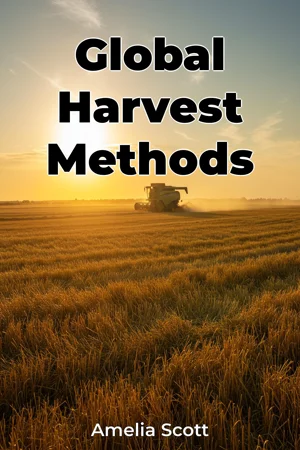
How can global agricultural practices evolve to sustainably feed a growing population in the face of climate change and resource scarcity? "Global Harvest Methods" addresses this critical question by undertaking a detailed examination of diverse harvesting techniques employed worldwide. This book delves into the science and economics underpinning these methods, drawing upon international agricultural studies and comparative research to offer a comprehensive and insightful analysis. The book centers on three key topics: the efficiency of different harvesting techniques, their environmental impact, and their socioeconomic implications for local communities. Understanding these aspects is vital for policymakers, agricultural professionals, and anyone concerned with food security and sustainable development. We begin by establishing the historical and contemporary context of agricultural practices, tracing the evolution of harvesting methods from traditional manual approaches to modern mechanized systems. Readers will gain a foundational understanding of key agricultural concepts, such as crop yield, resource management, and the principles of sustainable agriculture. The central argument of "Global Harvest Methods" is that a nuanced understanding of the interplay between harvesting techniques, environmental sustainability, and economic viability is crucial for optimizing agricultural practices globally. This argument is essential because it moves beyond simplistic solutions and promotes a holistic approach to addressing the challenges facing modern agriculture. The book’s structure is as follows: first, we introduce the core concepts of harvesting efficiency, environmental impact assessment, and socioeconomic analysis in agriculture. Second, we explore specific harvesting methods across different regions, examining case studies from North America, Europe, Asia, and Africa. This section will analyze the advantages and disadvantages of each method, considering factors such as labor requirements, energy consumption, and environmental consequences. Third, we compare these methods across multiple criteria, identifying best practices and potential areas for improvement. Finally, we discuss the practical applications of our findings, offering recommendations for policymakers, agricultural businesses, and individual farmers to adopt more sustainable and efficient harvesting practices. The evidence presented in this book is based on a wide range of sources, including peer-reviewed scientific publications, government reports, and data from international organizations such as the Food and Agriculture Organization (FAO) and the World Bank. We also incorporate original data collected through field research and interviews with farmers and agricultural experts. Our methodology involves comparative analysis, statistical modeling, and qualitative case studies. "Global Harvest Methods" connects to other fields such as environmental science, economics, and sociology. Environmental science informs our assessment of the ecological impacts of different harvesting techniques. Economics provides the framework for analyzing the costs and benefits of these techniques. Sociology helps us understand the social implications of agricultural practices for local communities. These interdisciplinary connections enrich the book’s argument and provide a more complete picture of the complex issues involved. This book offers a unique perspective by integrating scientific data with socioeconomic analysis to evaluate harvesting methods. Unlike many existing studies that focus solely on technical efficiency, we consider the broader implications of agricultural practices for environmental sustainability and social equity. The overall tone of the book is academic but accessible, presenting complex information in a clear and engaging manner. We avoid jargon and technical terms whenever possible, providing explanations and definitions to ensure that the book is accessible to a wide audience. The target audience for "Global Harvest Methods" includes agricultural students, researchers, policymakers, and professionals in the agricultural industry. This book will be valuable to them because it provides a comprehensive and up-to-date overview of harvesting techniques worldwide, along with practical recommendations for improving agricultural practices. As a work of non-fiction, "Global Harvest Methods" adheres to the conventions of accuracy, objectivity, and evidence-based reasoning. We strive to present information in a fair and unbiased manner, acknowledging the limitations of our data and interpretations. The scope of this book is global, covering a wide range of harvesting techniques across different regions and crops. However, we acknowledge that it is impossible to cover every aspect of agricultural practices in detail. Therefore, we focus on the most significant and representative examples, providing a broad overview of the key issues and challenges. The information presented in this book can be applied practically by readers in several ways. Policymakers can use our findings to develop more effective agricultural policies. Agricultural businesses can use our recommendations to improve their harvesting practices and reduce their environmental impact. Individual farmers can use our analysis to make informed decisions about which harvesting techniques are best suited to their specific circumstances. Finally, "Global Harvest Methods" addresses several ongoing debates in the field of agriculture, such as the role of technology in promoting sustainable practices and the balance between increasing crop yields and protecting the environment. By presenting a nuanced and evidence-based analysis of these debates, we hope to contribute to a more informed and productive discussion about the future of agriculture.
How can global agricultural practices evolve to sustainably feed a growing population in the face of climate change and resource scarcity? "Global Harvest Methods" addresses this critical question by undertaking a detailed examination of diverse harvesting techniques employed worldwide. This book delves into the science and economics underpinning these methods, drawing upon international agricultural studies and comparative research to offer a comprehensive and insightful analysis. The book centers on three key topics: the efficiency of different harvesting techniques, their environmental impact, and their socioeconomic implications for local communities. Understanding these aspects is vital for policymakers, agricultural professionals, and anyone concerned with food security and sustainable development. We begin by establishing the historical and contemporary context of agricultural practices, tracing the evolution of harvesting methods from traditional manual approaches to modern mechanized systems. Readers will gain a foundational understanding of key agricultural concepts, such as crop yield, resource management, and the principles of sustainable agriculture. The central argument of "Global Harvest Methods" is that a nuanced understanding of the interplay between harvesting techniques, environmental sustainability, and economic viability is crucial for optimizing agricultural practices globally. This argument is essential because it moves beyond simplistic solutions and promotes a holistic approach to addressing the challenges facing modern agriculture. The book’s structure is as follows: first, we introduce the core concepts of harvesting efficiency, environmental impact assessment, and socioeconomic analysis in agriculture. Second, we explore specific harvesting methods across different regions, examining case studies from North America, Europe, Asia, and Africa. This section will analyze the advantages and disadvantages of each method, considering factors such as labor requirements, energy consumption, and environmental consequences. Third, we compare these methods across multiple criteria, identifying best practices and potential areas for improvement. Finally, we discuss the practical applications of our findings, offering recommendations for policymakers, agricultural businesses, and individual farmers to adopt more sustainable and efficient harvesting practices. The evidence presented in this book is based on a wide range of sources, including peer-reviewed scientific publications, government reports, and data from international organizations such as the Food and Agriculture Organization (FAO) and the World Bank. We also incorporate original data collected through field research and interviews with farmers and agricultural experts. Our methodology involves comparative analysis, statistical modeling, and qualitative case studies. "Global Harvest Methods" connects to other fields such as environmental science, economics, and sociology. Environmental science informs our assessment of the ecological impacts of different harvesting techniques. Economics provides the framework for analyzing the costs and benefits of these techniques. Sociology helps us understand the social implications of agricultural practices for local communities. These interdisciplinary connections enrich the book’s argument and provide a more complete picture of the complex issues involved. This book offers a unique perspective by integrating scientific data with socioeconomic analysis to evaluate harvesting methods. Unlike many existing studies that focus solely on technical efficiency, we consider the broader implications of agricultural practices for environmental sustainability and social equity. The overall tone of the book is academic but accessible, presenting complex information in a clear and engaging manner. We avoid jargon and technical terms whenever possible, providing explanations and definitions to ensure that the book is accessible to a wide audience. The target audience for "Global Harvest Methods" includes agricultural students, researchers, policymakers, and professionals in the agricultural industry. This book will be valuable to them because it provides a comprehensive and up-to-date overview of harvesting techniques worldwide, along with practical recommendations for improving agricultural practices. As a work of non-fiction, "Global Harvest Methods" adheres to the conventions of accuracy, objectivity, and evidence-based reasoning. We strive to present information in a fair and unbiased manner, acknowledging the limitations of our data and interpretations. The scope of this book is global, covering a wide range of harvesting techniques across different regions and crops. However, we acknowledge that it is impossible to cover every aspect of agricultural practices in detail. Therefore, we focus on the most significant and representative examples, providing a broad overview of the key issues and challenges. The information presented in this book can be applied practically by readers in several ways. Policymakers can use our findings to develop more effective agricultural policies. Agricultural businesses can use our recommendations to improve their harvesting practices and reduce their environmental impact. Individual farmers can use our analysis to make informed decisions about which harvesting techniques are best suited to their specific circumstances. Finally, "Global Harvest Methods" addresses several ongoing debates in the field of agriculture, such as the role of technology in promoting sustainable practices and the balance between increasing crop yields and protecting the environment. By presenting a nuanced and evidence-based analysis of these debates, we hope to contribute to a more informed and productive discussion about the future of agriculture.
"Global Harvest Methods" examines agricultural practices worldwide, focusing on sustainable agriculture and food security. It tackles the critical question of how to feed a growing population while minimizing environmental impact and maximizing resource management. The book uniquely integrates scientific data with socioeconomic analysis, moving beyond simple efficiency metrics to consider broader implications like social equity. For instance, readers will discover that certain mechanized harvesting techniques, while increasing crop yield, can significantly impact local employment rates. The book explores harvesting techniques across different regions, including North America, Europe, Asia, and Africa, analyzing each method's advantages and disadvantages. It progresses by first introducing core concepts like harvesting efficiency and environmental impact, then delving into specific case studies, comparing various methods, and finally, offering practical recommendations for policymakers, agricultural businesses, and farmers. The book argues that a deep understanding of the interplay between harvesting techniques, environmental sustainability, and economic viability is crucial for optimizing agricultural practices globally.
Book Details
ISBN
9788233995898
Publisher
Publifye AS
Your Licenses
You don't own any licenses for this book
Purchase a license below to unlock this book and download the EPUB.
Purchase License
Select a tier to unlock this book
Need bulk licensing?
Contact us for enterprise agreements.