
About This Book
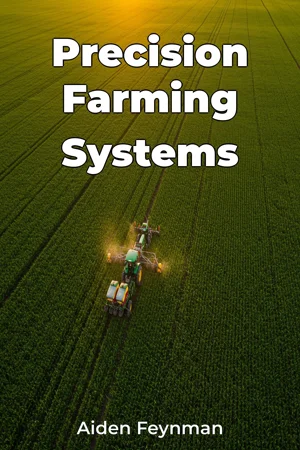
Can modern farming truly become a science of pinpoint accuracy, optimizing every seed and drop of water? "Precision Farming Systems" delves into the transformative world of digital agriculture, exploring techniques that are reshaping how we cultivate our land and secure our food supply. This book addresses the critical need for enhanced efficiency and sustainability in agriculture, examining how technological advancements are enabling farmers to make data-driven decisions that maximize yields while minimizing environmental impact. This book primarily focuses on three pivotal areas: the application of sensor technologies in monitoring crop health and soil conditions, the role of data analytics and machine learning in predicting optimal planting and harvesting times, and the integration of GPS-guided machinery for precise field operations. These topics are of paramount importance as the global population continues to grow, placing increasing demands on agricultural production while simultaneously requiring responsible stewardship of natural resources. The challenge lies in producing more food with fewer resources, and precision farming offers a pathway to achieving this balance. We begin by establishing a foundation in the history of agricultural technology, tracing the evolution from traditional farming methods to the modern era of digital agriculture. Readers will gain an understanding of basic agronomic principles, including soil science, plant physiology, and pest management, to provide context for the technological applications discussed throughout the book. The central argument of this book is that the successful implementation of precision farming hinges on the effective integration of technology, data analysis, and agronomic expertise. It’s not enough to simply deploy sensors and collect data; the real value lies in translating that data into actionable insights that inform decision-making at every stage of the farming process. The book is structured to provide a comprehensive overview of precision farming systems. First, we introduce the core concepts and technologies, including remote sensing, GPS, GIS, and variable rate application. Next, we delve into the practical applications of these technologies, with dedicated chapters on soil mapping and analysis, crop monitoring and yield prediction, and precise irrigation and fertilization. The culmination of the book explores the economic and environmental impacts of precision farming, examining the potential for increased profitability, reduced resource consumption, and improved sustainability. Throughout, real-world case studies will illustrate the successful implementation of precision farming techniques in diverse agricultural settings. The evidence presented in this book will draw from a wide range of sources, including peer-reviewed scientific literature, industry reports, and case studies of successful precision farming implementations. We analyze data collected from field trials and commercial farms, using statistical methods to evaluate the effectiveness of different precision farming techniques. This book also connects to other fields, such as environmental science (assessing the impact of farming practices on water quality and greenhouse gas emissions), computer science (exploring the development of algorithms for data analysis and machine learning), and economics (evaluating the cost-effectiveness of precision farming technologies). These interdisciplinary connections deepen the reader’s understanding of the multifaceted nature of precision farming. A unique aspect of this book is its holistic approach to precision farming, emphasizing the importance of integrating technology with traditional farming knowledge. We showcase viewpoints from farmers, researchers, and industry experts, providing a balanced perspective on the challenges and opportunities of precision farming. The tone of the book is academic yet accessible, presenting complex information in a clear and concise manner. The writing style is informative and engaging, using real-world examples and case studies to illustrate key concepts. The book is targeted towards students, researchers, agricultural professionals, and anyone interested in learning more about the future of farming. It will be valuable to those seeking a comprehensive overview of precision farming systems. As a non-fiction work in the science and technology genres, this book adheres to the conventions of presenting accurate, evidence-based information in a clear and logical manner. The scope of this book is limited to current and near-future precision farming techniques. While we acknowledge the potential of future technologies such as robotics and artificial intelligence, our focus remains on those technologies that are currently available and widely adopted. Readers will gain practical knowledge that can be applied to improve their own farming operations or to develop new precision farming technologies. The book provides guidance on selecting appropriate technologies, analyzing data, and implementing precision farming strategies. Finally, we address some of the ongoing debates in the field, such as the cost-effectiveness of precision farming for small-scale farmers and the potential for data privacy and security concerns. "Precision Farming Systems" provides a comprehensive and insightful look at this rapidly evolving field.
Can modern farming truly become a science of pinpoint accuracy, optimizing every seed and drop of water? "Precision Farming Systems" delves into the transformative world of digital agriculture, exploring techniques that are reshaping how we cultivate our land and secure our food supply. This book addresses the critical need for enhanced efficiency and sustainability in agriculture, examining how technological advancements are enabling farmers to make data-driven decisions that maximize yields while minimizing environmental impact. This book primarily focuses on three pivotal areas: the application of sensor technologies in monitoring crop health and soil conditions, the role of data analytics and machine learning in predicting optimal planting and harvesting times, and the integration of GPS-guided machinery for precise field operations. These topics are of paramount importance as the global population continues to grow, placing increasing demands on agricultural production while simultaneously requiring responsible stewardship of natural resources. The challenge lies in producing more food with fewer resources, and precision farming offers a pathway to achieving this balance. We begin by establishing a foundation in the history of agricultural technology, tracing the evolution from traditional farming methods to the modern era of digital agriculture. Readers will gain an understanding of basic agronomic principles, including soil science, plant physiology, and pest management, to provide context for the technological applications discussed throughout the book. The central argument of this book is that the successful implementation of precision farming hinges on the effective integration of technology, data analysis, and agronomic expertise. It’s not enough to simply deploy sensors and collect data; the real value lies in translating that data into actionable insights that inform decision-making at every stage of the farming process. The book is structured to provide a comprehensive overview of precision farming systems. First, we introduce the core concepts and technologies, including remote sensing, GPS, GIS, and variable rate application. Next, we delve into the practical applications of these technologies, with dedicated chapters on soil mapping and analysis, crop monitoring and yield prediction, and precise irrigation and fertilization. The culmination of the book explores the economic and environmental impacts of precision farming, examining the potential for increased profitability, reduced resource consumption, and improved sustainability. Throughout, real-world case studies will illustrate the successful implementation of precision farming techniques in diverse agricultural settings. The evidence presented in this book will draw from a wide range of sources, including peer-reviewed scientific literature, industry reports, and case studies of successful precision farming implementations. We analyze data collected from field trials and commercial farms, using statistical methods to evaluate the effectiveness of different precision farming techniques. This book also connects to other fields, such as environmental science (assessing the impact of farming practices on water quality and greenhouse gas emissions), computer science (exploring the development of algorithms for data analysis and machine learning), and economics (evaluating the cost-effectiveness of precision farming technologies). These interdisciplinary connections deepen the reader’s understanding of the multifaceted nature of precision farming. A unique aspect of this book is its holistic approach to precision farming, emphasizing the importance of integrating technology with traditional farming knowledge. We showcase viewpoints from farmers, researchers, and industry experts, providing a balanced perspective on the challenges and opportunities of precision farming. The tone of the book is academic yet accessible, presenting complex information in a clear and concise manner. The writing style is informative and engaging, using real-world examples and case studies to illustrate key concepts. The book is targeted towards students, researchers, agricultural professionals, and anyone interested in learning more about the future of farming. It will be valuable to those seeking a comprehensive overview of precision farming systems. As a non-fiction work in the science and technology genres, this book adheres to the conventions of presenting accurate, evidence-based information in a clear and logical manner. The scope of this book is limited to current and near-future precision farming techniques. While we acknowledge the potential of future technologies such as robotics and artificial intelligence, our focus remains on those technologies that are currently available and widely adopted. Readers will gain practical knowledge that can be applied to improve their own farming operations or to develop new precision farming technologies. The book provides guidance on selecting appropriate technologies, analyzing data, and implementing precision farming strategies. Finally, we address some of the ongoing debates in the field, such as the cost-effectiveness of precision farming for small-scale farmers and the potential for data privacy and security concerns. "Precision Farming Systems" provides a comprehensive and insightful look at this rapidly evolving field.
"Precision Farming Systems" explores the revolutionary impact of digital agriculture on modern farming. It highlights how sensor technologies, data analytics, and GPS-guided machinery are converging to optimize crop yields while minimizing environmental impact, addressing the crucial need for sustainable and efficient food production. For instance, the book examines how machine learning algorithms can predict optimal planting times, and how sensors monitor soil conditions leading to data-driven decisions. The book showcases how precision farming integrates technology with traditional farming knowledge. Beginning with the evolution of agricultural technology and basic agronomic principles, it progresses through the applications of remote sensing, GPS, GIS, and variable rate application. Case studies illustrate successful implementations, analyzing data from field trials to evaluate the effectiveness of different techniques. This work uniquely emphasizes the holistic nature of precision farming, presenting diverse perspectives from farmers, researchers, and industry experts. It explores the economic and environmental impacts, offering practical knowledge for improving farming operations and developing new technologies. It also discusses the cost-effectiveness for small-scale farmers and data privacy concerns.
Book Details
ISBN
9788233995867
Publisher
Publifye AS
Your Licenses
You don't own any licenses for this book
Purchase a license below to unlock this book and download the EPUB.
Purchase License
Select a tier to unlock this book
Need bulk licensing?
Contact us for enterprise agreements.