
About This Book
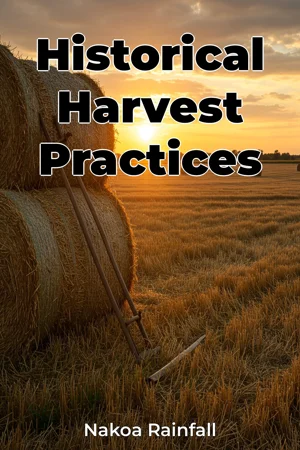
How have diverse societies throughout history sustained themselves through the vital act of harvesting, and what can we learn from their time-tested methods? "Historical Harvest Practices" delves into the intricate world of food procurement across cultures and eras, analyzing not just the techniques involved, but also the social, economic, and environmental contexts that shaped them. This book is important because understanding past harvesting strategies provides critical insights into food security, agricultural innovation, and human adaptation to environmental change. We focus on two central themes: the evolution of harvesting technologies and the role of social structures in organizing harvesting labor. The technologies range from simple hand tools to complex machinery, revealing a continuous quest for efficiency. Social structures, encompassing everything from communal labor to specialized guilds, illustrate how societies allocated resources and managed the distribution of harvested goods. Examining these topics requires understanding the interplay between environmental conditions, technological advancements, and social organizations. The book assumes a basic knowledge of world history and anthropological concepts, such as cultural adaptation and economic systems. Our central argument is that harvesting practices are not simply technical activities; they are deeply embedded in the cultural and economic fabric of a society, reflecting its values, beliefs, and power dynamics. Understanding these connections is crucial for addressing contemporary challenges related to food production and sustainability. The book is structured as follows. First, we introduce key concepts and methodologies for studying historical harvesting practices. Next, chapters explore specific case studies from different regions and time periods, analyzing the tools, techniques, and social organizations employed. These cases will illustrate the range of approaches to harvesting that humans have developed. Finally, we synthesize these findings to draw broader conclusions about the evolution of harvesting and its implications for the present. The analysis relies on a wide range of evidence, including archaeological data, historical texts, ethnographic studies, and agricultural records. We draw heavily on anthropological studies that provide rich descriptions of harvesting rituals, labor practices, and knowledge systems. "Historical Harvest Practices" connects to several other fields, including environmental history, agricultural economics, and development studies. By considering the environmental consequences of different harvesting techniques, the book contributes to debates about sustainable agriculture. By examining the economic factors that influence harvesting decisions, the book informs discussions about food markets and global trade. A unique aspect of this book is its interdisciplinary approach, integrating insights from archaeology, history, and anthropology to provide a holistic understanding of harvesting practices. The book adopts an academic, yet accessible tone, aiming to present complex information in a clear and engaging manner. It is targeted toward students and researchers in history, anthropology, agricultural studies, and environmental science, as well as anyone interested in the history of food production. The scope of the book is global, covering a wide range of cultures and time periods. However, it is limited to documented harvesting practices, focusing on the collection of crops and excluding hunting and gathering in their entirety. The lessons learned from past harvesting practices can be applied to contemporary challenges, such as improving food security in developing countries and promoting sustainable agriculture practices. Understanding how different societies have managed their resources in the past can inform present-day efforts to create more resilient and equitable food systems. The book also addresses ongoing debates about the impact of industrial agriculture on traditional harvesting practices, examining the trade-offs between efficiency and sustainability. By analyzing the historical roots of these debates, the book provides a nuanced perspective on the future of food production.
How have diverse societies throughout history sustained themselves through the vital act of harvesting, and what can we learn from their time-tested methods? "Historical Harvest Practices" delves into the intricate world of food procurement across cultures and eras, analyzing not just the techniques involved, but also the social, economic, and environmental contexts that shaped them. This book is important because understanding past harvesting strategies provides critical insights into food security, agricultural innovation, and human adaptation to environmental change. We focus on two central themes: the evolution of harvesting technologies and the role of social structures in organizing harvesting labor. The technologies range from simple hand tools to complex machinery, revealing a continuous quest for efficiency. Social structures, encompassing everything from communal labor to specialized guilds, illustrate how societies allocated resources and managed the distribution of harvested goods. Examining these topics requires understanding the interplay between environmental conditions, technological advancements, and social organizations. The book assumes a basic knowledge of world history and anthropological concepts, such as cultural adaptation and economic systems. Our central argument is that harvesting practices are not simply technical activities; they are deeply embedded in the cultural and economic fabric of a society, reflecting its values, beliefs, and power dynamics. Understanding these connections is crucial for addressing contemporary challenges related to food production and sustainability. The book is structured as follows. First, we introduce key concepts and methodologies for studying historical harvesting practices. Next, chapters explore specific case studies from different regions and time periods, analyzing the tools, techniques, and social organizations employed. These cases will illustrate the range of approaches to harvesting that humans have developed. Finally, we synthesize these findings to draw broader conclusions about the evolution of harvesting and its implications for the present. The analysis relies on a wide range of evidence, including archaeological data, historical texts, ethnographic studies, and agricultural records. We draw heavily on anthropological studies that provide rich descriptions of harvesting rituals, labor practices, and knowledge systems. "Historical Harvest Practices" connects to several other fields, including environmental history, agricultural economics, and development studies. By considering the environmental consequences of different harvesting techniques, the book contributes to debates about sustainable agriculture. By examining the economic factors that influence harvesting decisions, the book informs discussions about food markets and global trade. A unique aspect of this book is its interdisciplinary approach, integrating insights from archaeology, history, and anthropology to provide a holistic understanding of harvesting practices. The book adopts an academic, yet accessible tone, aiming to present complex information in a clear and engaging manner. It is targeted toward students and researchers in history, anthropology, agricultural studies, and environmental science, as well as anyone interested in the history of food production. The scope of the book is global, covering a wide range of cultures and time periods. However, it is limited to documented harvesting practices, focusing on the collection of crops and excluding hunting and gathering in their entirety. The lessons learned from past harvesting practices can be applied to contemporary challenges, such as improving food security in developing countries and promoting sustainable agriculture practices. Understanding how different societies have managed their resources in the past can inform present-day efforts to create more resilient and equitable food systems. The book also addresses ongoing debates about the impact of industrial agriculture on traditional harvesting practices, examining the trade-offs between efficiency and sustainability. By analyzing the historical roots of these debates, the book provides a nuanced perspective on the future of food production.
"Historical Harvest Practices" explores the diverse methods societies have used throughout history to gather food, highlighting the intricate connections between harvesting techniques, social structures, and environmental factors. It examines how communities, from ancient civilizations to more recent societies, have adapted their agricultural practices to ensure food security, revealing that harvesting is not merely a technical activity but is deeply embedded within a society's cultural and economic fabric. Readers will discover how some early societies developed sophisticated irrigation systems to maximize crop yields, while others relied on communal labor practices to manage the harvest, illustrating the diverse ways cultures have approached food production. The book progresses from introducing key concepts and methodologies to exploring specific case studies across different regions and eras, analyzing the tools, techniques, and social organizations employed in harvesting. By integrating insights from archaeology, history, and anthropology, "Historical Harvest Practices" offers a comprehensive understanding of how past approaches to harvesting can inform contemporary debates about sustainable agriculture, food security, and the future of food production. Understanding the evolution of these practices provides critical insights into agricultural innovation and human adaptation to environmental changes.
Book Details
ISBN
9788233995850
Publisher
Publifye AS
Your Licenses
You don't own any licenses for this book
Purchase a license below to unlock this book and download the EPUB.
Purchase License
Select a tier to unlock this book
Need bulk licensing?
Contact us for enterprise agreements.